
What Is SaRA
SaRA is a novel fine-tuning method for pretrained diffusion models, jointly launched by Shanghai Jiao Tong University and Tencent YouTu Lab. It reactivates parameters that appear ineffective during pretraining, enabling the model to adapt to new tasks. SaRA is based on a nuclear norm low-rank sparse training scheme to avoid overfitting, introduces a progressive parameter adjustment strategy, and optimizes model performance. SaRA can improve the model's adaptability and generalization ability and significantly reduce computational cost. It can be implemented by modifying just one line of code and has high practical value.
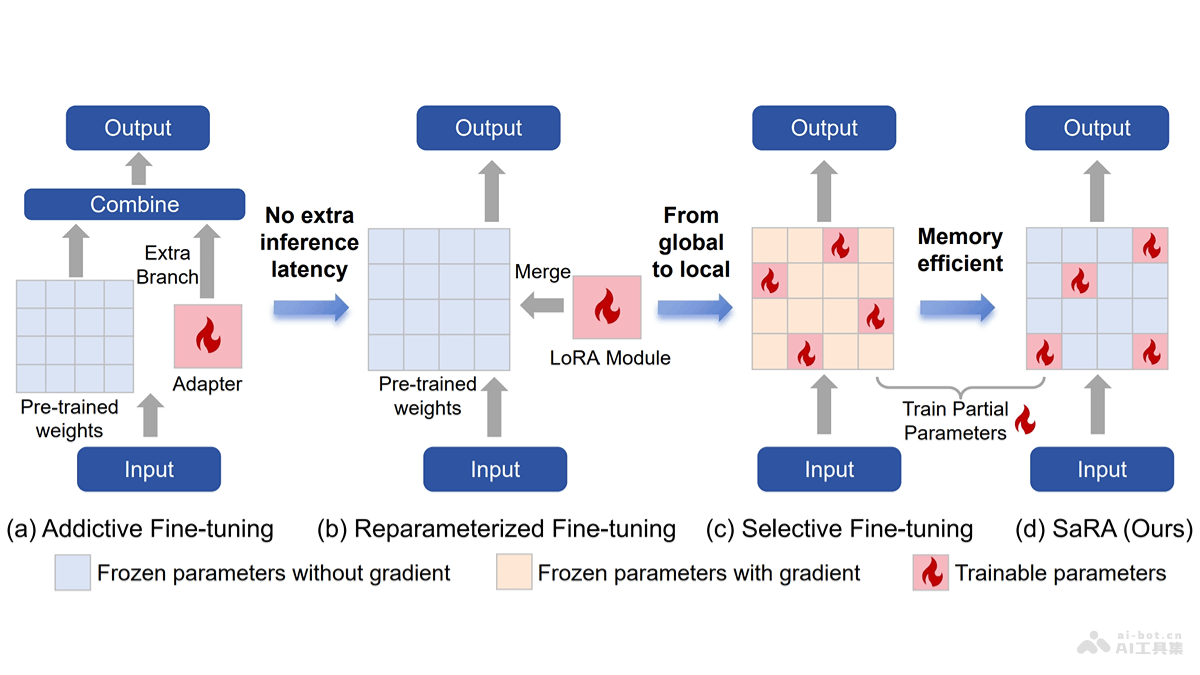
Main Features of SaRA
- Parameter Reuse: Activates parameters that were not fully utilized during pretraining, giving the model new capabilities.
- Prevent Overfitting: Based on a nuclear norm low-rank sparse training scheme, it reduces overfitting during the model fine-tuning process.
- Progressive Parameter Adjustment: Continuously evaluates and selects parameters throughout the fine-tuning process to ensure that all potentially effective parameters are fully utilized.
- Unstructured Backpropagation: Reduces memory cost during fine-tuning and improves the selectivity of the parameter field.
- Improve Model Performance: While preserving the original knowledge of the pretrained model, it optimizes the model's performance on the main task.
Technical Principles of SaRA
- Parameter Importance Analysis: Analyzes the parameters in the pretrained model and identifies parameters with little impact on the generation process.
- Low-Rank Sparse Training: Applies low-rank constraints to parameters and learns task-specific knowledge by optimizing a sparse weight matrix, improving fine-tuning efficiency and reducing overfitting.
- Progressive Parameter Adjustment Strategy: Designs a strategy to dynamically adjust parameters throughout the fine-tuning process, ensuring that all potentially effective parameters are fully utilized.
- Unstructured Backpropagation: Based on a special backpropagation strategy, it reduces memory consumption during fine-tuning and enhances the model's adaptability to specific tasks.
- Model Compatibility: The SaRA method is compatible with existing pretrained models. Fine-tuning can be achieved with only a small amount of code modification, making it easy to integrate into existing systems.
Project Addresses of SaRA
- Project Official Website:sjtuplayer.github.io/projects/SaRA
- GitHub Repository:https://github.com/sjtuplayer/SaRA
- arXiv Technical Paper:https://export.arxiv.org/pdf/2409.06633
Application Scenarios of SaRA
- Image Style Transfer: Use SaRA to adjust model parameters and convert ordinary images into images with a specific artistic style, such as oil painting or sketch style, while keeping the content and structure unchanged.
- Image Customization: In applications such as Dreambooth, SaRA is used to fine-tune the UNet network to achieve image customization for specific objects or styles, such as generating images with specific features.
- Video Generation: SaRA is used to fine-tune video generation models (such as AnimateDiff) on datasets with different camera movements (such as zooming and panning) to generate videos with specific dynamic effects.
- Downstream Dataset Fine-Tuning: SaRA is used for fine-tuning on various downstream datasets to adapt to different domain-specific tasks, such as fine-tuning on datasets of different styles to generate images consistent with text prompts.
- Image Generation Tasks:SaRA is used to improve the performance of pretrained models in image generation tasks, enhancing the model's performance on the main task by optimizing initially ineffective parameters.