
What is Sapiens
Sapiens is an AI vision model launched by Meta's lab, designed specifically to understand human actions in images and videos. It supports tasks such as 2D pose estimation, body part segmentation, depth estimation, and surface normal prediction, and adopts a Vision Transformer architecture. The model parameters range from 300 million to 2 billion, natively support 1K high-resolution inference, and are easy to adapt to different tasks. Even when annotated data is scarce, Sapiens can demonstrate excellent generalization capabilities, providing strong support for applications such as virtual reality and augmented reality.
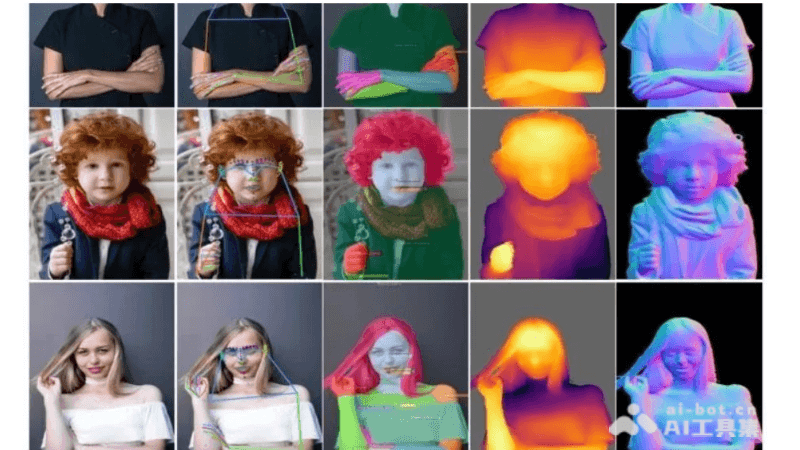
Sapiens' main features
- 2D pose estimation: Sapiens can identify various key points of the human body in an image, such as joints and other parts, helping analyze human posture and actions.
- Body part segmentation: It can identify and segment different human body parts in an image, such as the head, torso, arms, and legs, and is very useful in fields such as virtual try-on and medical imaging.
- Depth estimation: Sapiens can predict the depth information of each pixel in an image, generating 3D effects from 2D images, and is crucial for applications such as augmented reality and autonomous driving.
- Surface normal prediction: The model can predict the direction of the surface normal at each pixel in an image, providing important information for 3D reconstruction and understanding the geometric shape of objects.
Sapiens' technical principles
- Vision Transformer architecture: The Sapiens model adopts a Vision Transformers (ViT) architecture. By dividing images into fixed-size small patches, the architecture can effectively process high-resolution input images and perform fine-grained feature extraction.
- Encoder-decoder structure: The model uses an encoder-decoder architecture, in which the encoder is responsible for extracting image features, and the decoder performs inference for specific tasks based on these features. The encoder is initialized with pretrained weights, while the decoder is a lightweight and task-specific module.
- Self-supervised pretraining: The Sapiens model performs self-supervised pretraining through the Masked Autoencoder (MAE) method, observing partially masked images and attempting to reconstruct the original image, thereby learning robust feature representations.
- Large-scale dataset training: The model is pretrained on more than 300 million in-the-wild human images, using rich data to improve the model's generalization ability.
Sapiens' project address
- GitHub repository:https://github.com/facebookresearch/sapiens
How to use Sapiens
- Environment preparation:Ensure that the necessary software and libraries, such as Python, PyTorch, etc., are installed in the computing environment.
- Obtain the model:Visit Sapiens' official project page or GitHub repository, and download the pretrained model or source code.
- Data preparation:Prepare image or video data. Depending on the application scenario, the data may need to be preprocessed, such as adjusting resolution, format conversion, etc.
- Model loading:Load the pretrained Sapiens model into the computing environment. If fine-tuning is needed for a specific task, a custom dataset can also be loaded.
- Task selection:Select one or more visual tasks supported by Sapiens according to your needs, such as 2D pose estimation, body part segmentation, etc.
- Model fine-tuning(if needed):Fine-tune the model using a dataset to adapt it to a specific application scenario. This involves adjusting model parameters, loss functions, etc.
- Model inference:Use the loaded and fine-tuned model to perform inference on input data and execute the selected vision task.
Application scenarios of Sapiens
- Augmented reality (AR):In AR applications, Sapiens can provide precise human pose and body part information, enabling natural interaction between virtual objects and the real world.
- Virtual reality (VR):In VR environments, Sapiens is used for real-time tracking and rendering of users' body movements, enhancing the immersive experience.
- 3D human digitization:In 3D modeling and animation production, Sapiens can accurately capture human pose and shape, accelerating the creation process of 3D content.
- Human-computer interaction (HCI):In HCI systems, Sapiens is used to understand users' body language and gestures, improving the interaction experience.
- Video surveillance analysis:In the field of security surveillance, Sapiens can analyze human actions for abnormal behavior detection or crowd counting.
- Motion capture:In sports training or game development, Sapiens can be used to capture the movements of athletes or characters for motion analysis.
- Medical imaging and rehabilitation:In the medical field, Sapiens can help analyze patients' posture and movement, assisting diagnosis and rehabilitation training.