
What is Sana
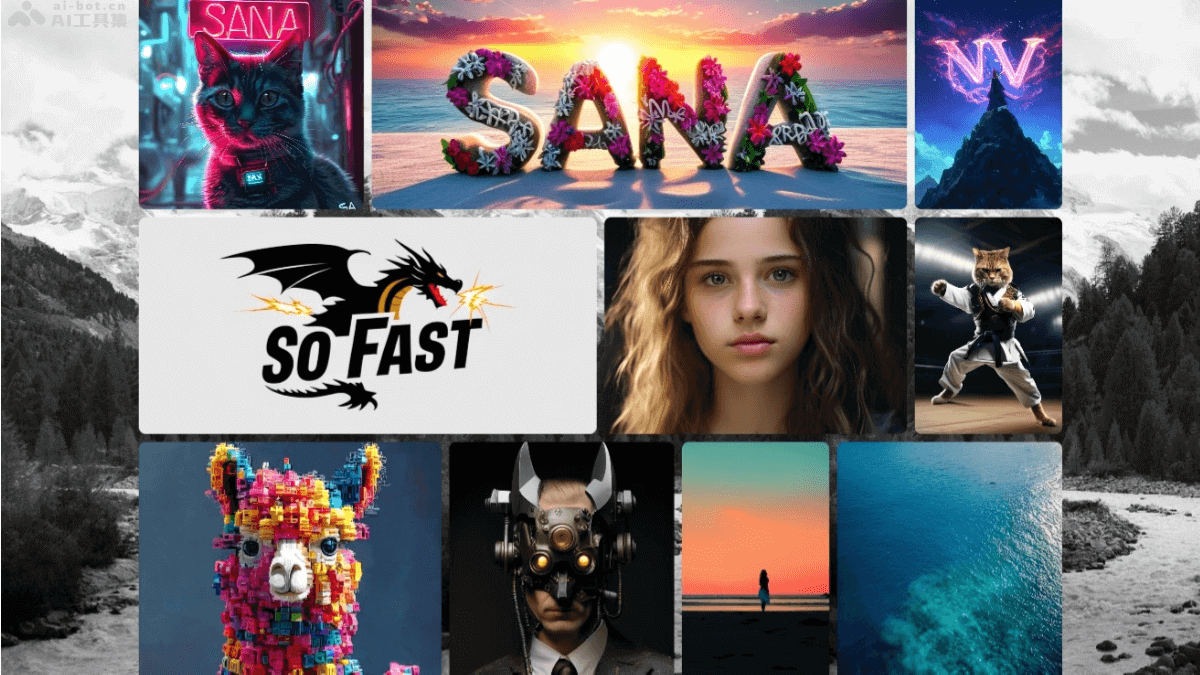
SANA is a text-to-image generation framework jointly launched by NVIDIA, the Massachusetts Institute of Technology, and Tsinghua University. It can efficiently generate high-definition images up to 4096×4096 resolution. SANA is based on a deep compression autoencoder, a Linear Diffusion Transformer (Linear DiT), a small decoder-only language model as the text encoder, and efficient training and sampling strategies, enabling fast generation of high-resolution images with strong text-image alignment. SANA has significant advantages in model size and throughput, and can be quickly deployed on laptop GPUs, generating 1024×1024 resolution images in less than 1 second, greatly reducing the cost of content creation and making efficient AI image generation technology more accessible and usable.
Main features of Sana
- Efficient image generation: Quickly generate high-resolution images, with resolution reaching 4096×4096 pixels.
- Text-to-image conversion: Convert text descriptions into visually matching images.
- Deep compression technology: Based on a deep compression autoencoder to reduce data volume and improve processing efficiency.
- Advanced attention mechanism: Based on the Linear Diffusion Transformer (Linear DiT) to reduce computational complexity and improve the efficiency of high-resolution image processing.
- Powerful text understanding: Based on a small decoder language model as the text encoder, enhancing the understanding and processing ability of text prompts.
- Optimized training strategy: Uses Flow-DPM-Solver and automated label generation to reduce sampling steps and accelerate model training and convergence.
Technical principles of Sana
- Deep compression autoencoder: Sana uses a special autoencoder to compress image data. Compared with traditional autoencoders, it has a higher compression ratio, can compress images by 32 times, and reduces the amount of data that needs to be processed during generation.
- Linear Diffusion Transformer (Linear DiT): Sana is based on a linear attention mechanism, replacing the traditional quadratic attention mechanism. When processing high-resolution images, it can reduce computational complexity from O(N^2) to O(N), improving the efficiency of image generation.
- Small decoder-only language model (LLM) as text encoder: Sana is based on a small LLM called Gemma as the text encoder. The model performs excellently in understanding text and following instructions, helping to improve the alignment between generated images and text descriptions.
- Efficient training and sampling strategy: Sana proposes Flow-DPM-Solver, a new sampling method that can reduce the number of sampling steps required to generate images. Sana is based on automated label generation and training strategies, such as strategies based on CLIP scores, to select high-quality text labels, accelerate model convergence, and improve the consistency between images and text.
Sana project address
- Project official website:nvlabs.github.io/Sana
- GitHub repository:https://github.com/NVlabs/Sana
- HuggingFace model library:https://huggingface.co/collections/Efficient-Large-Model/sana
- arXiv technical paper:https://arxiv.org/pdf/2410.10629
Application scenarios of Sana
- Content creation: Artists and designers use Sana to generate high-resolution artworks or design prototypes, accelerating the creative process.
- Game development: Game developers use Sana to quickly generate in-game scenes and character concept art, improving early-stage design efficiency.
- Advertising and marketing: Marketing teams use Sana to design advertising images and marketing materials, quickly responding to market changes and promotional activities.
- Education and Research: Educators and researchers use Sana to create teaching materials or scientific illustrations, making complex concepts more intuitive and easy to understand.
- Media and Entertainment: Media companies use Sana to enhance reporting, supplementing news stories with generated images or enhancing the audience's viewing experience.