
What Is SAM 2.1
SAM 2.1 (full name: Segment Anything Model 2.1) is an advanced visual segmentation model for images and videos released by Meta (the parent company of Facebook). Based on a simple Transformer architecture and streaming memory design, it enables real-time video processing. SAM 2.1 builds on its predecessor by introducing data augmentation techniques, improving recognition of visually similar objects and small objects, and enhancing occlusion handling. In addition, Meta has open-sourced the SAM 2 developer kit, including training code and the frontend and backend code for the web demo, making it convenient for users to use and fine-tune the model.
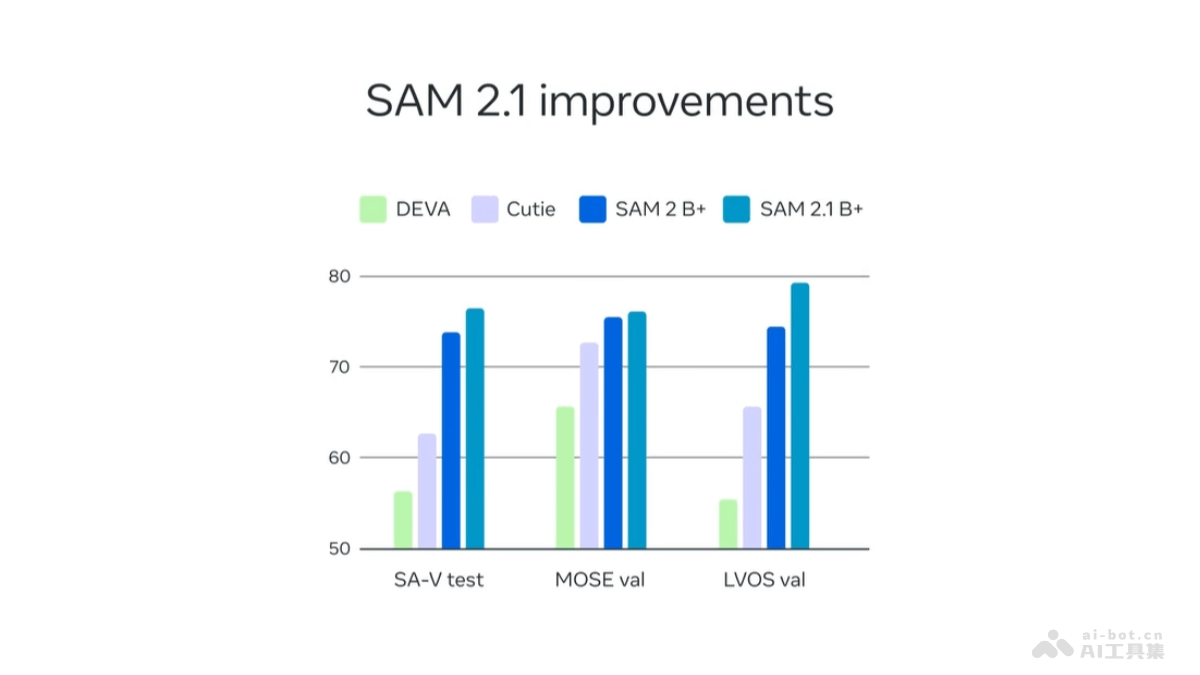
Main Features of SAM 2.1
- Image and Video Segmentation: Perform visual segmentation on images and videos to identify and separate different objects and elements.
- Real-Time Video Processing: Process video streams in real time based on streaming memory and the Transformer architecture.
- User-Interactive Segmentation: Interactively segment objects in images and videos based on user clicks or box selections.
- Multi-Object Tracking: Support tracking multiple objects in video sequences and generate segmentation masks for each object.
- Data Augmentation: Introduce data augmentation techniques to improve the model's ability to recognize visually similar objects and small objects.
- Occlusion Handling: Improve the model's positional encoding and training strategy to enhance its ability to handle occlusion.
Technical Principles of SAM 2.1
- Transformer Architecture: SAM 2.1 is based on the Transformer architecture, an efficient attention mechanism model that can process sequence data such as images and video frames.
- Streaming Memory: To process video data, a streaming memory mechanism is introduced, enabling the model to retain memory of previous frames while processing video frames and better understand dynamic changes in the scene.
- Data Augmentation Techniques: Data augmentation based on simulating visually similar objects and small objects improves the ability to recognize difficult-to-identify objects.
- Positional Encoding: Improve the positional encoding of spatial and object-pointing memory, helping the model better understand the spatial positions of objects and their interactions.
Project Links for SAM 2.1
- Project Website:https://ai.meta.com/blog/fair-news-segment-anything-2-1-meta-spirit-lm-layer-skip-salsa-sona/
- GitHub Repository:https://github.com/facebookresearch/sam2
Application Scenarios of SAM 2.1
- Content Creation and Editing: Dynamic background replacement in video editing makes video production more flexible and efficient.
- Augmented Reality (AR) and Virtual Reality (VR): In AR applications, achieve precise object recognition and interaction to enhance the user experience.
- Medical Imaging Analysis: Assist diagnosis by automatically identifying lesion areas in medical images to improve diagnostic accuracy.
- Autonomous Driving and Robotics: Improve the environmental perception capability of autonomous driving systems to ensure driving safety.
- Security Monitoring: Conduct crowd counting and abnormal behavior detection in public places to improve public safety.