
What Is Sakana Fugu
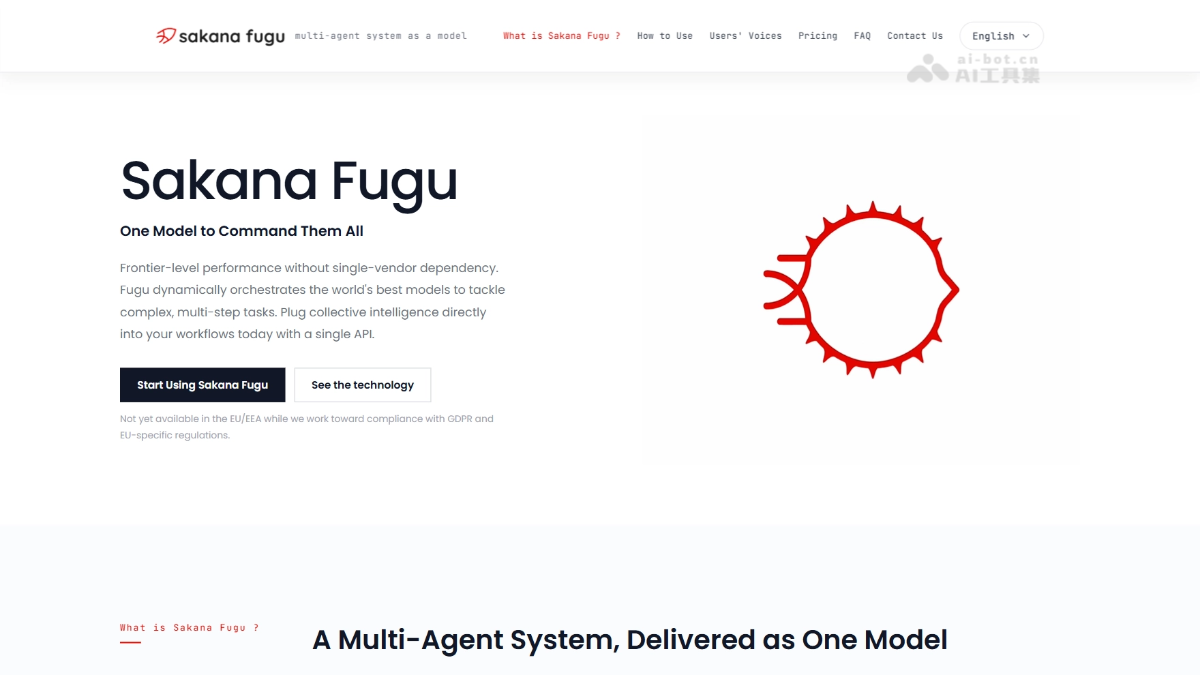
Sakana Fugu is a multi-agent orchestration system launched by Sakana AI that dynamically dispatches top-tier models through a single API. The system assigns Thinker, Worker, and Verifier roles, automatically handling selection, delegation, and synthesis without preset workflows. Sakana Fugu supports recursive invocation and model pool governance, and offers a Standard edition and an Ultra edition, achieving frontier-level performance on demanding benchmarks, rivalingFable 5andMythos Preview, with no single-vendor dependency or export control risk.
Sakana Fugu's Main Features
-
Unified dispatch via a single API: Users call through an OpenAI-compatible endpoint, and Fugu internally completes model selection, task delegation, verification, and answer synthesis, with no proprietary SDK required.
-
Dynamic role assignment: The system autonomously learns to assign Thinker, Worker, and Verifier roles to different models, without manually preset workflows.
-
Recursive self-invocation: Supports invoking its own instances as coordinators to handle complex tasks requiring multiple rounds of deep collaboration.
-
Flexible model pool governance: Users can independently choose to include or exclude specific vendors' models to meet data privacy and compliance requirements.
-
Two editions covering scenarios: Fugu Standard balances performance and latency, while Fugu Ultra coordinates a deeper expert pool to maximize answer quality on high-difficulty tasks.
-
Resilient risk-resistant architecture: The underlying model pool is replaceable, and when a single model is unavailable, routing automatically bypasses it, avoiding service interruptions and export control risks.
Sakana Fugu's Technical Principles
- TRINITY evolutionary coordinator: Based on the ICLR 2026 paper "TRINITY", a lightweight evolutionary module governs multiple LLMs across multiple rounds, adaptively assigning Thinker, Worker, and Verifier roles according to task types such as coding, mathematics, and reasoning, and dynamically delegating work to avoid the efficiency bottlenecks of fixed pipelines.
- Conductor reinforcement learning orchestration: Based on the ICLR 2026 paper "Conductor", a coordinator is trained through reinforcement learning to autonomously discover collaboration strategies at the natural language level, designing inter-agent communication patterns and focused prompts, enabling diverse model clusters to surpass any single worker on difficult reasoning benchmarks.
- Model-as-orchestrator architecture: Fugu itself is a specially trained language model that understands when to delegate, how to communicate, and how to integrate; through a lightweight head, it predicts from hidden states which model and role should be invoked next, achieving efficient routing and the emergence of collective intelligence at extremely low additional computational cost.
How to Use Sakana Fugu
-
API access: Call through an OpenAI-compatible endpoint, and directly modify the endpoint to integrate into existing workflows, with no proprietary SDK required.
-
Edition selection: Choose Fugu Standard for everyday coding and low-latency scenarios, and Fugu Ultra for high-difficulty scientific research and complex reasoning.
-
Send requests: Send natural language requests just like calling an ordinary LLM, and Fugu automatically completes internal model selection, task delegation, verification, and answer synthesis.
-
Model pool configuration: In the console, independently choose to include or exclude specific vendors' models to meet data privacy and compliance requirements.
Sakana Fugu's Core Advantages
-
Single API, plug and play: Compatible with the OpenAI format; simply change the endpoint to integrate into existing workflows, with no proprietary SDK or complex configuration required.
-
Dynamic autonomous learning orchestration: The system autonomously learns to assign thinker, executor, and verifier roles to different models, with no need for manually predefined workflows.
-
Recursive self-invocation capability: Supports invoking its own instances as coordinators to handle complex tasks requiring multiple rounds of deep collaboration.
-
Flexible model pool control: Users can independently choose to include or exclude specific vendor models to meet data privacy and compliance requirements.
-
Resilient anti-risk architecture: The underlying model pool is replaceable; when a single model is unavailable, it automatically routes around it, avoiding service interruptions and export control risks.
-
Significant cost advantage: Fugu Ultra's input price is only one-third that of Opus 4.8, and its output price is less than half, achieving frontier performance at lower cost.
Sakana Fugu project address
- Project official website:https://sakana.ai/fugu/
Comparison of Sakana Fugu with similar competitors
| Dimension | Sakana Fugu | OpenRouter Fusion |
|---|---|---|
| Product form | Multi-agent orchestration as a single model API | Multi-model intelligence fusion API |
| Orchestration method | Autonomous learning dynamic role assignment and recursive invocation | Rule-based and intelligent routing to distribute requests |
| Vendor dependency | No single dependency; the model pool is replaceable | Aggregates APIs from multiple vendors, with no single dependency |
| Usage threshold | Single API, plug and play | Single API, plug and play |
| Core advantage | Emergent collective intelligence and task resilience | Multi-model selection and cost optimization |
Application scenarios of Sakana Fugu
-
Software engineering: Integrate tools such as Codex for real-time code generation, review, and debugging of complex algorithms.
-
Scientific research competitions: Used for Kaggle competitions, academic paper reproduction, and highly difficult mathematical and scientific reasoning.
-
Security analysis: Performs excellently on security benchmarks such as CTI-REALM, suitable for threat analysis and vulnerability research.
-
Knowledge work: Performs literature reviews, patent investigations, long-context reasoning, and multilingual in-depth document analysis.
-
Financial trading: Achieved an average return of +19.43% in a 50-week backtest, outperforming other frontier models.