
What is SAIL-VL2
SAIL-VL2 is an open-source vision-language foundation model jointly developed by the Douyin team and the National University of Singapore, focusing on multimodal understanding and reasoning. It consists of the vision encoder SAIL-ViT, a vision-language adapter, and a large language model, and adopts a progressive training framework, from visual pretraining to multimodal fusion, and finally improves performance through an SFT-RL hybrid paradigm. Architecturally, SAIL-VL2 introduces a Mixture of Experts (MoE) architecture, breaking through the limitations of traditional dense models and significantly improving efficiency and performance.
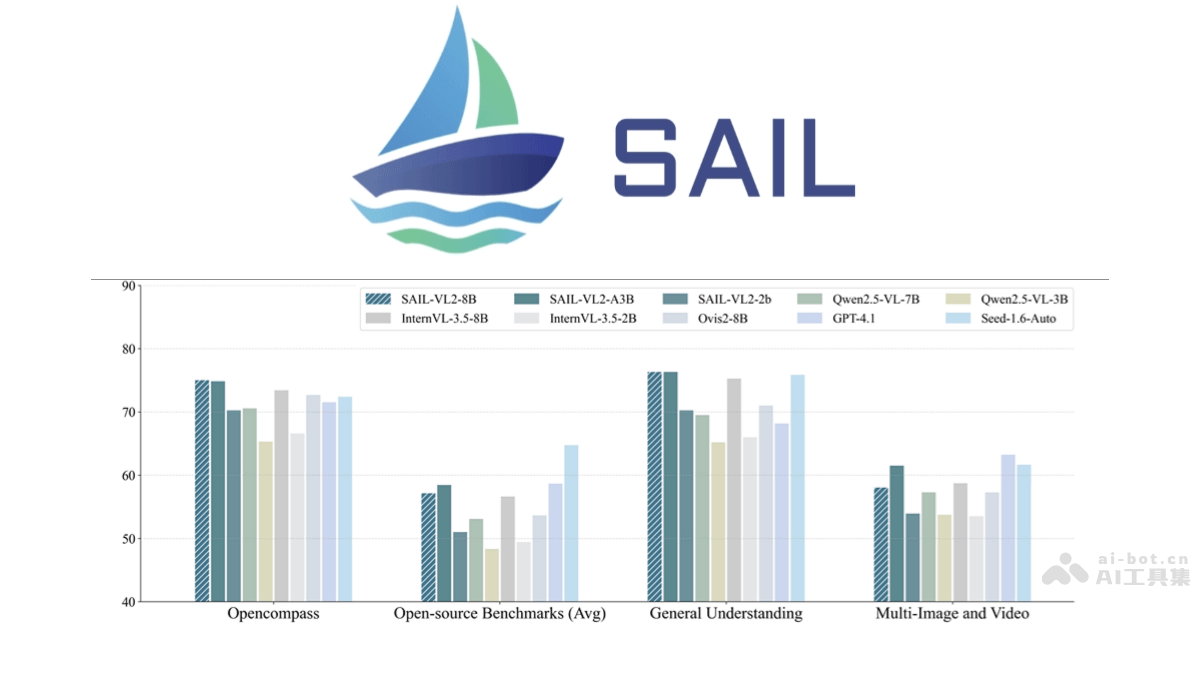
Main features of SAIL-VL2
-
Multimodal understanding: Capable of handling combined image and text tasks, such as image caption generation and visual question answering, accurately understanding visual content and generating corresponding language descriptions.
-
Visual reasoning: Possesses strong logical reasoning capabilities, able to analyze and reason about complex scenes in images, such as determining object relationships or event logic in an image.
-
Cross-modal generation: Supports generating images from text or generating text from images, enabling effective conversion between vision and language.
-
Large-scale data processing: Through an optimized data processing pipeline, it can efficiently process massive multimodal data, improving training efficiency and model performance.
-
Efficient training architecture: Adopts a progressive training framework and a Mixture of Experts (MoE) architecture, breaking through traditional model limitations and significantly improving training efficiency and the scalability of model scale.
-
Multi-task learning: Supports a variety of multimodal tasks, such as caption generation, OCR recognition, and video understanding, with broad applicability.
-
Open source and extensibility: As an open-source model, SAIL-VL2 provides researchers and developers with flexible extension and customization capabilities, promoting the development of multimodal technology.
Technical principles of SAIL-VL2
-
Vision encoder SAIL-ViT: Adopts the Vision Transformer architecture, capable of efficiently encoding images, extracting key features and semantic information from images, and providing a visual foundation for subsequent multimodal tasks.
-
Vision-language adapter: Through a lightweight two-layer neural network, it converts the image features extracted by the vision encoder into a form that the language model can understand, achieving effective connection between visual information and language information.
-
Large language model: Supports traditional dense models and the more advanced Mixture of Experts (MoE) architecture, capable of handling complex language generation and reasoning tasks, while improving computational efficiency and scalability through the MoE architecture.
-
Progressive training framework: Starting from the pretraining of the vision encoder, gradually transitioning to multimodal pretraining, and finally optimizing through a hybrid paradigm of supervised fine-tuning (SFT) and reinforcement learning (RL), systematically improving model performance.
-
Large-scale data processing pipeline: Optimizes data quality and distribution through scoring and filtering strategies, covering multiple multimodal data types, including caption generation, OCR, question answering, and video data, ensuring the model's performance across diverse tasks.
-
Mixture of Experts (MoE) architecture: Breaks through the limitations of traditional dense large language models, adopts an efficient MoE architecture, and achieves high performance while activating only part of the parameters, significantly improving computational efficiency and the scalability of model scale.
-
Multimodal Task Adaptation: By designing flexible adapters and training strategies, SAIL-VL2 can adapt to a variety of multimodal tasks, such as image captioning, visual question answering, video understanding, etc., demonstrating strong generality and adaptability.
SAIL-VL2 Project Address
- Github Repository:https://github.com/BytedanceDouyinContent/SAIL-VL2
- Hugging Face Model Library:https://huggingface.co/BytedanceDouyinContent
- arXiv Technical Paper:https://arxiv.org/pdf/2509.14033
SAIL-VL2 Application Scenarios
-
Image Captioning: Can automatically generate accurate and natural descriptive text based on input images, suitable for scenarios such as image annotation and content recommendation.
-
Visual Question Answering (VQA): Can understand image content and answer questions related to images, widely used in fields such as intelligent customer service and educational assistance.
-
Multimodal Content Creation: Supports generating images from text or generating text from images, helping creators quickly generate creative content, such as advertising design and story creation.
-
Video Understanding and Analysis: Can process video data, extract key frame information, and generate video summaries or descriptions, suitable for video recommendation, surveillance analysis, etc.
-
Intelligent Search: Combines image and text information to provide more accurate search results and improve user experience, suitable for e-commerce platforms, content retrieval, etc.
-
Assisted Education: Through the combination of images and text, helps students better understand complex concepts and scenarios, suitable for online education and multimedia teaching.