
What Is SAIL-Embedding
SAIL-Embedding is an omni-modal embedding foundation model jointly developed by the ByteDance Douyin SAIL team and the Chinese University of Hong Kong MMLab. It addresses practical application problems in multimodal information retrieval and recommendation systems. By supporting arbitrary modality inputs (including text, vision, and audio), it generates unified and information-rich representations, supporting multimodal retrieval and classification tasks. SAIL-Embedding enhances training robustness and scalability through training strategies such as dynamic hard negative mining and adaptive multi-source data balancing. It adopts a large language model (LLM) as the core reasoning and fusion backbone network, supporting flexible modality integration. In multiple benchmark tests, SAIL-Embedding significantly outperforms other methods, especially in search and collaboration-aware scenarios.
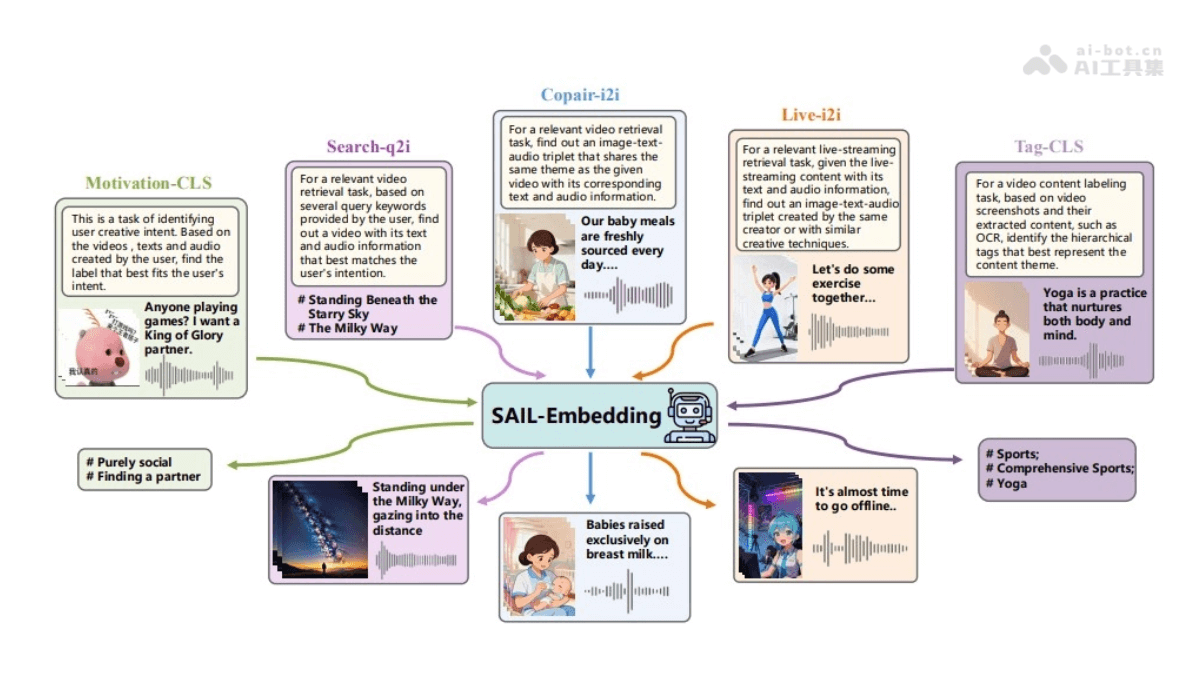
Main Features of SAIL-Embedding
-
Omni-Modal Support: It can process inputs from multiple modalities such as vision, text, and audio, generating unified multi-dimensional representation vectors to meet the needs of different business scenarios.
-
Dynamic Hard Negative Mining: By adaptively determining the optimal similarity threshold, it mines challenging negative samples, improving the model's ability to distinguish complex data and enhancing training robustness.
-
Adaptive Multi-Source Data Balancing: It dynamically adjusts the sampling weights of different datasets according to the data distribution, balancing data quality and distribution diversity, and reducing dependence on manual parameter tuning.
-
Content-Aware Progressive Training: It gradually enhances the ability of embedding vectors to distinguish diverse task requirements, improving the model's generalization ability to unseen scenarios and equipping the model with comprehensive domain knowledge.
-
Collaboration-Aware Recommendation Enhancement: Through multi-dimensional interest-driven sequence-to-item distillation, it integrates users' historical behavior patterns into multimodal representations, further aggregating user preference signals and improving recommendation accuracy.
-
Random Specialized Training: It randomly selects datasets for training, enhancing the model's adaptability to specific domains and improving training efficiency and model generalization ability.
-
Data-Driven Pattern Matching: It dynamically constructs query-target pairs based on data characteristics, flexibly handling contrastive learning tasks between different modalities and improving the model's optimization stability.
Technical Principles of SAIL-Embedding
-
Dynamic Hard Negative Mining: It helps the model focus on distinguishing challenging negative samples, consolidating understanding of domain-specific knowledge and reducing the risk of misclassification caused by ambiguous samples.
-
Adaptive Multi-Source Data Balancing: It dynamically learns weights from the data distribution, reducing dependence on manual parameter tuning and balancing data quality and distribution diversity.
-
Content-Aware Progressive Training: It gradually enhances the ability of embedding vectors to distinguish diverse task requirements and generalize to unseen scenarios, equipping the model with comprehensive domain knowledge.
-
Collaboration-Aware Recommendation Enhancement: Through multi-dimensional interest-driven sequence-to-item distillation, it integrates users' historical behavior patterns into multimodal representations, further aggregating user preference signals and improving the accuracy of item recommendations.
SAIL-Embedding Project Address
- HuggingFace Model Library:https://huggingface.co/collections/BytedanceDouyinContent/sail-embedding
- arXiv Technical Paper:https://arxiv.org/pdf/2510.12709
Application Scenarios of SAIL-Embedding
-
Multimodal Information Retrieval: Supports cross-modal retrieval tasks, such as image-text, video-text, audio-text retrieval, etc., and can find related image, video, or audio content based on a text query, improving retrieval accuracy and efficiency.
-
Recommendation systems: Applied to scenarios such as video recommendation and live-streaming recommendation, by understanding users' historical behavior and preferences, it provides users with personalized content recommendations, improving recommendation relevance and user experience.
-
Content classification and tag generation: Automatically classifies and generates tags for multimedia content, helping with content management and organization, for example generating topic tags for videos and classifying images, improving the efficiency and accuracy of content management.
-
Cold-start recommendation: In recommendation systems, for the cold-start problem of new users or new content, SAIL-Embedding can quickly establish feature representations of users or content through multimodal embeddings, providing effective recommendations.
-
Video content understanding: Performs in-depth understanding of video content, including video topic recognition, sentiment analysis, etc., providing support for video editing, content moderation, and more.
-
Cross-modal generation: Supports cross-modal generation tasks, such as generating images or videos based on text descriptions, or generating related text descriptions based on images, expanding the boundaries of multimodal applications.