
What is SadTalker
SadTalker is an open-source AI digital human project jointly launched by Xi'an Jiaotong University, Tencent AI Lab, and Ant Group. SadTalker focuses on generating realistic talking face animations from a single face image and speech audio using 3D motion coefficients. By accurately learning facial expressions through ExpNet and synthesizing head motions in different styles with PoseVAE, SadTalker can create high-quality, stylized video animations. SadTalker also includes extensive video demonstrations and ablation studies, demonstrating its application effects across multiple languages and datasets.
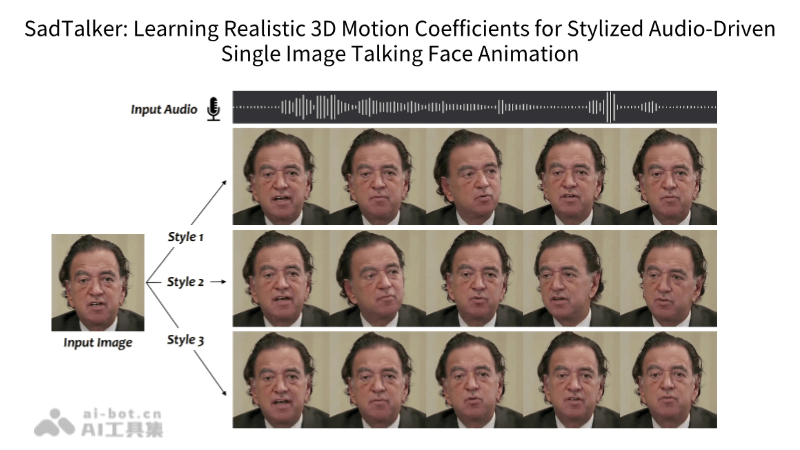
Main features of SadTalker
- 3D motion coefficient generation: Extracts 3D motion coefficients of head pose and expression from audio.
- ExpNet: A specially designed network for learning accurate facial expressions from audio.
- PoseVAE: A conditional variational autoencoder for head motion synthesis in different styles.
- 3D face rendering: Maps 3D motion coefficients to the 3D keypoint space for rendering stylized facial animations.
- Multilingual support: Can process audio input in different languages and generate talking animations in the corresponding language.
Technical principles of SadTalker
- 3D motion coefficient learning: SadTalker learns 3D motion coefficients by analyzing audio signals, including head pose and facial expressions. These are key parameters of the 3D Morphable Model (3DMM).
- ExpNet (Expression Network): Used to extract facial expression information from audio. By learning the mapping relationship between audio and facial expressions, ExpNet can generate accurate facial expression animations.
- PoseVAE (Head Pose Variational Autoencoder): PoseVAE is a Conditional Variational Autoencoder (CVAE) used to generate head motions in different styles. It can synthesize natural and stylized head poses based on audio signals.
- 3D face rendering: SadTalker uses a novel 3D face rendering technique to map the learned 3D motion coefficients to the 3D keypoint space. This process involves facial geometry and texture information to generate realistic facial animations.
- Multimodal learning: SadTalker considers both audio and visual information during training, improving the naturalness and accuracy of the animation through multimodal learning.
- Stylized processing: SadTalker can generate face animations in different styles as needed, involving nonlinear transformations of facial features and motion to adapt to different visual styles.
- Unsupervised learning: SadTalker adopts an unsupervised learning method when generating 3D keypoints, meaning it can learn effective motion patterns without requiring large amounts of annotated data.
- Data fusion: By fusing audio and visual data, SadTalker can generate talking face animations that are synchronized with the audio and have natural expressions.
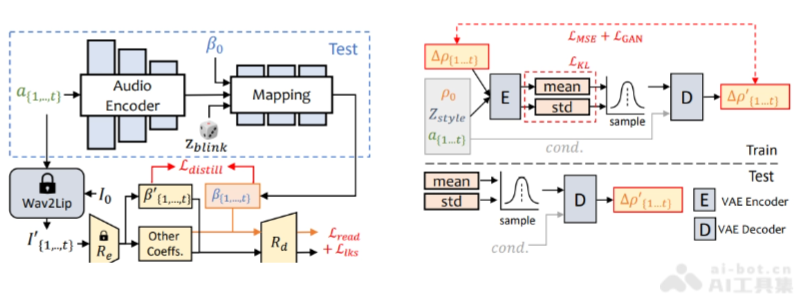
SadTalker project address
-
GitHubRepository:https://sadtalker.github.io/
-
Hugging Face model library:https://huggingface.co/spaces/vinthony/SadTalker
-
arXivTechnical paper:https://arxiv.org/pdf/2211.12194
Application scenarios of SadTalker
- Virtual assistants and customer service: Provide realistic facial animations for virtual assistants or online customer service to improve user experience.
- Video production: In video production, SadTalker can be used to generate facial animations for characters, saving the cost and time of traditional motion capture.
- Language learning applications: Provide pronunciations and facial expressions in different languages for language learning software, helping learners better understand and imitate.
- Social media and entertainment: Users can create personalized virtual avatars for sharing on social media or entertainment content.
- Education and training: In remote teaching or online training, SadTalker can provide virtual avatars for instructors, enhancing interactivity.