
What is RWKV-7
RWKV-7 is the latest large model architecture version in the RWKV series, surpassing traditional attention and linear attention paradigms, with more flexible state evolution capabilities, and can solve problems that attention cannot solve under the same computational cost. RWKV-7 research began in September 2024, and the preview versionRWKV-7 "Goose" x070.rc2-2409-2r7a-b0b4aIts training code was first submitted in a commit in the RWKV-LM repository. Its core advantages lie in powerful ICL (In-context Learning) capabilities, as well as stability and efficiency during training. The RWKV-7 architecture has been confirmed to use the "rc4a" version as the final code, and models with two parameter sizes, 0.1B and 0.4B, have been released. RWKV-7 research and development is an active field, with new progress and model releases continuously emerging.
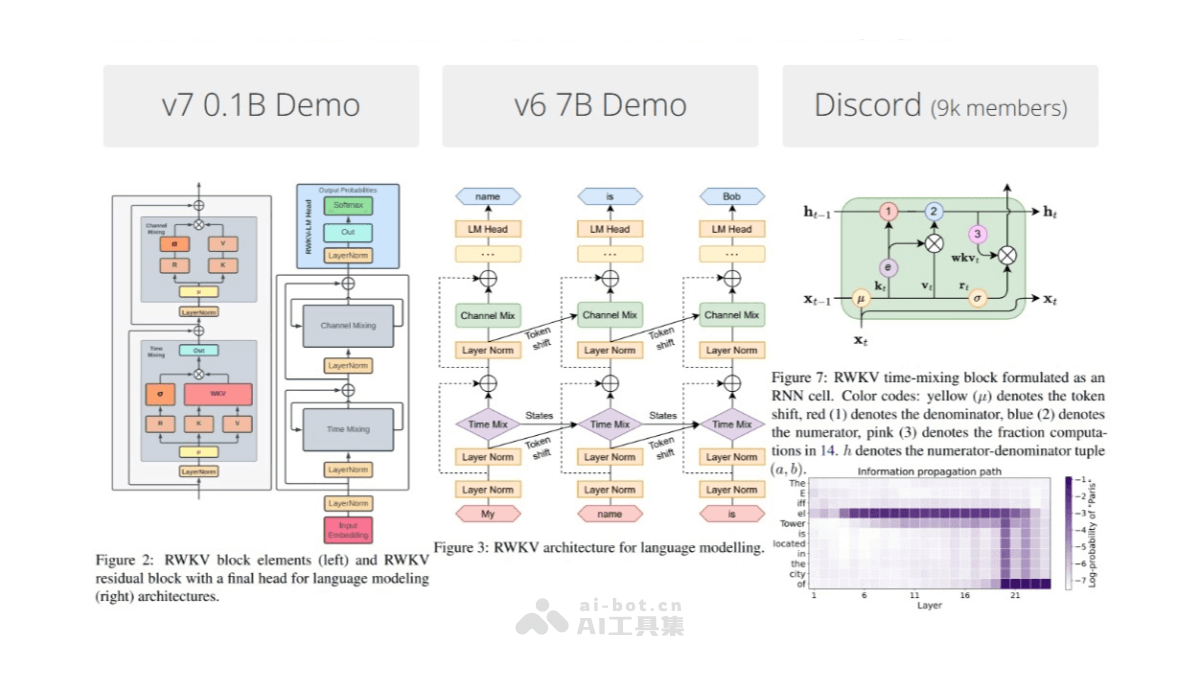
Main features of RWKV-7
- Beyond traditional Attention mechanisms: The RWKV-7 architecture surpasses traditional attention and linear attention paradigms, with more flexible state evolution capabilities, and can solve problems that attention cannot solve under the same computational cost.
- Dynamic learning strategy: RWKV-7 uses a weighted key-value (WKV) mechanism to efficiently process information and flexibly adjust strategies during the learning process.
- Dynamic state update: RWKV-7's dynamic state update formula allows the model to retain important information at each time step while adapting to new inputs.
- Dynamic adjustment of learning rate: RWKV-7 achieves dynamic adjustment of the learning rate through specific formulas, effectively controlling the learning rate and making the model more stable during the learning process.
- Contextual learning rate: RWKV-7 introduces the concept of "contextual learning rate", supporting the model to adaptively adjust the learning rate in different contexts, enhancing the model's flexibility and learning efficiency in changing environments.
- Efficient inference speed and low memory usage: RWKV-7 can handle infinite context, making it very suitable for applications such as long text processing and multi-turn dialogue, and it is hardware-friendly, performing only matrix-vector multiplication operations and requiring no KV cache.
- RNN-like inference: RWKV-7 is based on a recurrent network structure, and during the inference stage it can conveniently decode in recursive form.
- Additional optimizations: RWKV-7 includes optimization strategies such as small initialization embeddings and custom initialization to accelerate and stabilize the training process, and achieve better convergence in deeper architectures.
RWKV-7 project address
- Project official website:rwkv.com
- Github repository:https://github.com/BlinkDL/RWKV-LM/tree/main/RWKV-v7
RWKV-7 evaluation results
- Training efficiency and stability: RWKV-7 has lower training Loss and is very stable during training, showing significant improvement compared to RWKV-6.
- Multilingual model performance: RWKV-7-World-0.1B is currently the strongest 0.1B multilingual model in the world, performing excellently in English and multilingual benchmark evaluations, with multilingual capabilities significantly surpassing all models of the same size.
- Model design advantages: RWKV-7-World-0.1B-v2.8 maintains the L12-D768 architecture design. Fewer neural network layers make RWKV-7 faster and more suitable for inference scenarios with limited resources such as edge devices.
- Reduced inference cost: The Eagle 7B model based on the RWKV-v5 architecture reduces inference cost by 10-100 times, indicating that the RWKV architecture has significant advantages in efficiency.
- Multilingual benchmark testing: Eagle 7B outperforms all 7B-class models on multilingual benchmarks, demonstrating the strong capabilities of the RWKV architecture in multilingual processing.
- English Evaluation Performance: In English evaluations, Eagle 7B performs close to Falcon (1.5T), LLaMA2 (2T), and Mistral, and is comparable to MPT-7B (1T), demonstrating the strong performance of the RWKV architecture on English tasks.
Application Scenarios of RWKV-7
- Text Generation: RWKV-7 can generate fluent and coherent text, making it especially suitable for creative tasks such as novel writing and poetry creation.
- Machine Translation: RWKV-7 can handle long sentences and complex grammatical structures, improving the accuracy and fluency of machine translation.
- Sentiment Analysis: RWKV-7 can deeply understand the sentiment tendencies in text, providing precise sentiment analysis services for fields such as e-commerce and social networking.
- Dialogue Systems: RWKV-7 can maintain long-term context memory, providing dialogue systems with a more natural and coherent interaction experience.
- Multilingual Processing: The RWKV-7 model performs well on multilingual tasks, especially on non-English languages such as Chinese and Japanese, where its results are better than many open-source models.
- Code Generation: RWKV-7 also performs well on program code generation tasks and can be used to assist programming.