
What is RustGPT
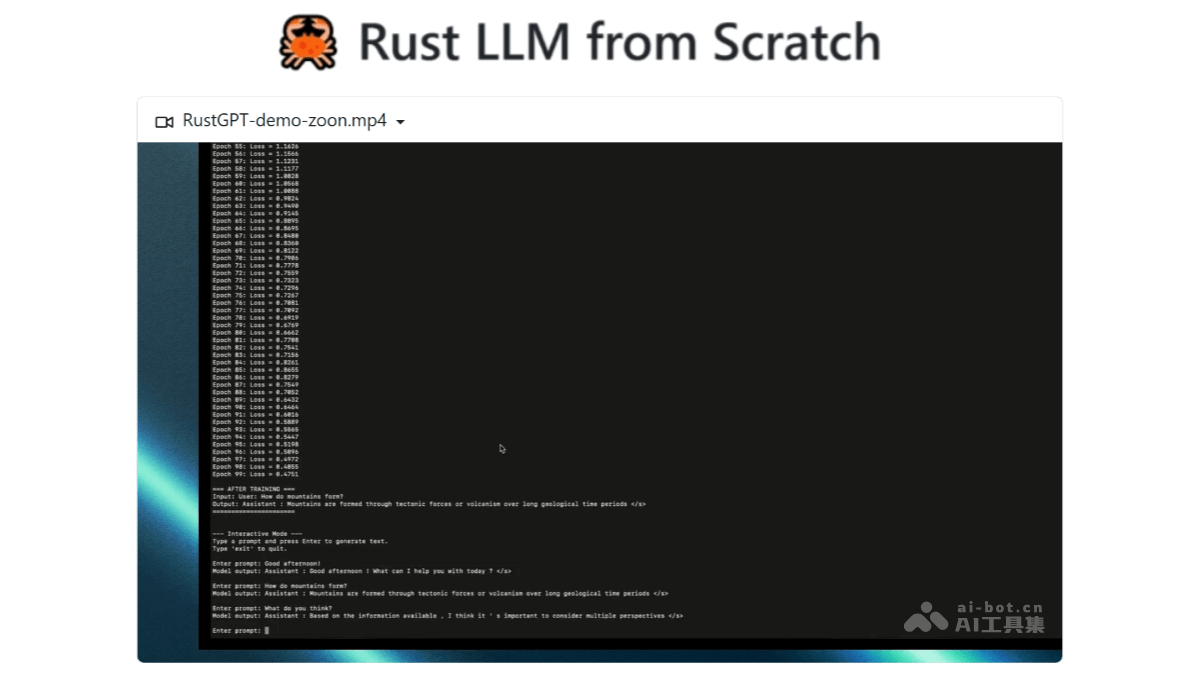
RustGPT is a Transformer architecture language model written in Rust. RustGPT is built from scratch, without relying on any external machine learning frameworks, using only ndarray for matrix operations. The project includes pre-training for factual text completion, instruction fine-tuning for conversational AI, and interactive chat mode testing. RustGPT's modular architecture ensures a clear separation of concerns, making it easy to understand and extend. RustGPT is suitable for developers interested in Rust and machine learning, and is an excellent learning project.
Main Features of RustGPT
- Factual Text Completion: RustGPT can generate reasonable follow-up content based on the input text fragment.
- Instruction Fine-Tuning: The model undergoes instruction fine-tuning, enabling it to understand and generate text that conforms to human instructions.
- Interactive Chat Mode: RustGPT supports an interactive chat mode, where users input questions or prompts, and the model generates corresponding answers.
- Dynamic Vocabulary: The model supports dynamically building a vocabulary, automatically expanding the vocabulary based on input data to adapt to different text content.
Technical Principles of RustGPT
- Transformer-Based Architecture: RustGPT uses the Transformer architecture, a neural network architecture based on the attention mechanism, capable of processing long sequence data and capturing long-range dependencies. The Transformer architecture includes the Multi-Head Self-Attention mechanism and the Feed-Forward Neural Network.
- Custom Tokenization: The model uses a custom tokenization method to split text into tokens, which include words, subwords, or characters. The tokenized text is embedded into a high-dimensional vector space for use as the model's input.
- Matrix Operations: The model's computations mainly rely on matrix operations, implemented with the
ndarraylibrary. Matrix operations include matrix multiplication in the embedding layer, matrix operations in the Multi-Head Self-Attention mechanism, matrix operations in the feed-forward network, etc. - Pre-Training and Fine-Tuning:
- Pre-Training: The model is first pre-trained on a large amount of text data to learn the basic patterns and structures of language. The goal of pre-training is to maximize the probability of predicting the next token.
- Instruction Fine-Tuning: On the basis of pre-training, the model is further instruction fine-tuned to learn how to generate text that conforms to human instructions. During fine-tuning, the model is optimized according to specific tasks or instructions.
RustGPT Project Address
- GitHub Repository:https://github.com/tekaratzas/RustGPT
Application Scenarios of RustGPT
-
Text Completion: Automatically generate reasonable follow-up content based on partial text input by the user, helping users quickly complete writing or input.
-
Creative Writing: Provide inspiration for writers and content creators, generating creative texts such as stories, poems, and articles.
-
Chatbots: Build intelligent chatbots for scenarios such as customer service and virtual assistants, understanding and generating natural language conversations.
-
Machine Translation: Translate text from one language to another, helping to overcome language barriers.
-
Multilingual Dialogue: Support multilingual interaction, helping users communicate across languages.