
What is RSIDiff
RSIDiff is a recursive self-training (RSI) framework for improving the performance oftext-to-imagediffusion models. By iteratively optimizing the model and training on data generated by the model itself, it solves the training collapse problem commonly seen in traditional self-training. The core of RSIDiff lies in improving the quality of generated images and alignment with human preferences through three strategies: first, high-quality prompt construction and filtering, which enhances the perceptual consistency of generated images by optimizing the clarity, specificity, and diversity of prompts; second, preference sampling, which filters out samples consistent with human preferences through automatic evaluation metrics to avoid introducing generation hallucinations; third, a distribution-based sample weighting mechanism, which penalizes out-of-distribution samples to reduce their negative impact on model training.
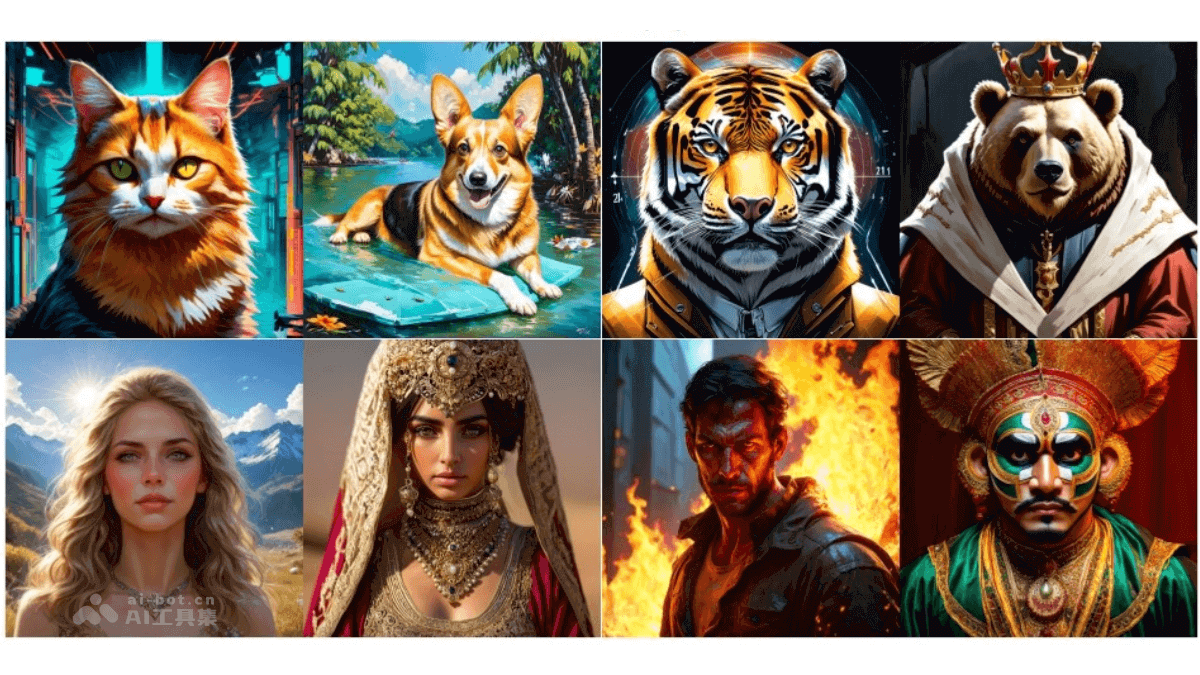
Main Features of RSIDiff
- Improve the quality of generated images: Through the construction and filtering of high-quality prompts, RSIDiff can generate clearer images with richer details.
- Enhance alignment with human preferences: Through a preference sampling strategy, RSIDiff prioritizes generated samples consistent with human preferences while filtering out defective images (such as generation hallucinations).
- Optimize the model's self-evolution capability: RSIDiff introduces a distribution-based sample weighting mechanism. By penalizing out-of-distribution samples, it reduces errors accumulated by the model during iterative training, avoids training collapse, and achieves more stable model optimization.
- Reduce dependence on large-scale datasets: Through self-optimization based on synthetic data, RSIDiff can continuously improve model performance in situations of data scarcity or privacy restrictions, reducing dependence on large-scale annotated datasets.
- Improve artistic style and concept understanding: RSIDiff shows stronger artistic style understanding in experiments, better generating painting-style images consistent with prompts, and also achieves significant improvements in concept centralization and text alignment.
Technical Principles of RSIDiff
- High-quality prompt construction and filtering: By optimizing the clarity, specificity, and diversity of prompts, RSIDiff improves the perceptual consistency of generated images and reduces the possibility of generation hallucinations.
- Preference sampling: Based on automated metrics, it filters samples consistent with human preferences, filters out defective images, ensures the quality of training data, and improves the stability and performance of the model.
- Distribution-based sample weighting: By calculating the distance between samples and the initial distribution and assigning weights, RSIDiff penalizes out-of-distribution samples, reduces their negative impact on training, and achieves more stable self-evolution.
Project Address of RSIDiff
- arXiv technical paper:https://arxiv.org/pdf/2502.09963
Application Scenarios of RSIDiff
- Creative design and art generation: By optimizing the generation capability of diffusion models, RSIDiff can help artists and designers quickly generate high-quality images, paintings, or concept art.
- Advertising and marketing: Based on its ability to generate high-quality images, RSIDiff can be used to create personalized advertising content, improving the appeal and conversion rate of advertisements.
- Virtual reality (VR) and augmented reality (AR): By generating images consistent with human preferences, RSIDiff can provide more realistic visual experiences for VR and AR applications.
- Game development: In game development, RSIDiff can be used to quickly generate characters, scenes, and props in games, improving development efficiency.
- Education and Training: By generating images related to teaching content, RSIDiff can help create more engaging educational materials.