
What Is Robostral Navigate
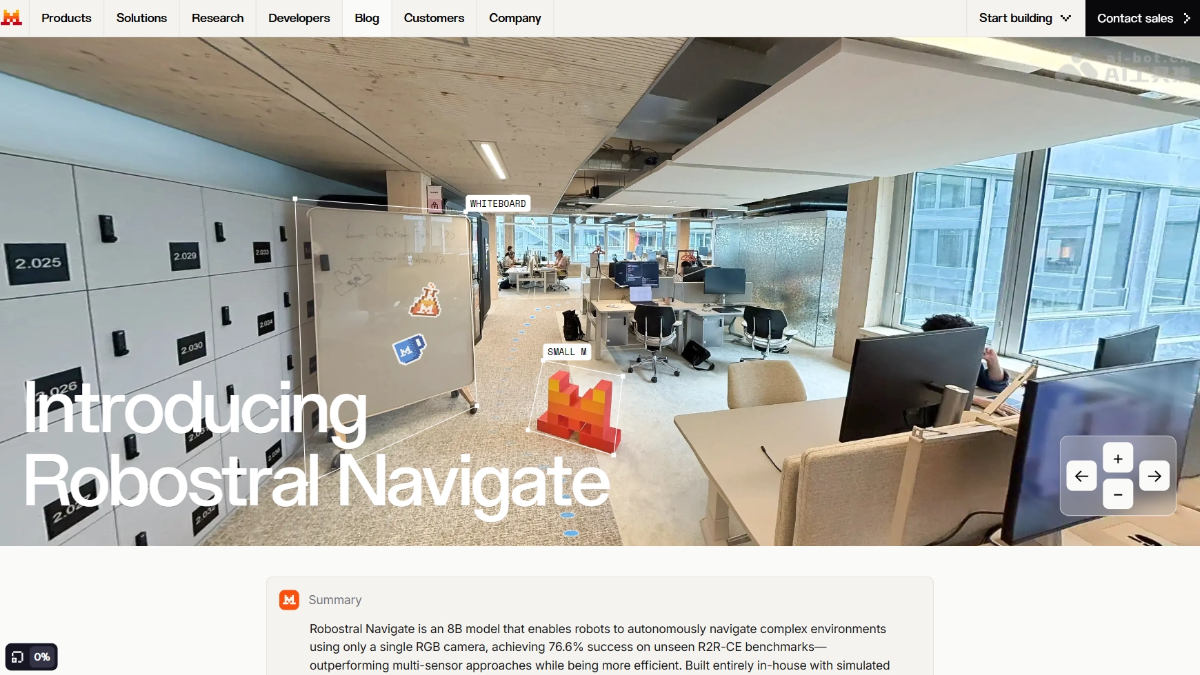
Robostral Navigate is the first embodied intelligent navigation model launched by Mistral AI. With an ordinary RGB camera, it enables robots to navigate autonomously in complex environments. The model has 8B parameters and achieves a 76.6% success rate on unknown environments in the R2R-CE benchmark, surpassing multi-sensor solutions. The model guides movement by pointing to predicted target locations and continuously optimizes through reinforcement learning. It can generalize to wheeled, legged, and aerial robots, and is suitable for scenarios such as manufacturing, logistics, and hospitality.
Main Features of Robostral Navigate
-
Monocular Vision Navigation: It relies only on a single RGB camera, without the need for LiDAR or depth sensors, to navigate autonomously in complex indoor and outdoor environments.
-
Natural Language Instruction Following: It receives long-horizon language instructions such as leave the lobby, go through the corridor, and enter the storage room, driving the robot to complete end-to-end tasks.
-
Cross-Platform Generalization: It can be deployed on wheeled, legged, and aerial robots, and can adapt to differences in size and camera intrinsics.
-
Dynamic Obstacle Avoidance and Adaptation: It moves in real unknown spaces filled with people and obstacles, with real-time obstacle avoidance capability.
-
Continuous Self-Improvement: It learns from trial and error through online reinforcement learning, alleviating the distribution shift problem in behavior cloning.
Technical Principles of Robostral Navigate
- Navigation Strategy Based on "Pointing": The model guides movement by predicting the image coordinates of the target location in the current camera view and the expected orientation, making it naturally robust to variations in different camera intrinsics and world scale. When the target is outside the field of view, the model falls back to displacement instructions based on the local coordinate frame.
- Fully Autonomous Construction and Data Generation: It does not rely on existing open-source VLMs, and is initialized from a vision-language model dedicated to referring, counting, and object localization. An efficient data pipeline was built in a simulation environment, generating a dataset of approximately 400,000 trajectories covering 6,000 scenes.
- Efficient Training with Prefix Caching: It adopts a tree-based attention masking strategy, compressing an entire episode into a single sequence and training all time steps in one forward pass. Compared with traditional methods, the number of tokens is reduced by 22 times, shortening training that originally took months to days.
- Online Reinforcement Learning Optimization: After supervised training, the CISPO algorithm is used for online reinforcement learning, enabling the model to recover from failures and acquire exploratory behavior, further improving the success rate by 3.2%.
How to Use Robostral Navigate
Robostral Navigate is still in the model release stage, and no usage entry point is currently provided.
Core Advantages of Robostral Navigate
-
Minimal Hardware: The single RGB camera solution greatly reduces hardware costs and deployment barriers, and is easier to scale than multi-sensor solutions.
-
Leading Performance: It achieves a 76.6% success rate on unknown R2R-CE data, surpassing the best single-camera solution by 9.7 percentage points and the best multi-sensor solution by 4.5 percentage points.
-
Extremely High Training Efficiency: Prefix caching technology compresses training tokens by 22 times, reducing the training cycle from months to days.
-
Strong Generalization Ability: It performs stably from simulation to the real world, across robot types, and across camera parameters.
-
Continuous Evolution: The online RL mechanism allows the model to continuously improve its performance through trial and error even after deployment.
Project address of Robostral Navigate
- Project official website:https://mistral.ai/news/robostral-navigate/
Comparison of Robostral Navigate with similar competing products
| Dimension | Robostral Navigate | LingBot-VLA 2.0 |
|---|---|---|
| Publisher | Mistral AI | Ant Group (Robbyant) |
| Model positioning | Dedicated model for embodied navigation | Vision-Language-Action (VLA) foundation model |
| Core task | Autonomous navigation in environments (Navigation) | Fine manipulation + long-horizon mobile manipulation (Manipulation) |
| Sensor input | Single RGB camera only | Multimodal (vision, depth, robot proprioceptive state) |
| Architecture features | Prefix caching efficient training + online RL | Sparse MoE sparse mixture-of-experts architecture |
| Training data | 400,000 simulation-generated trajectories / 6,000 scenes | 50,000 hours of real robot data + 10,000 hours of egocentric video |
| Action output | Image-coordinate "pointing" + displacement fallback | Unified action space (arm, gripper, waist, head, hand, mobility) |
| Cross-platform generalization | Wheeled / legged / flying robots | 20 different robot embodiments |
| Training efficiency | Prefix caching compresses tokens by 22x, months to days | MoE activation parameters decoupled, capacity expands tenfold under the same compute |
| Open-source status | Not open-sourced, requires business contact | Open source (GitHub + arXiv paper + weights) |
Application scenarios of Robostral Navigate
-
Smart logistics warehousing: A robot autonomously navigates in a warehouse and completes picking according to instructions such as going to Area B, Shelf 3 to retrieve goods.
-
Commercial building delivery: In office buildings and hospital scenarios, delivery robots complete express or medicine delivery according to floor and room number instructions.
-
Manufacturing production line inspection: In complex factory environments, autonomously move and report status according to instructions such as "inspect the equipment at the end of Production Line 2."
-
Hotel service guidance: Reception robots complete guidance in dynamic crowd environments according to instructions such as "take the guest to Room 1208."
-
Outdoor facility inspection: Drones or wheeled robots complete outdoor facility inspections according to instructions such as "inspect the third area of the east fence."