
What is RoboOS
RoboOS is the first cross-embodiment embodied brain-cerebellum collaboration framework launched by the Beijing Academy of Artificial Intelligence. Based on a "brain-cerebellum" hierarchical architecture, the embodied brainRoboBrainis responsible for global perception and decision-making, the cerebellum skill library is responsible for low-latency precise execution, and the cross-robot data hub shares spatial, temporal, and embodiment memory in real time, forming a closed loop of perception-cognition-decision-action. RoboOS supports different types of embodied bodies such as AgileX dual arms, RealMan single/dual arms, AgiBot humanoid, and Unitree humanoid, enabling "plug-and-play" between brain models and cerebellum skills, and achieving state synchronization and intelligent collaboration among multiple robots through a shared memory system. RoboOS has integrated device-cloud collaboration capabilities, supports device-cloud collaboration for multi-robot systems, and has instruction response latency below 10ms.
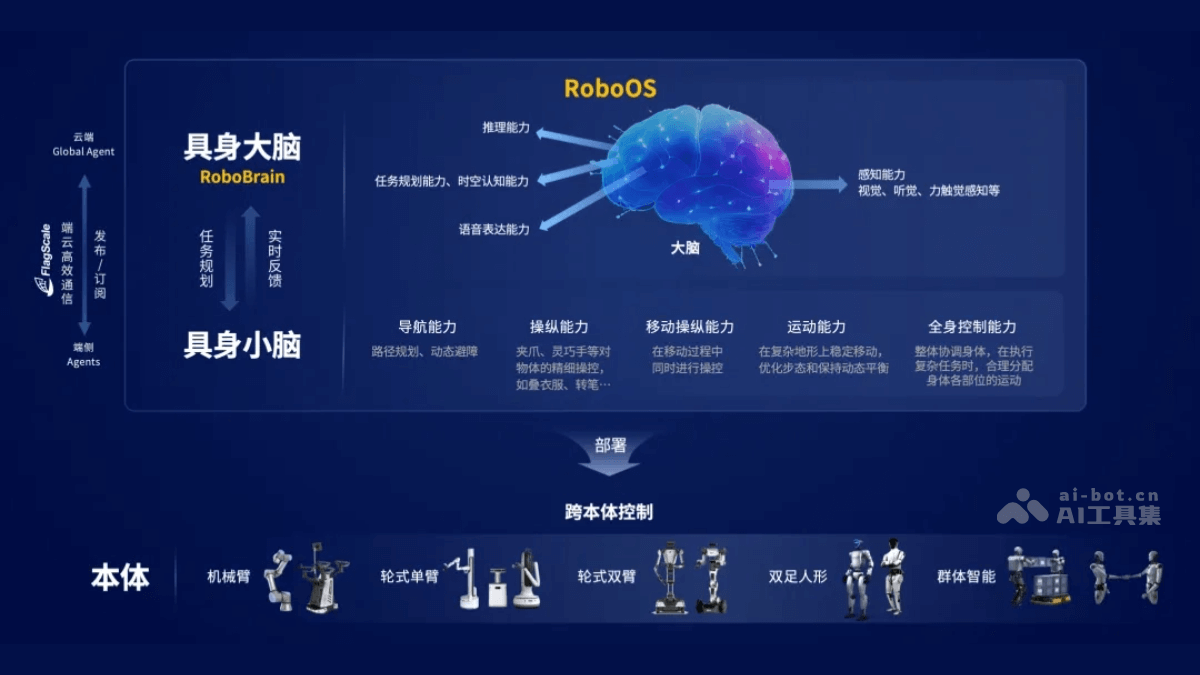
Main features of RoboOS
- Cross-embodiment collaboration: Based on a "brain-cerebellum" hierarchical architecture, it supports different types of embodied bodies such as AgileX dual arms, RealMan single/dual arms, AgiBot humanoid, and Unitree humanoid, enabling state synchronization and intelligent collaboration among multiple robots and breaking through the limitations of traditional "information silos".
- Task planning and execution: The embodied brain RoboBrain is responsible for global perception and decision-making, building mechanisms for dynamic spatiotemporal perception, planning guidance, and feedback error correction; the cerebellum skill library is responsible for low-latency precise execution, enabling flexible and precise operations, etc., forming a closed loop of perception-cognition-decision-action.
- Dynamic task management: It can dynamically manage multi-robot task queues, support priority preemption and optimized resource allocation, ensure real-time response in complex scenarios, and achieve high-concurrency task scheduling. It can dynamically adjust strategies based on execution feedback, continuously optimize task planning in combination with environmental changes, improve robustness, and achieve real-time closed-loop optimization.
- Plug-and-play and rapid deployment: It enables "plug-and-play" between brain models (such as LLM/VLM) and cerebellum skills (such as grasping and navigation), natively supports flexible access of heterogeneous robot bodies, and quickly completes robot capability modeling and adaptation through a Profile template mechanism, greatly reducing development thresholds and access costs.
- Integrated device-cloud collaboration: In device-side deployment, once a robot is registered, it can automatically establish a two-way communication link with the RoboBrain deployed in the cloud, achieving real-time task scheduling and state feedback through an efficient publish-subscribe mechanism, with instruction response latency below 10ms, meeting the closed-loop control requirements of complex dynamic tasks.
Technical principles of RoboOS
- "Brain-cerebellum" hierarchical architecture:
- Embodied brain RoboBrain: Responsible for global perception and decision-making, building mechanisms for dynamic spatiotemporal perception, planning guidance, and feedback error correction.
- Cerebellum skill library: Responsible for low-latency precise execution, enabling flexible and precise operations, etc.
- Cross-robot data hub: Responsible for real-time sharing of spatial, temporal, and embodiment memory, providing information support for decision-making planning and optimized collaborative operations, thereby forming a closed loop of perception-cognition-decision-action.
Application scenarios of RoboOS
- Industrial automation: In industrial production, RoboOS can enable collaboration among different types of robots to complete complex production tasks, such as multiple robots collaboratively completing the handling and assembly of parts, improving production efficiency and quality.
- Smart logistics: RoboOS can support collaboration among logistics robots in warehousing and delivery processes, such as sorting, handling, and delivery tasks, optimizing logistics workflows.
- Smart Manufacturing: In the field of smart manufacturing, RoboOS can be used for the automated execution of complex manufacturing tasks, enhancing production flexibility and adaptability.
- Service Robots: RoboOS can be used for service robots in various scenarios, such as restaurant service, hotel service, etc., enabling collaboration among robots and providing more efficient services.
- Laboratory and Scientific Research: RoboOS provides researchers with a powerful platform for studying cutting-edge technologies such as autonomous mobile robots and self-driving cars.