
What is RoboBrain-X0
RoboBrain-X0 is the world's first open-source embodied model from the Beijing Academy of Artificial Intelligence (BAAI) that supports zero-shot cross-embodiment generalization. Without fine-tuning, it can drive a variety of real robots with different configurations to complete basic manipulation tasks, and after fine-tuning with a small number of samples, it demonstrates cross-embodiment adaptability for complex tasks. By uniformly modeling vision, language, and action, the model decomposes tasks into general semantic action sequences decoupled from the robot's "body," then translates them in real time into executable commands for specific robots, breaking through the limitations of a single robot system and achieving unified modeling of heterogeneous embodiments.
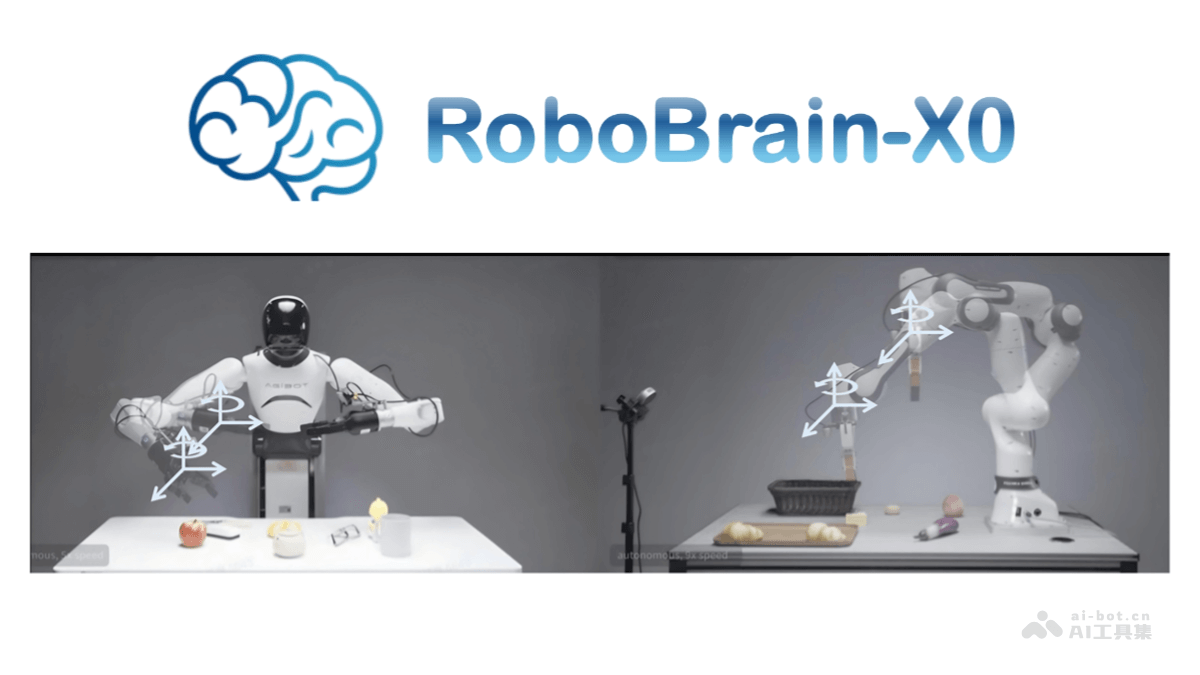
Main Features of RoboBrain-X0
-
Zero-Shot Cross-Embodiment Generalization: Without fine-tuning for different robots, it can drive a variety of real robots to complete basic manipulation tasks, breaking through the dependence of traditional robot models on a single hardware form.
-
Few-Shot Fine-Tuning Potential: After fine-tuning with a small number of samples (e.g., 50), it can further improve cross-embodiment adaptability for complex tasks, demonstrating stronger generalization ability.
-
Control Consistency: When different embodiments perform the same task, the generated action primitive sequences are highly consistent, ensuring the reliability of actual physical execution.
-
Unified Modeling of Vision, Language, and Action: By uniformly modeling vision, language, and action, it achieves integrated capabilities from perception to execution, providing robots with more comprehensive intelligent support.
-
Efficient Task Decomposition: It can decompose complex tasks into general semantic action sequences, then translate them in real time into executable commands for specific robots, improving the flexibility and adaptability of task execution.
-
Open Dataset Support: It has open-sourced the core training dataset RoboBrain-X0-Dataset, providing developers with rich data resources and helping accelerate the research and application of embodied intelligence technology.
Technical Principles of RoboBrain-X0
-
Embodiment Mapping Mechanism: It decomposes tasks into general semantic action sequences unrelated to the robot's body, then efficiently translates these sequences through a mapping mechanism into actions that multiple robots can directly execute, achieving cross-embodiment generalization.
-
Unified Action Space: It uses pose representations of the end effector in the SE(3) task space, combined with a Unified Action Vocabulary (UAV) and action tokenizer, to unify the actions of different robots into a shared discrete action primitive space, ensuring semantic consistency and transferability.
-
Grouped Residual Vector Quantizer (GRVQ): It maps continuous control sequences with different degrees of freedom and mechanical structures into a shared discrete action primitive space, achieving cross-embodiment semantic consistency and transferability.
-
Multimodal Input and Output: The model accepts single-image, multi-image, and text inputs, covering various task scenarios, and outputs multi-dimensional action sequences to drive robots to complete manipulations.
-
Data-Driven Training: It is trained on large amounts of real robot data and embodied reasoning data, further integrating RoboBrain 2.0 data to improve the model's generalization ability and task execution capability.
RoboBrain-X0 Project Address
- Project Website:https://superrobobrain.github.io/
- GitHub Repository:https://github.com/FlagOpen/RoboBrain-X0
- HuggingFace Model Repository:https://huggingface.co/BAAI/RoboBrain-X0-Preview
- RoboBrain-X0-Dataset:https://huggingface.co/datasets/BAAI/RoboBrain-X0-Dataset
Application Scenarios of RoboBrain-X0
-
Service Robots: Can be used in scenarios such as homes, hotels, and hospitals to complete tasks like item delivery, cleaning and tidying, and companion interaction, improving service quality and efficiency.
-
Intelligent Manufacturing: In factory workshops, it performs material handling, component assembly, quality inspection, and other work, improving the level of production automation and flexibility.
-
Logistics and Warehousing: It assists with operations such as goods sorting, handling, and palletizing in logistics centers, optimizes warehousing management processes, and reduces labor costs.
-
Education and Scientific Research: As a research platform, it supports universities and research institutions in teaching and research in fields such as robotics technology and artificial intelligence, accelerating technological innovation.
-
Operations in Special Environments: In dangerous environments such as nuclear radiation, deep sea, and space, it replaces humans in performing tasks such as detection, maintenance, and sampling, ensuring personnel safety.