
What is RLCM
RLCM (Reinforcement Learning for Consistency Model) is a framework launched by Cornell University for optimizing text-to-image generation models. It fine-tunes consistency models based on reinforcement learning methods to adapt to task-specific reward functions. The multi-step inference process of the consistency model is modeled as a Markov decision process (MDP), and the model parameters are optimized based on policy gradient algorithms to maximize task-related rewards. Compared with traditional diffusion models, RLCM is significantly faster in training and inference speed and can generate high-quality images. RLCM can adapt to objectives that are difficult to express with prompts, such as image compressibility and aesthetic quality, demonstrating advantages in task-specific reward optimization and fast generation.
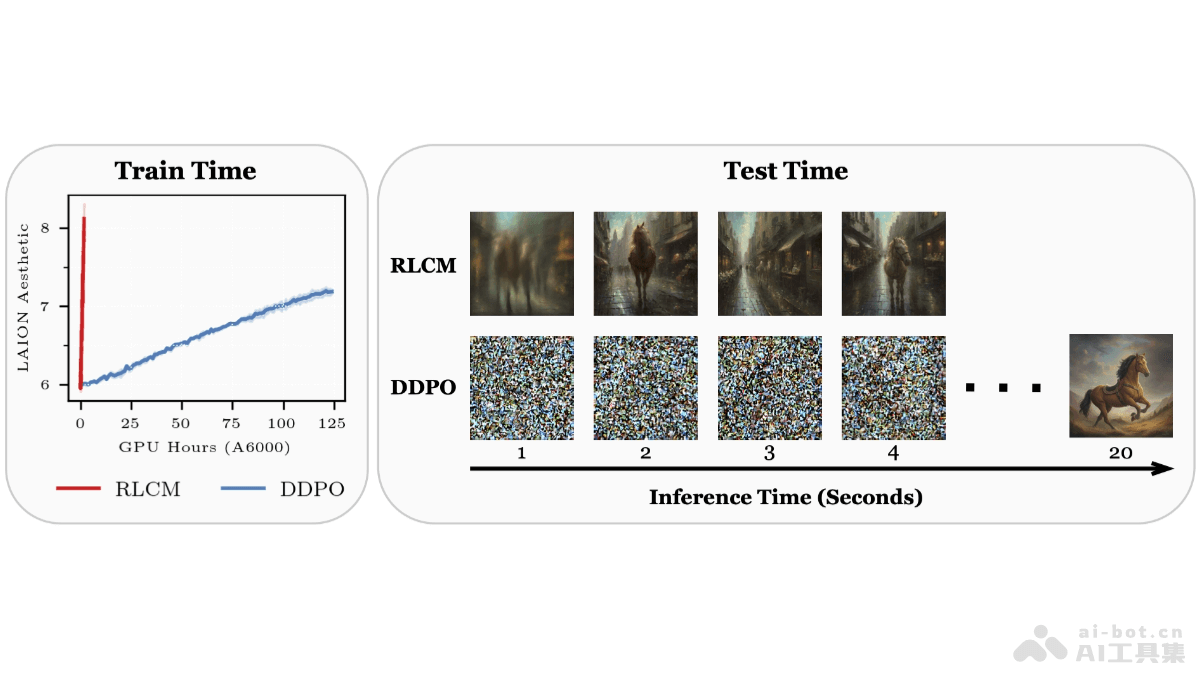
Main features of RLCM
- Task-specific reward optimization: Fine-tunes the consistency model according to the reward function of a specific task, so that the generated images better conform to the task objectives, such as improving the aesthetic quality and compressibility of images.
- Fast training and inference: Compared with traditional diffusion models, RLCM has faster speed in the training and inference process, significantly reduces the consumption of computing resources, and improves generation efficiency.
- Adaptation to complex objectives: Adapts to complex objectives that are difficult to express with simple prompts, such as aesthetic quality based on human feedback, making the images generated by the model better conform to human aesthetics and needs.
- Flexible adjustment of inference steps: Provides a flexible trade-off between inference time and generation quality, supports adjusting the number of inference steps according to actual needs, and obtains faster inference speed or higher-quality images.
Technical principles of RLCM
- Consistency model foundation: Based on the consistency model, the model directly maps noise to data and generates high-quality images within a small number of steps. Compared with the multi-step iterative process of diffusion models, it has faster inference speed.
- Reinforcement learning framework: Models the multi-step inference process of the consistency model as a Markov decision process (MDP), treats each step in the generation process as a decision point, and optimizes the model's policy based on reinforcement learning methods to maximize the task-related reward function.
- Policy gradient algorithm: Uses a policy gradient algorithm to optimize the consistency model. The algorithm calculates the gradient of the policy based on trajectories generated by the sampling policy, updates the model parameters according to the gradient, and thereby optimizes the reward function.
- Reward function driven: Driven by task-specific reward functions, it continuously adjusts the model's generation policy based on reinforcement learning, making the generated images better conform to the task objectives and achieving high-quality image generation.
Project addresses of RLCM
- Project official website:rlcm.owenoertell.com
- GitHub repository:https://github.com/Owen-Oertell/rlcm
- arXiv technical paper:https://arxiv.org/pdf/2404.03673
Application scenarios of RLCM
- Artistic creation: Artists explore new painting styles, generate artworks that conform to specific styles, and quickly gain inspiration and creative direction.
- Personalized recommendation: Users generate images on social media platforms that conform to user personality, improving users' personalized experience and the platform's user stickiness.
- Dataset expansion: When developing autonomous driving systems, researchers generate simulated images under various weather conditions, different time periods, and complex traffic situations to expand the training dataset and improve the robustness and accuracy of autonomous driving models.
- Image Restoration and Reconstruction: Users generate restored complete historical photos, helping users recover precious historical memories.
- Biomedical Imaging: Biomedical researchers need to simulate the morphological changes of cells under the effects of different drugs. Based on known cell morphology and drug mechanisms of action, simulated cell images are generated to assist researchers in drug screening and biomedical research.