
What is RF-DETR
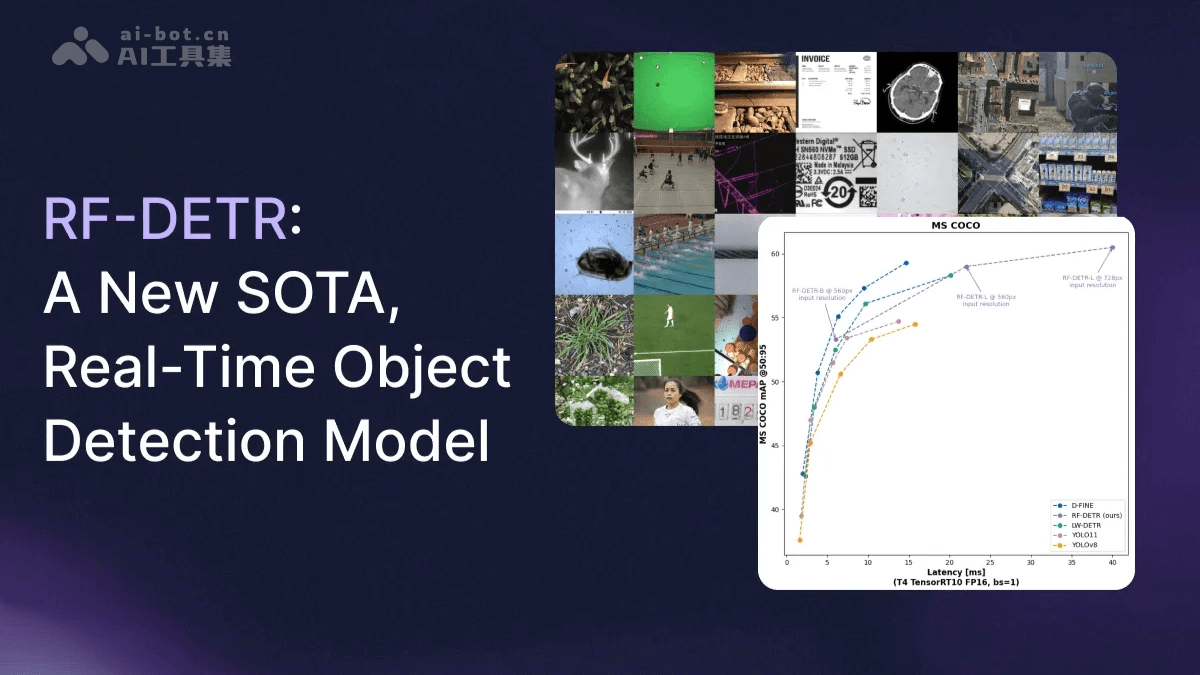
RF-DETR is a real-time object detection model launched by Roboflow. RF-DETR is the first real-time model to reach 60+ mean Average Precision (mAP) on the COCO dataset, outperforming existing object detection models. RF-DETR combines LW-DETR with a pretrained DINOv2 backbone and has strong domain adaptability. RF-DETR supports multi-resolution training, allowing flexible trade-offs between accuracy and latency as needed. RF-DETR provides pretrained checkpoints, making it convenient for users to fine-tune on custom datasets via transfer learning.
Main features of RF-DETR
- High-accuracy real-time detection: Achieves 60+ mean Average Precision (mAP) on the COCO dataset while maintaining real-time performance (25+ FPS), suitable for scenarios with high requirements for speed and accuracy.
- Strong domain adaptability: Adapts to various domains and datasets, including but not limited to aerial imagery, industrial scenarios, natural environments, etc.
- Flexible resolution selection: Supports multi-resolution training and operation, allowing users to trade off between accuracy and latency according to actual needs.
- Convenient fine-tuning and deployment: Provides pretrained checkpoints; users can fine-tune on custom datasets based on the checkpoints to quickly adapt to specific tasks.
Technical principles of RF-DETR
- Transformer architecture: RF-DETR belongs to the DETR (Detection Transformer) family and performs object detection based on the Transformer architecture. Compared with traditional CNN-based object detection models (such as YOLO), Transformers can better capture long-range dependencies and global contextual information in images, improving detection accuracy.
- Pretrained DINOv2 backbone: The model combines a pretrained DINOv2 backbone network. DINOv2 is a powerful visual representation learning model that learns rich image features based on self-supervised pretraining on large-scale datasets. Applying the pretrained features to RF-DETR gives the model adaptability and generalization ability when facing new domains and small datasets.
- Single-scale feature extraction: Unlike the multi-scale self-attention mechanism of Deformable DETR, RF-DETR extracts image feature maps from a single-scale backbone. This simplifies the model structure, reduces computational complexity, maintains high detection performance, and helps achieve real-time performance.
- Multi-resolution training: RF-DETR is trained at multiple resolutions, allowing the model to select an appropriate resolution at runtime according to different application scenarios. High resolution improves detection accuracy, while low resolution reduces latency. Users can flexibly adjust according to actual needs without retraining the model, achieving a dynamic balance between accuracy and latency.
- Optimized post-processing strategy: When evaluating model performance, RF-DETR is based on an optimized non-maximum suppression (NMS) strategy to ensure that the model's Total Latency remains at a low level while accounting for NMS latency, truly reflecting the model's operating efficiency in practical applications.
RF-DETR project addresses
- Project official website:https://blog.roboflow.com/rf-detr/
- GitHub repository:https://github.com/roboflow/rf-detr
- Online demo:https://huggingface.co/spaces/SkalskiP/RF-DETR
Application scenarios of RF-DETR
- Security monitoring: Real-time detection of people, vehicles, etc. in surveillance video to improve security efficiency.
- Autonomous driving: Detects road targets and provides a basis for decision-making in autonomous driving.
- Industrial inspection: Used for quality inspection on production lines, improving production efficiency.
- Drone Monitoring: Real-time detection of ground targets, supporting agriculture, environmental protection, and other fields.
- Smart Retail: Analyzes customer behavior, manages product inventory, and improves operational efficiency.