
What Is Reverb ASR
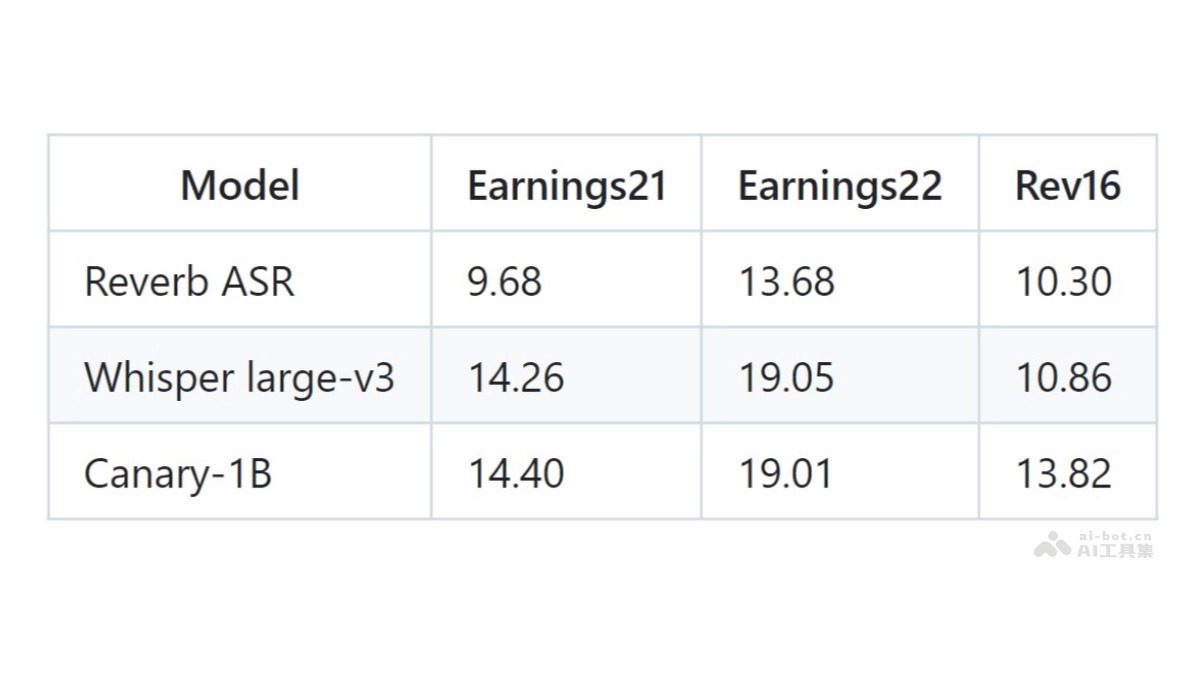
Reverb ASR is an open-source automatic speech recognition and speaker diarization model launched by Rev, trained on 200,000 hours of human-transcribed English data. The model performs excellently in the field of long-form speech recognition and is suitable for handling scenarios such as podcasts and earnings call conferences. Reverb ASR supports user control over the verbatim level of the output text, supporting different styles from fully verbatim to non-verbatim, meeting the needs of precise transcription and improved readability. Reverb ASR provides multiple decoding modes, including attention decoding and CTC prefix beam search, adapting to different recognition tasks. In long-form speech recognition, Reverb ASR's performance exceeds existing open-source models such as OpenAI's Whisper and NVIDIA's Canary-1B.
Main Features of Reverb ASR
- High-Precision Speech Recognition: Reverb ASR efficiently and accurately converts English speech into text.
- Verbatim Transcript Control: Users can adjust the verbatim level of the output as needed, from fully verbatim to non-verbatim, adapting to different use cases.
- Multiple Decoding Modes: Supports multiple decoding modes such as attention decoding, CTC greedy search, CTC prefix beam search, attention rescoring, and joint decoding.
- Long-Form Speech Processing: Excels at processing long-duration speech input, such as podcasts, meeting records, and more.
- Speaker Diarization: Speaker diarization technology helps distinguish and identify different speakers.
Technical Principles of Reverb ASR
- Dataset: Reverb ASR's training dataset consists of 200,000 hours of English speech, transcribed by human experts, covering multiple domains, accents, and recording conditions.
- Joint CTC/Attention Architecture: Reverb ASR is based on an architecture that combines Connectionist Temporal Classification (CTC) and attention mechanisms. It enables the model to consider both the sequential characteristics and contextual information of speech when recognizing speech.
- Encoder-Decoder Structure: The model uses an 18-layer convolutional encoder and a 6-layer bidirectional attention decoder, helping the model capture long-term dependencies and short-term speech features.
- Language-Specific Layers: Reverb ASR uses language-specific layers in the first and last layers of the encoder and decoder, facilitating control over the verbatim level of the output.
- Model Quantization: Provides an Int8 quantized version of the ASR model, improving the model's inference speed, reducing memory usage, and being suitable for applications sensitive to speed and memory.
- Multiple Decoding Modes: Reverb ASR supports multiple decoding modes, including greedy CTC decoding, CTC prefix beam search (with or without attention rescoring), attention decoding, and joint CTC/attention decoding.
Reverb ASR Project Addresses
- GitHub Repository:https://github.com/revdotcom/reverb/tree/main/asr
- HuggingFace Online Experience Demo:https://huggingface.co/spaces/Revai/reverb-asr-demo
- arXiv Technical Paper:https://arxiv.org/pdf/2410.03930v1
Application Scenarios of Reverb ASR
- Podcast Production: Automatically transcribes podcast content, facilitating editing and content management.
- Meeting Records: Generates meeting records in real time during business meetings or academic seminars.
- Court Records: Provides accurate records of court proceedings, ensuring the accuracy of legal procedures.
- Voice Content Creation: Helps content creators convert speech into text, improving work efficiency.
- Language Learning: Assists language learners in pronunciation and listening practice, providing real-time feedback.
- Media Monitoring: Monitors speech content from radio, television, or other media for news analysis or public opinion monitoring.
- Customer Service: Automatically records and analyzes customer conversations in call centers to improve service quality.