
What is ReSum
ReSum is a new WebAgent reasoning paradigm launched by Alibaba Tongyi, belonging to theTongyi DeepResearchfamily. It can solve the context length limitation problem faced by WebAgent in long-horizon tasks. By periodically summarizing the interaction history, it compresses the ever-growing conversation content into a compact reasoning state, enabling unlimited exploration while maintaining awareness of previous discoveries. The core of ReSum is the ReSum-GRPO scheme, which integrates the GRPO algorithm to enable the agent to master summary-conditioned reasoning. Experiments show that ReSum performs excellently in multiple tasks, achieving an average absolute improvement of 4.5% compared to the traditional ReAct method. This innovative mechanism provides broader possibilities for the application of WebAgent in complex tasks.
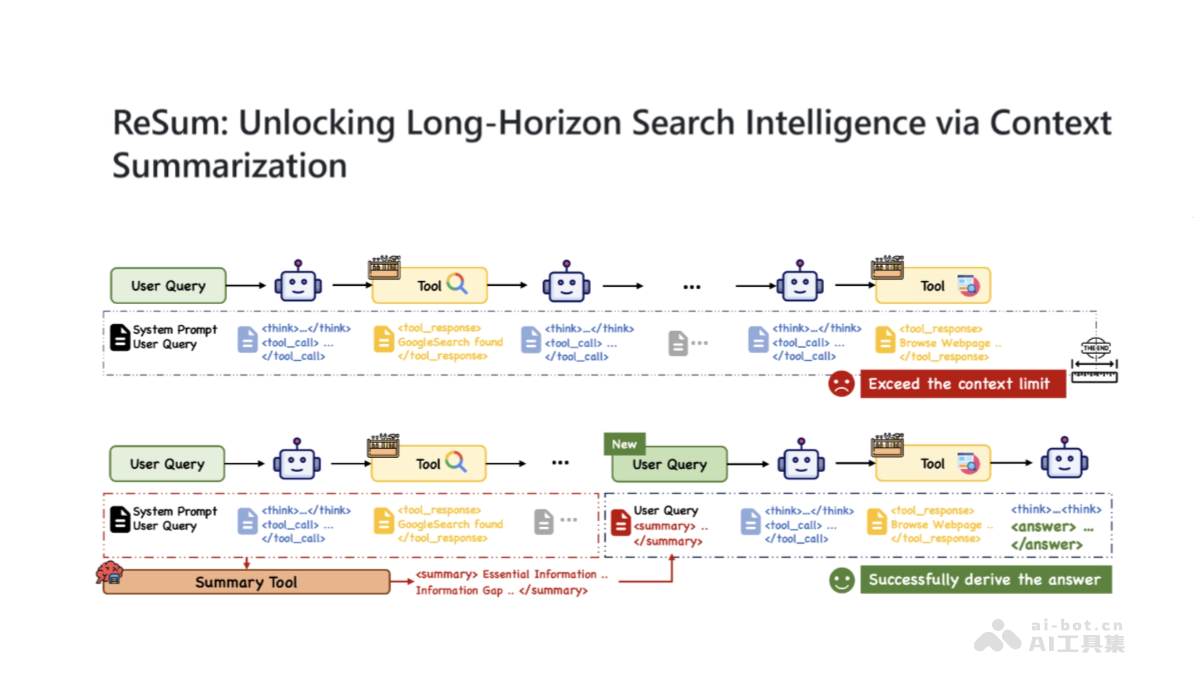
Main Features of ReSum
-
Breaking through context length limitations: Through a periodic summarization mechanism, long conversations are compressed into a compact reasoning state, effectively solving the context length limitation problem.
-
Enabling unlimited exploration: ReSum enables WebAgent to conduct unlimited exploration and dynamically update the reasoning state, ensuring that each decision is based on the latest information.
-
Enhancing reasoning capability: ReSum integrates the ReSum-GRPO scheme and significantly enhances the agent's reasoning capability through four steps: generation, retrieval, planning, and optimization.
-
Experimental validation: Experiments show that ReSum achieves an average absolute improvement of 4.5% compared to the traditional ReAct method, performing excellently in long conversations and complex tasks.
Technical Principles of ReSum
-
Periodic context summarization: ReSum periodically summarizes the interaction history, compresses long conversations into a compact reasoning state, breaks through context length limitations, and retains key information to support subsequent reasoning.
-
ReSum-GRPO algorithm: ReSum is based on the ReSum-GRPO scheme and integrates the GRPO (Group Relative Policy Optimization) algorithm. Through four steps: generation, retrieval, planning, and optimization, it optimizes the agent's decision-making process and improves performance in complex tasks.
-
Dynamic reasoning state update: ReSum can dynamically update the reasoning state, ensuring that the agent reasons based on the latest information at every step, enabling efficient multi-step reasoning.
-
Reinforcement learning framework: ReSum is trained under a reinforcement learning framework. Through on-policy training and a customized GRPO algorithm, it ensures that the learning signal is always relevant to the model's current capabilities, improving training stability and efficiency.
Project Address of ReSum
- GitHub Repository:https://github.com/Alibaba-NLP/DeepResearch/tree/main/WebAgent/WebResummer
- arXiv Technical Paper:https://arxiv.org/pdf/2509.13313
Application Scenarios of ReSum
-
Academic research: Efficiently handles complex academic literature and multi-step reasoning tasks, helping researchers quickly locate key information and improve research efficiency.
-
Legal research: Systematically retrieves case law and cross-references regulations, providing legal professionals with precise legal research support.
-
Travel planning: ReSum can generate complex travel plans, such as multi-day self-driving itineraries, including specific attractions and pet-friendly hotels, providing users with personalized travel suggestions.
-
Medical consultation: Integrates patients' medical records and the latest research to provide doctors with comprehensive medical information support and assist in formulating treatment plans.
-
Financial analysis: Analyze large amounts of financial data and market dynamics to provide investors with in-depth market analysis and investment advice.