
What is RepText
RepText is a multilingual visual text rendering framework launched by Shakker Labs and Liblib AI, which achieves high-quality text rendering by copying glyphs rather than understanding text content. The framework is based on a pretrained monolingual text-to-image generation model and introduces ControlNet structure, Canny edge detection, positional information, and glyph latent copying technology to precisely render multilingual text with user-specified fonts and positions. RepText is suitable for various scenarios such as graphic design and natural scenes.
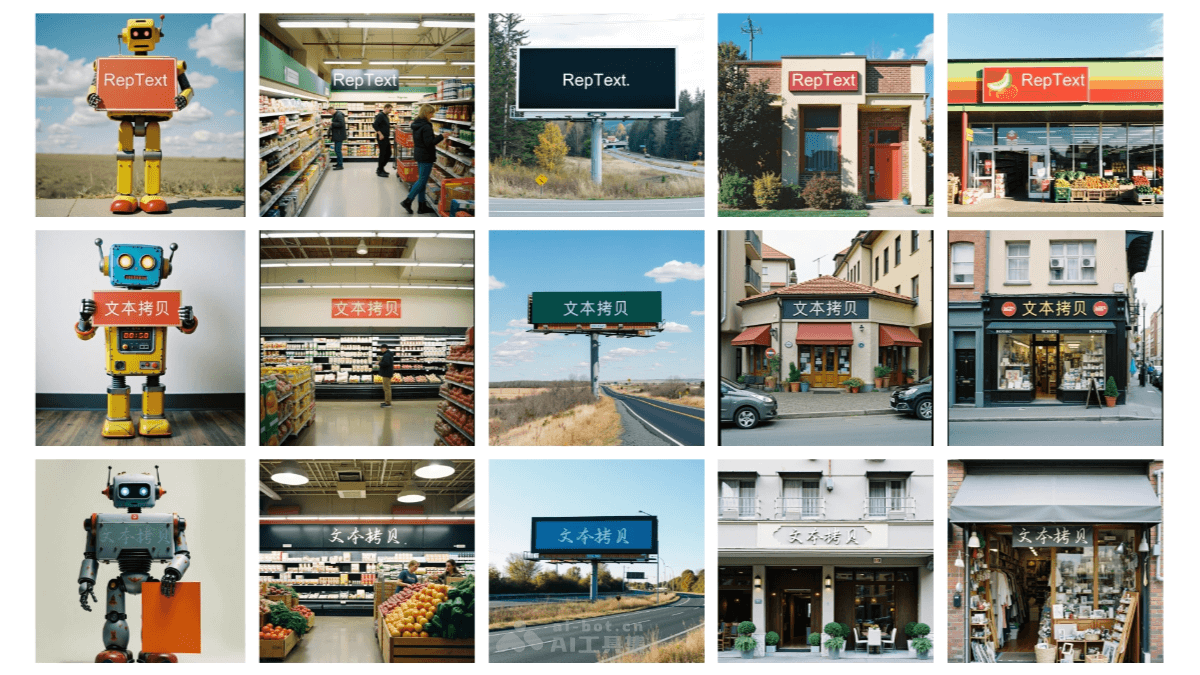
Main Features of RepText
- Multilingual Text Rendering: Supports the generation of visual text in multiple languages (including non-Latin alphabets), allowing users to specify text content, font, color, and position.
- Precise Control: Users can precisely control the position and style of text in the image, achieving highly customized text rendering.
- High-Quality Generation: Based on innovative technical approaches, the generated text is visually coordinated with the background and has high clarity and accuracy.
- Compatibility with Existing Models: Supports seamless integration with existing text-to-image generation models (such as DiT-based models) without the need to retrain the base model.
Technical Principles of RepText
- Imitation Rather Than Understanding: The core idea of RepText is to imitate glyphs rather than understand the semantics of the text. It generates text by copying glyphs, similar to the process of humans learning to write.
- ControlNet Structure: Based on the ControlNet framework, it uses Canny edge detection and positional information as conditions to guide the model in generating text. This avoids reliance on text encoders and reduces the demand for multilingual understanding.
- Glyph Latent Copying: During inference, RepText initializes from noise-free glyph latents, providing guidance for text generation and improving text accuracy and color control capability.
- Region Masking: To avoid interference with non-text regions during the generation process, RepText introduces region masking to ensure that only text regions are modified while the background remains unchanged.
- Text-Aware Loss: During training, RepText introduces a text-aware loss (based on the feature maps of an OCR model) to improve the recognizability and accuracy of the generated text.
Project Address of RepText
- Project Website:https://reptext.github.io/
- GitHub Repository:https://github.com/Shakker-Labs/RepText
- arXiv Technical Paper:https://arxiv.org/pdf/2504.19724
Application Scenarios of RepText
- Graphic Design: Used in designing greeting cards, posters, brochures, etc., with precise control over text font, color, and position.
- Natural Scene Rendering: Generates text in natural scenes, such as shop signs, billboards, road signs, etc., supporting multilingual and multi-style fonts.
- Artistic Creation: Supports the generation of artistic fonts and complex layouts, such as calligraphic-style text, artistic text effects, etc., providing inspiration and materials for artistic creation.
- Digital Content Creation: In fields such as video games, animation, and web design, it quickly generates text content that meets scene requirements, improving content creation efficiency.
- Multilingual Content Localization: Provides localized text rendering support for global digital content, quickly generating visual text in different language versions.