
What is RegionDrag
RegionDrag is a region-based image editing technology jointly developed by the University of Hong Kong and the University of Oxford. Based on diffusion models, it allows users to define handle regions and target regions to express editing intentions, enabling fast and precise image editing. It is faster than traditional point-drag editing, reduces computation time, and improves the intuitiveness and accuracy of editing. RegionDrag completes editing in a single iteration, improving editing efficiency. It adopts attention swap technology to enhance stability, enabling image editing to be more than 100 times faster than existing technologies while maintaining high-quality output.
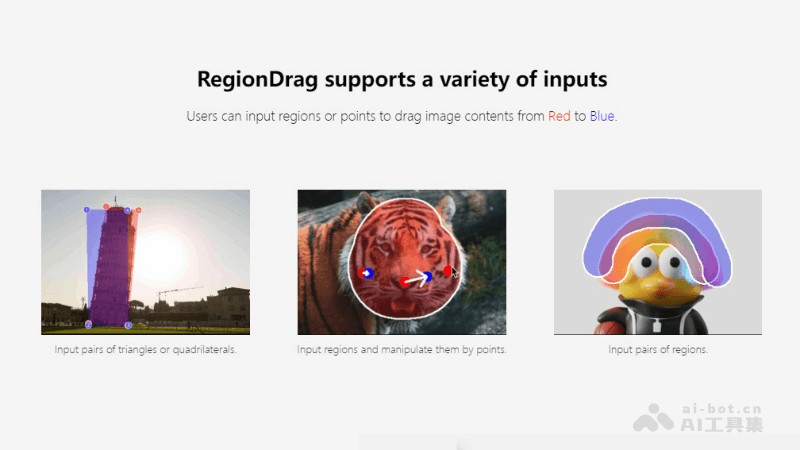
Main Features of RegionDrag
- Region Selection Editing: Select the handle region(handle region)in the image and specify the target region(target region)for editing, which is more intuitive and precise than traditional point-drag editing.
- Fast Editing Processing: Complete the editing task in a single iteration, greatly reducing the time required for editing. Editing high-resolution images can be completed within seconds.
- Attention Swap Technology: RegionDrag adopts attention swap technology to enhance the stability of image editing and ensure the naturalness and coherence of editing results.
- Efficient Model Design: RegionDrag's model design focuses on efficiency and simplicity. It directly copies and pastes regions in the latent representation of the image to achieve editing, reducing the consumption of computational resources.
- New Benchmarks: To evaluate the performance of RegionDrag, the researchers created new benchmarks (DragBench-SR and DragBench-DR), specifically for evaluating region-based editing methods.
Technical Principles of RegionDrag
- Region Selection and Definition:Users specify editing operations by defining handle regions and target regions. The handle region is the part the user wants to edit, and the target region is where the user wants the edited content to appear.
- Diffusion Models:RegionDrag is based on diffusion models, generating images by gradually adding and removing noise. It provides a natural and coherent way to modify image content in image editing.
- Copying and Pasting of Latent Representations:During the editing process, the latent representation of the image is first inverted to an intermediate time point of the diffusion process. Then, the latent representation of the handle region is copied and pasted to the target region, thereby achieving the editing effect.
- Attention Swap Technology:To enhance the stability of editing, RegionDrag adopts attention swap technology. By swapping key information in the self-attention module, it helps maintain the consistency of image features and preserves the naturalness and coherence of the image during the editing process.
RegionDrag Project Address
- Project Website:visual-ai.github.io/regiondrag
- GitHub Repository:https://github.com/Visual-AI/RegionDrag
- arXiv Technical Paper:https://arxiv.org/pdf/2407.18247
Application Scenarios of RegionDrag
- Digital Art and Design: Artists and designers use RegionDrag to quickly adjust the position, shape, or size of image elements, creating works that match their creative vision.
- Photo Editing: In post-processing of photography, RegionDrag quickly corrects defects in photos, such as removing unwanted objects or adjusting poses of people.
- Virtual Reality (VR) and Augmented Reality (AR): In the creation process of VR or AR content, RegionDrag quickly edits and adjusts virtual elements to adapt to different scenes and environments.
- Game development: Game designers use RegionDrag to quickly modify game assets, such as characters, scenes, or props, improving development efficiency.
- Film and video production: In film visual effects (VFX) and video editing, RegionDrag quickly adjusts scene elements, such as removing continuity errors or enhancing specific visual effects.