
What is Reflection AI
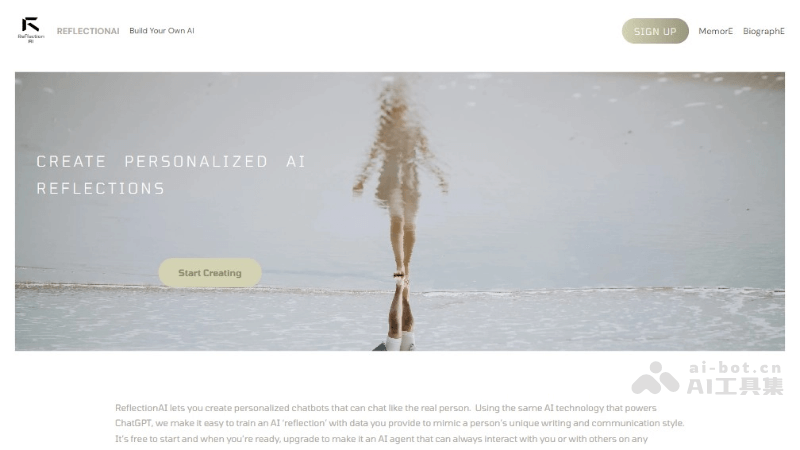
Reflection AI is a zero-code AI Agent development platform that supports users in creating personalized AI chatbots capable of mimicking a real person's communication style. Reflection AI is based on the same advanced technology as ChatGPT, allowing users to provide personal data to train the AI so it can communicate in the user's unique way. The platform is easy to use, requiring no programming or technical expertise, and anyone can create and deploy their own AI Agent within a day. Reflection AI's vision is to democratize AI technology and empower people's daily work and life through personalized AI Agents.
Main Features of Reflection AI
- Personalized AI Agent Creation: Users can create AI Agents that mimic their personal writing and communication style according to their own communication style and needs.
- Rapid Deployment: Users can quickly create and deploy AI Agents to various communication channels without a technical background.
- Learning and Adaptation: AI Agents can learn from users' writing samples, text messages, emails, and conversation records to improve the naturalness and accuracy of their communication.
- Customization and Fine-Tuning: Users can fine-tune the AI's behavior by adding training data and using human feedback to ensure it communicates in the expected way.
- Easy-to-Use Interface: Reflection AI provides an intuitive user interface, making it simple and quick to create and train AI Agents.
- Multi-Channel Integration: AI Agents can be integrated into websites, emails, text messages, and other communication platforms to provide a seamless user experience.
Technical Principles of Reflection AI
- Generative AI: Reflection AI is based on advanced generative AI technology, generating new text, images, or other types of output based on large amounts of data. The technology relies on deep learning models, such as large language models (LLMs), which learn from vast amounts of text data to understand the patterns and structure of language.
- Large Language Models (LLMs): They are the foundation of Reflection AI, trained to understand the complexity of language and capable of generating coherent, relevant text. The models can capture the nuances of language, enabling AI Agents to communicate in a very human-like way.
- Personalized Training: Users can train the AI by uploading their own writing samples, communication records, and other data. The AI can mimic the user's unique language style and communication habits.
- Natural Language Processing (NLP): Reflection AI uses NLP technology to parse user input and generate appropriate responses.
Reflection AI Project Address
- Project Official Website:reflectionai.xyz
How to Use Reflection AI
- Register and Log In:Visit the official Reflection AI website to register an account and log in.
- Create a New AI Agent:On the platform, you will be guided to create a new AI Agent. This involves choosing a name, defining its functions, and personalizing a prompt to set the basic behavior of the AI Agent.
- Upload Training Data:To enable the AI Agent to mimic your communication style, you need to upload some training files, such as your past articles, emails, text message conversation records, etc. The data will help the AI learn your language habits.
- Fine-Tuning and Training:By interacting with the AI Agent, you can begin fine-tuning its performance. If the AI Agent's response does not meet expectations, you can correct it, helping the AI Agent learn and improve future responses.
- Set guardrails:You can define the AI Agent's behavioral boundaries by setting rules and restrictions, ensuring it follows specific guiding principles when communicating with users.
- Deploy the AI Agent:AI AgentOnce its training and fine-tuning reach a satisfactory level, it can be deployed to different channels, such as websites, social media, email, or SMS services.
Application scenarios of Reflection AI
- Customer service: As a virtual customer service representative, AI chatbots can provide 24/7 customer support, answer common questions, handle order inquiries, and more.
- Personal assistant: AI Agents can serve as personal assistants, helping users manage schedules, remind them of important events, and even help handle emails and messages.
- Social media management: On social media platforms, AI Agents can interact with fans, provide information, and manage user-generated content.
- Education and training: In the education field, AI Agents can serve as virtual teachers, provide personalized learning experiences, answer students' questions, and offer tutoring.
- Medical consultation: In the healthcare industry, AI Agents can provide basic health consultation, guide patients in self-diagnosis, or help schedule doctor appointments.