
What is Reflection 70B
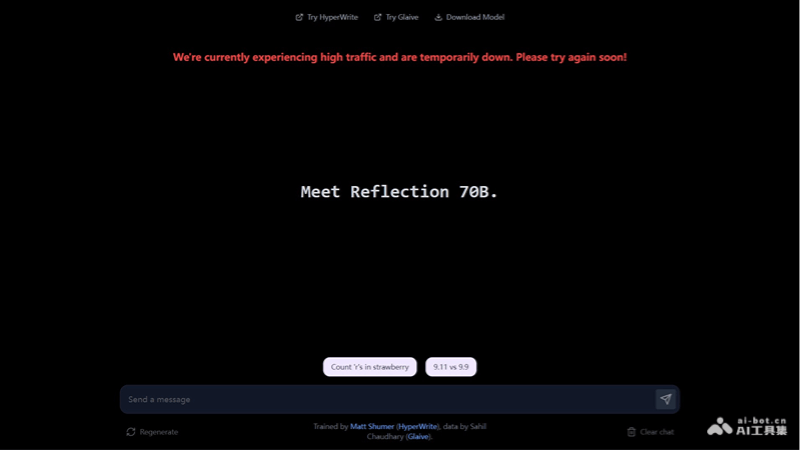
Reflection 70B is an open-source AI large model launched by HyperWrite, surpassing GPT-4o and Llama 3.1 in multiple benchmark tests with outstanding performance. Reflection 70B is built on Meta's Llama 3.1 70B Instruct and adopts "Reflection-Tuning" technology, which can detect and correct its own errors before finalizing a response, significantly improving output accuracy. Reflection 70B is particularly suitable for tasks requiring high-precision reasoning, and its zero-shot reasoning capability is also quite outstanding. Reflection 70B also introduces special tokens for reasoning and error correction, enabling users to interact with the model in a more structured way.
Reflection 70B can be downloaded via Hugging Face, and API access is provided by Hyperbolic Labs. HyperWrite plans to integrate Reflection 70B into its AI writing assistant product and will soon launch the more powerful Reflection 405B model.
Features of Reflection 70B
- Outstanding benchmark performance: In multiple benchmark tests including MMLU (Massive Multitask Language Understanding), MATH, IFEval, and GSM8K, Reflection 70B surpassed models such as GPT-4o and Llama 3.1.
- GSM8K score: In the GSM8K test, Reflection 70B achieved a score of 99.2%, close to a perfect score, indicating extremely high accuracy in understanding and generating natural language.
- Automatic error identification and correction: Using "Reflection-Tuning" technology, the model can detect and correct its own errors before generating the final answer, improving response accuracy.
- High-precision reasoning: Particularly suitable for tasks requiring precise reasoning, improving accuracy by dividing the reasoning process into different steps.
- Zero-shot reasoning capability: Without additional examples, Reflection 70B can effectively reason about content it has never encountered.
- Introduction of special tokens: The model introduces special tokens for reasoning and error correction, supporting users to interact with the model in a more structured way.
- Easy to integrate: The underlying model is compatible with existing tools and pipelines, making it easy for developers and researchers to integrate into various applications.
- Open source and open API: The open-source model is provided through the Hugging Face platform, and API access is provided through GPU service provider Hyperbolic Labs.
Reflection 70B project address
- HuggingFace model library:https://huggingface.co/mattshumer/Reflection-Llama-3.1-70B
- Experience Demo:https://reflection-playground-production.up.railway.app/
Technical principles of Reflection 70B
- Based on Meta's Llama 3.1 70B Instruct: The underlying model architecture of Reflection 70B is built on Meta's open-source large language model Llama 3.1 70B Instruct, which provides it with strong foundational performance.
- Reflection-Tuning technology: A novel training technique that supports large language models (LLMs) in detecting errors in their own reasoning and correcting them before generating the final answer. By introducing special tags into the model's output, the model can identify and correct errors in real time during the reasoning process.
- Use of special Tokens: Reflection 70B introduces several special Tokens for reasoning and error correction. The special Tokens help the model think and output in a more structured way, thereby improving the accuracy and efficiency of interaction.
- Zero-shot reasoning capability: Reflection 70B demonstrates excellent zero-shot reasoning capabilities, effectively reasoning about and answering new questions without additional training samples.
- Applicability to High-Precision Tasks: The model's design particularly emphasizes performance in tasks requiring high-precision reasoning, improving overall accuracy by refining the reasoning steps.
- Compatibility and Integrability: Reflection 70B uses the original Llama chat format, ensuring compatibility with existing tools and pipelines and allowing easy integration into various applications.
Application Scenarios of Reflection 70B
- Natural Language Processing (NLP) Tasks: Including text classification, sentiment analysis, machine translation, text summarization, etc.
- Chatbots and Virtual Assistants: Providing a smooth conversational experience, able to understand and respond to users' questions.
- Content Creation and Editing: Assisting with writing, generating articles, reports, emails, and other content, or proofreading and editing existing text.
- Education and Research: Serving as a teaching tool to help students and researchers understand complex concepts, or to conduct academic research.
- Data Annotation and Information Extraction: Automatically identifying and extracting key information from text for data organization and analysis.
- Programming and Code Generation: Assisting programmers in writing, reviewing, and optimizing code.