
What is RedOne
RedOne is the first customized large language model (LLM) launched by Xiaohongshu for the social networking service (SNS) domain. Through a three-stage training strategy, the model injects social cultural knowledge, strengthens multi-task capabilities, and aligns with platform norms and human preferences. Compared with the base model, RedOne improves average performance by 14.02% on eight social tasks and by 7.56% on bilingual evaluation benchmarks. The model reduces exposure rate by 11.23% in harmful content detection and increases click-through page rate by 14.95% in post-browsing search. RedOne demonstrates outstanding effectiveness in the social domain and provides strong support for SNS applications.
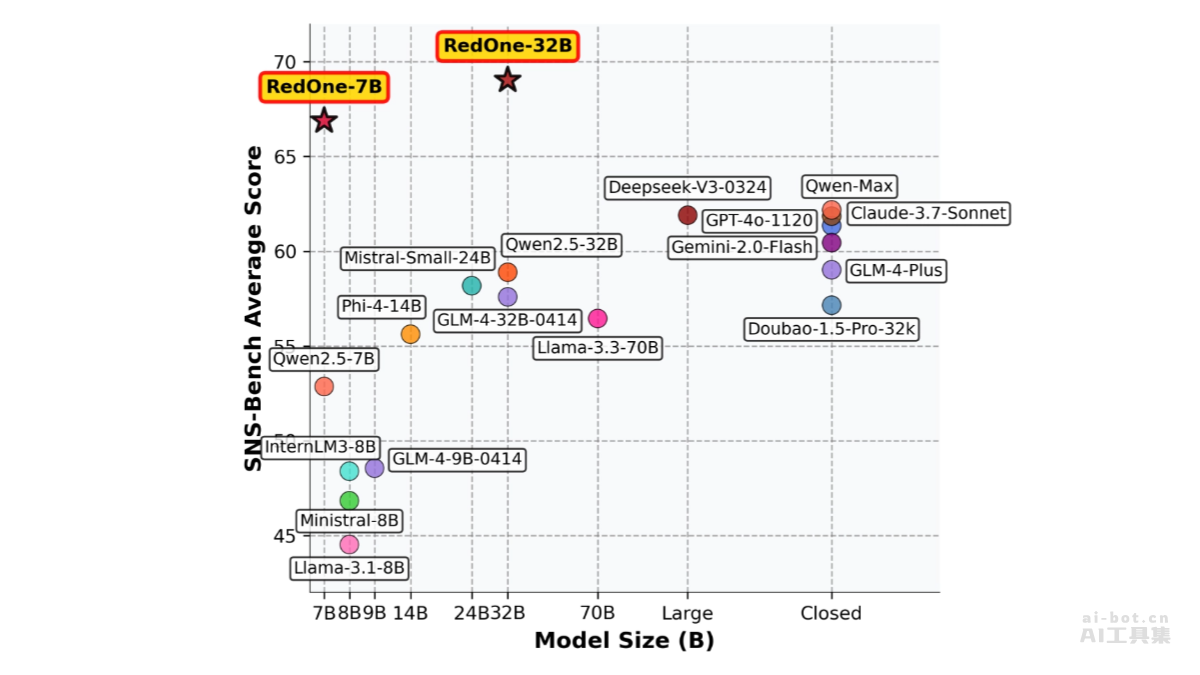
RedOne's main features
- Content understanding: Can classify user-generated content, identify topics, and understand intent.
- Information extraction: Extracts structured information from informal social posts, such as predicting tags, answering questions, and detecting key words.
- Semantic matching: Determines the semantic relationship between user queries and social notes, providing relevance assessment.
- User behavior modeling: Simulates user behavior, such as generating follow-up queries based on browsing history.
- Dialogue and role simulation: Supports emotional companion dialogue and role-playing in group chats.
- Translation: Translates notes in multilingual environments, preserving the original tone and emotion.
- Harmful content detection: Reduces the exposure rate of harmful content and improves platform safety.
- Post-browsing search optimization: Increases user click-through page rate and enhances content discovery.
RedOne's technical principles
- Continue Pretraining (CPT): RedOne's continued pretraining stage injects foundational knowledge of the social domain into the model. Researchers collect large-scale data from general high-quality corpora and social networking platforms, covering various social communication patterns such as informal discussions, short comments, and sarcastic statements. With a carefully designed data filtering process, low-quality data is removed and the data mixture distribution is optimized, and the model continues training on the basis of Qwen2.5.
- Supervised Fine-Tuning (SFT): In the supervised fine-tuning stage, based on carefully designed task definitions and data construction, the gap between pretraining objectives and actual SNS application needs is bridged. Researchers compiled a large amount of real user-generated content, defined six core capabilities, including content understanding, information extraction, semantic matching, etc., and mapped each capability to specific tasks. Based on a two-step training strategy, the first step mixes large-scale general data with SNS data for training, and the second step increases the proportion of SNS data to further optimize the model's performance on key tasks.
- Preference Optimization (PO): The preference optimization stage uses implicit preference signals to make the model's output better conform to human preferences and platform norms. Researchers use different preference pair construction strategies according to different task types (subjective tasks and objective tasks), invite experts to annotate preferences, and expand the dataset. Based on the Direct Preference Optimization (DPO) algorithm, the signals in the preference dataset are used to optimize the model's output so that it is closer to human preferences.
- Data mixing and general capability retention: During the training process, general-domain data and SNS-domain data are mixed to maintain the model's general capabilities while improving its adaptability in the SNS domain, enhancing the model's performance in specific domains, and improving its generalization ability on unseen tasks (Out-of-Domain, OOD).
RedOne's project address
- arXiv technical paper:https://www.arxiv.org/pdf/2507.10605
RedOne's application scenarios
- Harmful content detection: Effectively identify and filter harmful content, such as hate speech, false information, pornographic and violent content, etc. By reducing the exposure rate of harmful content, it significantly improves platform safety and user experience.
- Search optimization after browsing: Based on the user's browsing history and behavior, generate more accurate search suggestions and recommended content, which can improve the user's content discovery ability and enhance interaction between users and the platform.
- Content understanding and classification: Automatically classify and understand user-generated content, helping the platform better manage and recommend content.
- Information extraction: Extract key information from informal social posts, such as tags, key terms, key facts, etc. It is very helpful for content recommendation, information aggregation, and knowledge graph construction.
- Semantic matching: Evaluate the semantic relevance between user queries and social notes, providing more accurate search results and recommended content.