
What is recurve
recurve is an AI-driven DataOps platform that simplifies enterprise data integration, design, and BI performance processes. recurve supports over 300 data connectors, covering databases, files, APIs, etc., enabling seamless data access and processing. recurve provides modular data design, simplifies model creation, and supports a single source of truth for business metrics. Based on AI-driven monitoring and automated processes, it accelerates the analytics development lifecycle, improves data quality and governance standards, and ensures the reliability and smooth operation of data pipelines. recurve is committed to making data management more efficient and empowering enterprises to make data-driven decisions.
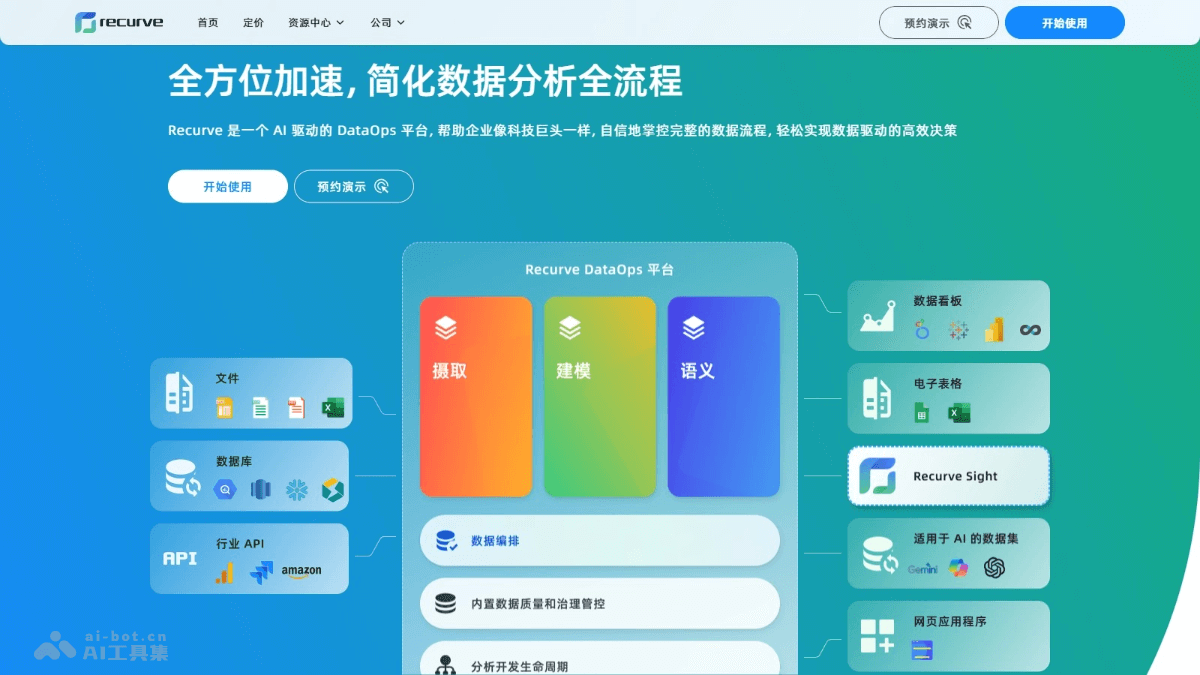
Main features of recurve
- Data connection management: Supports over 300 connectors, covering databases, files, APIs, etc., enabling seamless data access.
- Data flow construction: Simplifies the construction of high-quality data flows from data access to the semantic layer, including data modeling and analysis.
- Modular data design: Simplifies model creation and supports testing and fast risk-free deployment.
- Business metric management: Provides a single source of truth (SSOT) for business metrics, with fast query and caching capabilities.
- ETL process simplification: Simplifies common ETL processes based on built-in Operators, supporting transfers between data sources and custom scheduling.
- Workflow design: Provides an intuitive interface and real-time topology view, facilitating coding and workflow maintenance.
recurve official website address
- Official website address:recurvedata.com
Application scenarios of recurve
- Data integration and cleansing: During data warehouse construction, integrates data from different sources, performs cleansing and preprocessing, and ensures data quality.
- Business analysis and reporting: Enterprises build business metrics and key performance indicators (KPIs), automate report generation, and make data-driven decisions.
- Customer data analysis: Integrates CRM systems and other customer touchpoint data to help enterprises deeply analyze customer behavior, optimize customer experience, and improve customer satisfaction.
- Supply chain optimization: Integrates supply chain data to help enterprises analyze inventory levels, logistics efficiency, and supplier performance, and optimize supply chain management.
- Product analysis: During product development and marketing promotion, integrates product usage data and market feedback to help enterprises optimize products and adjust market strategies.