
What is ReasonGraph
ReasonGraph is an open-source web platform for visualizing and analyzing the reasoning process of large language models (LLMs). ReasonGraph supports over 50 mainstream models (such as Anthropic, OpenAI, Google, etc.) and covers a variety of reasoning methods (including sequential reasoning and tree-based reasoning). With an intuitive user interface, ReasonGraph transforms complex reasoning paths into clear diagrams and updates the reasoning process in real time, helping users quickly understand the thinking logic of AI, detect errors, and optimize model performance. ReasonGraph's modular design supports the rapid integration of new methods and models, and it is widely used in academic research, education, and development.
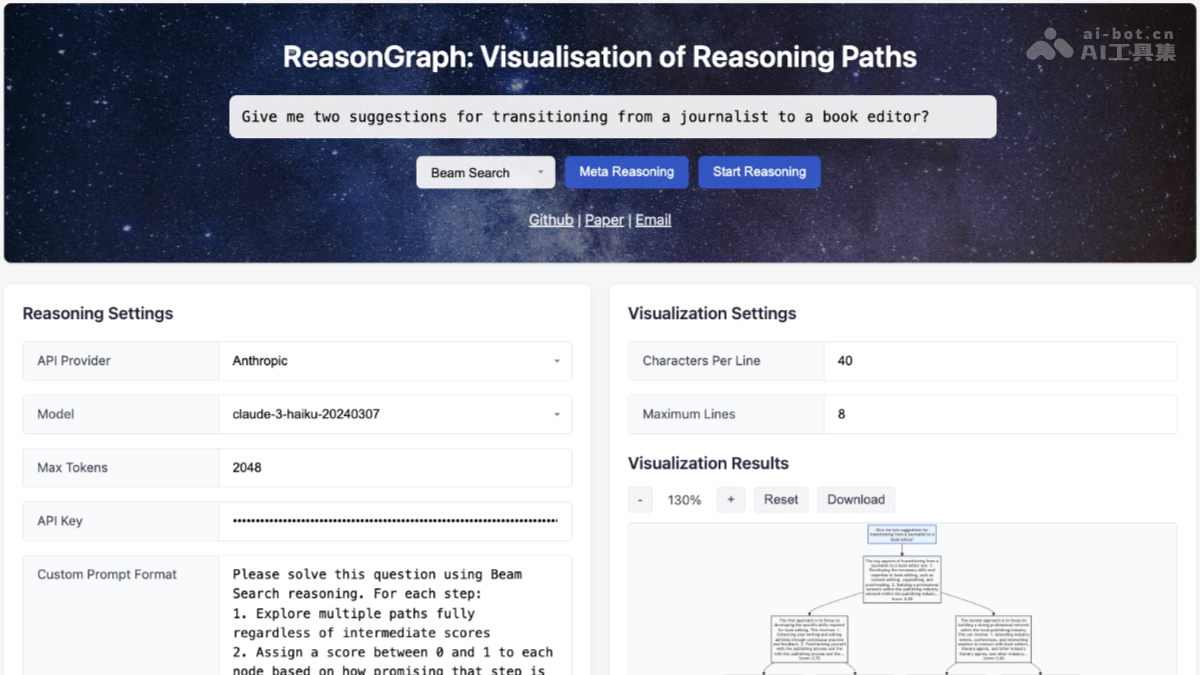
Main features of ReasonGraph
- Reasoning path visualization: Displays the reasoning process of LLMs with intuitive diagrams, supporting tree-based reasoning and sequential reasoning.
- Support for multiple reasoning methods: Covers mainstream reasoning methods including sequential reasoning methods and tree-based reasoning methods.
- Compatibility with multiple LLM models: Supports 50+ mainstream models, such as OpenAI, Google, Anthropic, etc.
- Interactive visualization: Updates the reasoning path diagram in real time, and supports parameter adjustment, zooming, resetting, and export to SVG format.
- User-friendly interface: Provides an intuitive UI design, making it convenient for users to select reasoning methods, configure models, and view results.
Technical principles of ReasonGraph
- Reasoning path parsing: Uses a rule-based XML parsing method to extract reasoning paths from LLM outputs. Parses well-formed reasoning outputs with nearly 100% accuracy. The parsed reasoning paths are converted into structures suitable for visualization, such as tree structures or directed graphs.
- Dynamic visualization technology: The front end uses Mermaid.js for dynamic graphic rendering and supports real-time updates of the visualization of reasoning paths. Users can adjust visualization parameters through the interface, such as node density and layout optimization, to adapt to different reasoning methods and models.
- Modular backend framework: The backend is built on Flask and is divided into three core modules:
- Configuration Manager: Responsible for state updates and configuration management.
- API Factory: Provides a unified API interface and supports multiple LLM providers.
- Reasoning Methods Module: Encapsulates different reasoning methods and provides standardized parsing and visualization interfaces. Implements frontend-backend communication and error handling based on a RESTful API layer.
- Real-time interaction and updates: The front end uses an asynchronous event handling module to respond to user operations, such as reasoning method selection and parameter configuration. The backend calls the corresponding LLM model according to user input and feeds the reasoning results back to the front end in real time for visualization.
- Open source and extensibility: ReasonGraph adopts an open-source model, supporting developers in extending new reasoning methods and models through standardized API interfaces. The modular design allows the platform to flexibly adapt to the capabilities of different LLMs and changes in reasoning methods.
Project address of ReasonGraph
- GitHub repository:https://github.com/ZongqianLi/ReasonGraph
- arXiv technical paper:https://arxiv.org/pdf/2503.03979
- Online experience Demo:https://huggingface.co/spaces/ZongqianLi/ReasonGraph
Application scenarios of ReasonGraph
- Academic research: Helps researchers analyze and compare the effects of different reasoning methods, evaluate model performance on complex tasks, and advance research progress in LLM reasoning capabilities.
- Education field: As a teaching tool, it helps students intuitively understand the logical reasoning process, demonstrates the decision-making mechanism of LLMs, and enhances interest in and efficiency of learning about the principles of AI reasoning.
- Model Debugging and Optimization: Quickly identify errors or inefficient steps in reasoning paths, assist developers in optimizing LLM reasoning performance, and improve model performance.
- Application Development: Support developers in selecting the optimal reasoning method when developing LLM applications, optimize application logic based on visualized reasoning paths, and improve user experience.
- Reasoning Method Research: Provide visualization support for researching new reasoning methods, help researchers explore and improve LLM reasoning strategies, and drive technological innovation.