
What is Realtime TTS-2
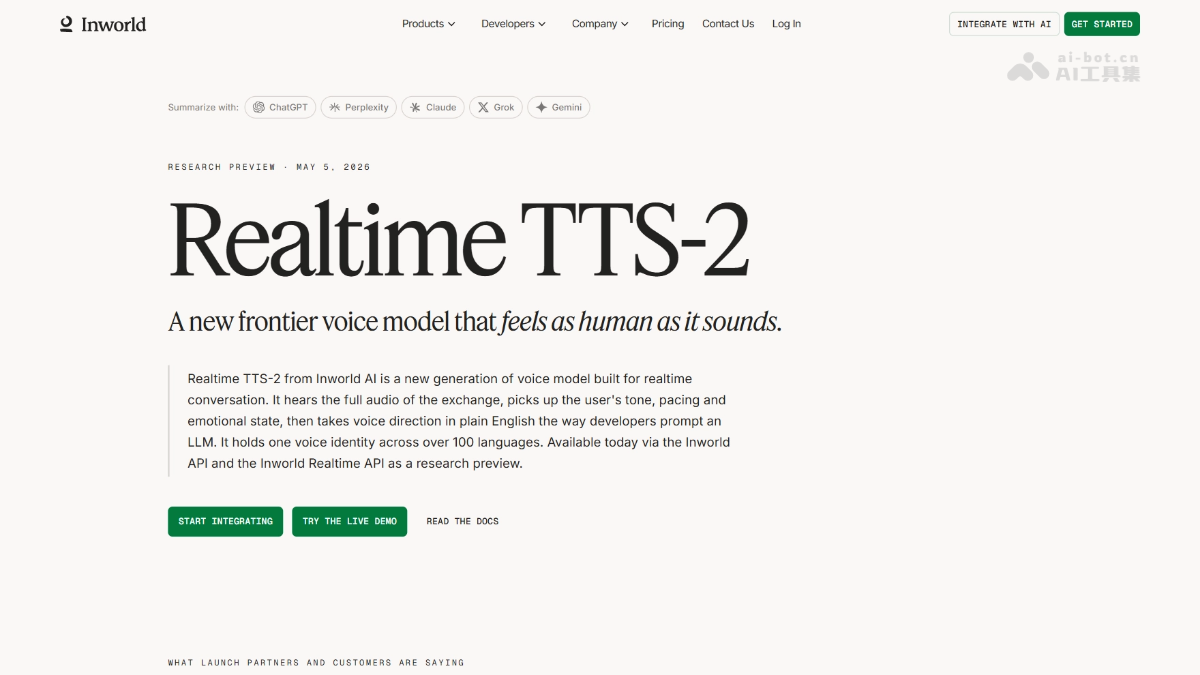
Realtime TTS-2 is a new-generation real-timespeech synthesismodel launched by Inworld AI, designed specifically for conversational AI scenarios. The model can convert text into natural speech, and can even "understand" the audio emotion, intonation, and rhythm of the conversation context, enabling multi-turn perceptive speech synthesis. Realtime TTS-2 supports crosslingual switching across 100+ languages, natural language voice direction control (such as whispering 、sigh ), and designing virtual voices directly from text descriptions, with latency as low as real-time streaming levels.
Main features of Realtime TTS-2
- Voice Direction (voice direction control): Use natural language descriptions (such as "tired but warm, like she just got home") or inline tags (such as laugh 、breathe ) to guide the emotion, speaking rate, and style of the voice in real time, without the need for fixed emotion enumerations.
- Conversational Awareness (conversational awareness): The model receives the actual audio of the previous few turns of dialogue (rather than only text transcripts) as input, and automatically adjusts its response style according to the user's tone—the same sentence will be lighter and livelier after a joke, and lower and more cautious after bad news.
- Crosslingual (crosslingual consistency): A single voice identity can remain consistent across 100+ languages, supporting seamless switching within the same sentence among Chinese, English, Spanish, Japanese, and more, without the need to manage different voice libraries by language.
- Advanced Voice Design (advanced voice design): A custom voice can be generated and saved using a text description (such as "warm low-pitch female with slight rasp, late-30s"), without the need for reference audio.
Technical principles of Realtime TTS-2
- End-to-end unified architecture: Integrates the three stages of "listen-think-express" into a single persistent connection. Unlike traditional TTS, which generates a single sentence in isolation, the model is conditioned during training on the complete audio context of multi-turn conversations, so that timbre, intonation, and emotional state automatically continue along with the flow of the conversation.
- Multi-turn audio awareness mechanism (Conversational Awareness): Receives the actual audio of the previous few turns of dialogue (rather than only text transcripts) as input, and automatically adjusts its response style according to the user's tone and emotion. The same sentence will produce different speech expressions in different conversation contexts.
- Token-level streaming audio generation: Supports SSE (Server-Sent Events) streaming transmission and token-level audio output, enabling low-latency real-time conversation. Optimized for conversational scenarios, it meets the real-time interaction needs of voice assistants, game NPCs, and more.
- Natural language voice direction control (Voice Direction): Guides speech generation through natural language descriptions (such as "tired but warm, like she just got home"), supports inline tags (such as [laugh], [breathe], [sigh]) to regulate emotion, speaking rate, and style in real time, without the need for fixed emotion enumerations.
- Crosslingual consistency technology: A single voice identity can remain consistent across 100+ languages, supporting seamless multilingual switching within the same sentence, without the need to manage different voice libraries by language.
- Advanced voice design: A custom voice can be generated and saved using only a text description, without the need for reference audio, enabling zero-shot voice design. Supports selection of stability modes (Expressive / Balanced / Stable).
How to use Realtime TTS-2
- Call via the Inworld API: After registering an Inworld AI account, specify the model identifier as Realtime TTS-2 in the request, and send text and voice direction instructions via the REST or Realtime API to generate audio.
- Integrate Realtime Sessions: In a Realtime session, the system automatically passes the user's audio history as context; developers only need to maintain the same session connection, without manually concatenating the prior_audio field.
- Voice Cloning and Design: Re-clone the voice with the original reference audio to maintain optimal fidelity; or directly create a new voice via a text prompt and choose a stability mode (Expressive / Balanced / Stable).
Key information and usage requirements for Realtime TTS-2
- Product Name:Inworld Realtime TTS-2
- Publisher:Inworld AI
- Product Positioning: Real-time conversational speech synthesis model
- Supported Languages: 100+ languages, supports intra-sentence cross-language switching
- Latency Performance: Real-time streaming, low latency for the first token
- Access Methods:Inworld API / Inworld Realtime API / Node & Python SDK
- Pricing: Billed according to Inworld's official pricing (see inworld.ai/pricing)
- Compatibility : Supports the OpenAI Realtime protocol; existing OpenAI Realtime clients only need to change the URL to connect
Core advantages of Realtime TTS-2
- Context-Aware Expression: Dynamically adjusts tone based on multi-turn audio context, giving the AI voice true conversational coherence rather than mechanical stitching of single sentences.
- Director-Level Voice Control: Natural language prompts can finely control emotion and style, support inline non-verbal markers (sighs, laughter, breathing sounds), and offer far greater expressiveness than fixed emotion sliders.
- Cross-Language Voice Consistency: The same virtual character maintains a completely consistent voice identity across global multilingual environments, greatly reducing the cost of multilingual content production.
- Low-Latency Real-Time Streaming: Optimized for conversational scenarios, supports SSE streaming, and meets the real-time interaction needs of voice assistants, game NPCs, and more.
- Zero-Shot Voice Design: No need to collect audio from voice actors; text descriptions can generate professional-grade character voices, with extremely low iteration costs.
Project address for Realtime TTS-2
- Project Official Website:https://inworld.ai/blog/realtime-tts-2
Comparison of Realtime TTS-2 with similar competitors
| Comparison Dimension | Inworld Realtime TTS-2 | ElevenLabs | OpenAI GPT-4o Audio |
|---|---|---|---|
| Voice Quality (Artificial Analysis ranking) | #1 | #3 | #5 |
| Natural conversational expression | ✅ | Not specified | ✅ |
| Real-time low latency | ✅ | Not specified | Not specified |
| Multi-turn audio awareness (Conversational Awareness) | ✅ | ❌ | ✅ |
| Natural language voice direction control | ✅ | ❌ | ✅ |
| Voice cloning | ✅ | ✅ | Not specified |
| Generate voice from text descriptions | ✅ | ✅ | ❌ |
| 100+ languages with unified cross-language voice | ✅ | ✅ | ❌ |
| User voice profile awareness | ✅ | ❌ | ❌ |
| Single customized voice API | ✅ | ❌ | ❌ |
| OpenAI Realtime protocol compatibility | ✅ | ❌ | ✅ (Native) |
Application scenarios of Realtime TTS-2
- AI game NPCs: Give game characters voices that can sense the player's emotions and respond in real time, so that NPCs' tone changes naturally with the dialogue context, greatly enhancing immersion and interaction realism.
- Intelligent customer service and voice assistants: Automatically adjust response strategies based on the user's tone, adopting a low, cautious tone when soothing complaints and a light, enthusiastic tone when celebrating success, achieving a truly humanized service experience.
- Multilingual educational practice partner: The same virtual foreign teacher voice can seamlessly switch between Chinese, English, Japanese, and 100+ languages, maintaining learners' familiarity with the voice identity and reducing the cognitive switching cost in multilingual learning.
- Virtual streamers and audio content: Generate differentiated character voices in batches through text prompts, support emotionally rich long-text narration, and quickly produce high-quality audio content without the need for human voice acting.