
What is Realtime API
Realtime API is a low-latency, multimodal conversational API launched by OpenAI that supports text and audio as input and output. Realtime API allows developers to build near-real-time interactive experiences, such as voice-to-voice applications. It includes native voice processing capabilities, natural voice output, and the ability to handle multiple modalities of output simultaneously. The public beta version supports developers using the 6 presets currently supported by the API for voice interaction. Developers connect to the API using WebSocket, sending and receiving JSON-formatted events to enable real-time conversation and interaction. Realtime API is suitable for application scenarios that require fast responses and natural conversation, such as customer service, language learning, gaming, and entertainment.
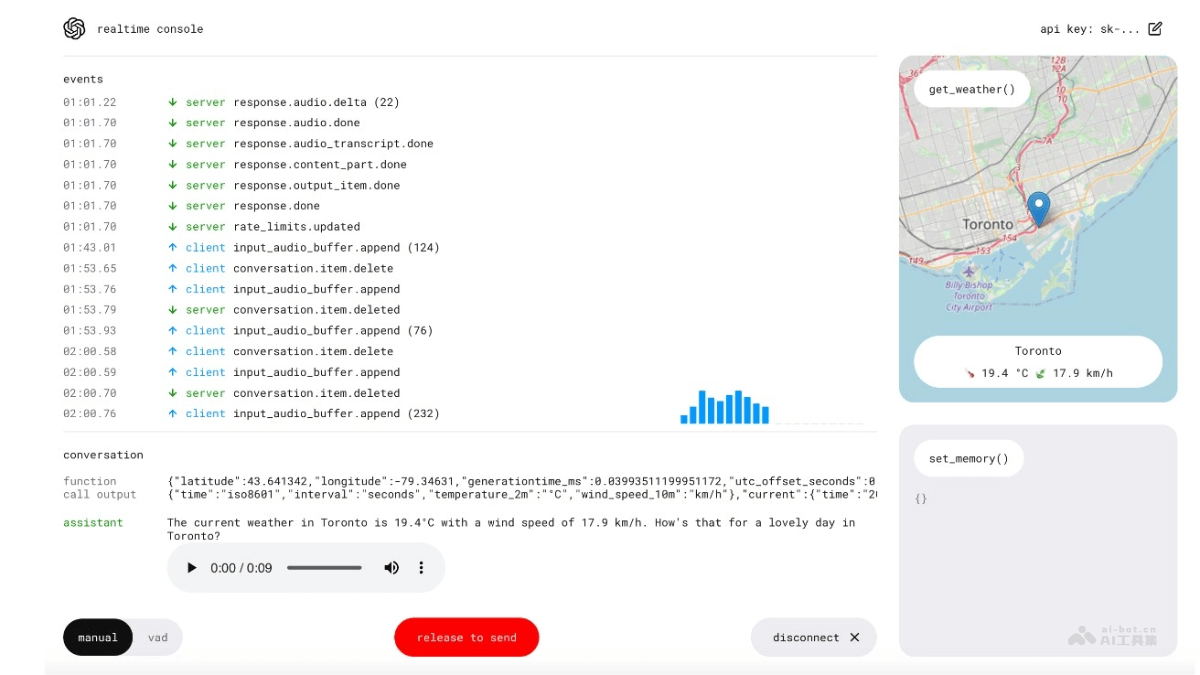
Main features of Realtime API
- Real-time voice processing: Supports real-time voice-to-voice interaction, directly processing voice input and output without text conversion.
- Natural speech synthesis: Provides natural, fluent voice output, including different tones, emotions, and accents.
- Multimodal interaction: Combines text and audio output to provide a richer interactive experience.
- WebSocket connection: Uses the WebSocket protocol to achieve persistent connections and maintain session state.
- Event-driven interaction: An event-based communication mechanism that allows flexible request and response handling.
- Function calling integration: Allows function calling to be integrated into conversations, enabling the AI to perform specific actions or retrieve information.
- Audio format support: Supports multiple audio formats, including raw 16-bit PCM and G.711 encoding.
Technical principles of Realtime API
- WebSocket communication: Uses the WebSocket protocol to establish a persistent connection, allowing real-time bidirectional data streaming. This enables the API to respond to input and send output instantly.
- State management: Realtime API is stateful and maintains interaction state during a session. This includes user input, system instructions, session configuration, and more.
- Event-driven architecture: The API is based on an event-driven architecture, where the client and server interact by sending and receiving events. Events can be text messages, audio data, function call requests, and more.
- Voice activity detection (VAD): In server VAD mode, the server runs a voice activity detection algorithm to determine when to start and end voice input. This helps reduce unnecessary processing and latency.
- Audio processing: Supports buffering, committing, and transcription of audio input. The client sends audio data to the server, and the server converts the data into text or directly generates a voice response.
Project address of Realtime API
- Project official website:platform.openai.com/docs/guides/realtime
- GitHub repository:
Application scenarios of Realtime API
- Virtual assistant: Provides a virtual assistant with real-time voice interaction to help users perform tasks such as setting reminders and searching for information.
- Customer service: Used in call centers to provide a more natural voice interaction experience, automatically answering customer questions or guiding them through transactions.
- Language learning: Used in language learning applications to provide real-time voice feedback and help learners practice pronunciation and listening.
- Real-time translation: Provides real-time voice translation services for multilingual conferences or individuals.
- Smart Home Control: Integrated into smart home devices, allowing users to control various smart devices in the home through voice.
- Games: Provides natural non-player character (NPC) dialogue in games, enhancing immersion.
- Assistive Technology: Provides voice-controlled assistive technology for people with visual or mobility impairments.