
What is ReactAI
ReactAI is an open-source AI tool used to quickly create React components. Based on AI technology, it allows users to generate various components without writing code, such as contact forms, newsletter subscription forms, and more. ReactAI provides a free and unlimited experience, and can be used without an API key. Users can choose different Claude AI models to customize the style and functionality of components. ReactAI's goal is to simplify the front-end development process, enabling developers and designers to efficiently build and iterate React applications.
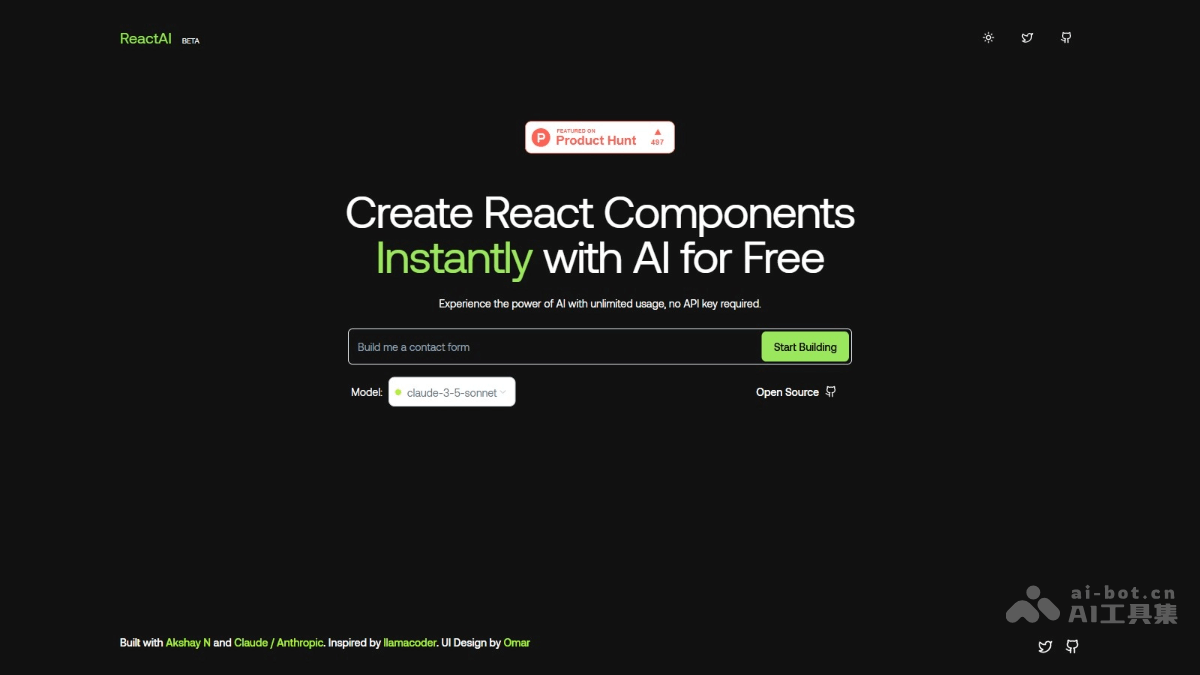
Main features of ReactAI
- Quickly generate React components: Users can quickly create various common React components based on AI technology, such as forms, buttons, lists, etc., without manually writing code.
- No programming knowledge required: Users without a programming background can also easily generate the components they need, lowering the development threshold.
- Free and unlimited use: ReactAI provides free usage permissions, and users can generate components an unlimited number of times.
- No API key required: No API key needs to be configured or entered, simplifying the usage process and allowing users to start creating components directly.
- Multiple AI model options: Users can choose different AI models to customize the style and functionality of components, meeting different design needs and application scenarios.
ReactAI official website address
- Official website address:reactai.vasarai.net
- GitHub repository:https://github.com/akshaynstack/reactai
Application scenarios of ReactAI
- Rapid prototyping: When designing new products or features, developers and designers can quickly generate component prototypes, accelerating the design iteration and decision-making process.
- Beginners and non-technical users: Non-technical users, such as marketers, can quickly create simple applications.
- Education and training
- Teaching aids: In online courses on React or front-end development, teachers can use them as teaching cases to show students the implementation methods and code structures of different components, helping students better understand the concepts and techniques of component development and improving learning outcomes.
- Front-end development teams: When developing large projects, team members can quickly generate some common components, allowing the team to focus on developing the project's unique features and complex logic, improving overall development efficiency.
- Small businesses and startups: For small businesses and startups with limited budgets, it helps them quickly build product user interfaces at a lower cost.