
What is RAIN
RAIN (Real-time Animation Of Infinite Video Stream) is an innovative real-time animation solution that, based on consumer-grade hardware such as a single RTX 4090 GPU, achieves real-time animation of infinite video streams. The core lies in efficiently computing frame token attention across different noise levels and long time intervals, while denoising a large number of frame tokens, to generate video frames with extremely low latency and maintain the long-term continuity and consistency of the video stream. By introducing a small number of additional one-dimensional attention blocks, RAIN fine-tunes the Stable Diffusion model, and after a few rounds of training, it can generate high-quality, consistent, infinitely long video streams in real time with low latency. It is of great significance in the field of real-time animation, providing strong technical support for application scenarios such as online interaction and virtual character generation.
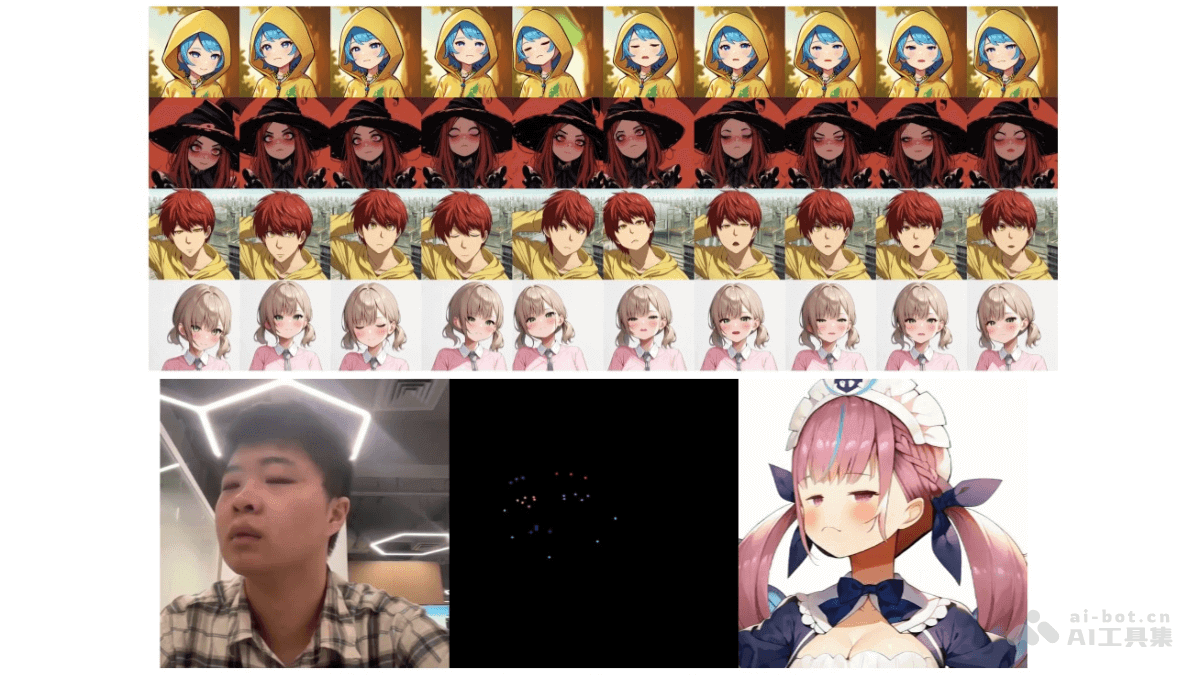
RAIN's Main Features
- Real-Time Animation Generation: It can generate animations in real time with low latency on consumer-grade GPUs such as a single RTX 4090, breaking through the limitations of traditional methods in generation speed and latency, enabling animation content to be presented instantly, and is suitable for scenarios requiring real-time interaction, such as live streaming and online meetings.
- Infinite Video Stream Processing: It breaks the limitation of video length and can continuously generate infinitely long video streams, meeting the needs of long-duration live streaming or continuous animation display, and making it possible to create a continuous, smooth visual experience.
- High Quality and Consistency Guarantee: By efficiently computing frame token attention across different noise levels and long time intervals while denoising a large number of frame tokens, it ensures that the generated video maintains high standards in visual quality while maintaining long-term continuity and consistency, avoiding abrupt changes in the picture and quality degradation.
- Model Fine-Tuning and Adaptation: The Stable Diffusion model is fine-tuned in a targeted manner to quickly adapt to the real-time animation generation task. Only a small number of training cycles are needed to achieve the desired generation effect, reducing model training costs and time investment.
RAIN's Technical Principles
- Frame Token Attention Mechanism: The core of RAIN lies in efficiently computing frame token attention across different noise levels and long time intervals. By expanding the size of StreamBatch, RAIN assigns every p consecutive frame tokens to denoising groups with the same noise level, and gradually increases the noise level of these groups. This fully utilizes the computing potential of the hardware, allowing the model to compute attention over longer frame token sequences, significantly improving the consistency and continuity of the generated video stream.
- Optimization of the Denoising Process: RAIN introduces an innovative method into the denoising process. When RAIN combines long-term attention between different denoising groups, attention computation across noise levels can effectively improve continuity and visual quality. This synergy of long-term attention and cross-noise-level attention significantly enhances the smoothness and visual effect of the animation.
- Application of Consistency Models: RAIN is based on the Consistency Model to accelerate the sampling process of diffusion models. The Consistency Model satisfies specific mathematical conditions, enabling the model to generate samples in one step. Through the consistency distillation loss function, RAIN trains a model capable of fast sampling, achieving multi-step sampling and improving sampling efficiency.
- Stream Diffusion Technology: RAIN draws on Stream Diffusion technology, pushing frames with different noise levels into a batch, fully utilizing the GPU's batch computation capability.
- Reference Mechanism: To maintain character consistency, RAIN adopts a reference mechanism. By using a pretrained 2D UNet as ReferenceNet, it performs inference on reference images and caches the input hidden states before the spatial attention operation.
- Two-Stage Training Strategy: RAIN's training adopts a two-stage strategy. In the first stage, the model is trained on image pairs from the same video, training the reference network, the pose guider, and the denoising UNet simultaneously. In the second stage, the model adds noise to video frames and fine-tunes the motion module according to specific timesteps to adapt to temporal changes. This training strategy enables the model to accept streaming video input and process infinitely long videos.
RAIN Project Address
- Project Website:https://pscgylotti.github.io/pages/RAIN
- Github Repository:https://github.com/Pscgylotti/RAIN
- arXiv Technical Paper:https://arxiv.org/pdf/2412.19489
RAIN Application Scenarios
- Virtual Character Interaction: In gaming and virtual reality (VR)/augmented reality (AR) applications, RAIN can generate animations of virtual characters in real time, and the characters can respond in real time to the player's movements and expressions, enhancing immersion and interactivity.
- Animation Production: For animation production companies, RAIN can serve as an auxiliary tool to quickly generate animation drafts or previews, improving production efficiency.
- Virtual Streamer: On live streaming platforms, RAIN can generate real-time animations of virtual streamers, and the virtual streamers can react in real time to the streamer's voice and expressions, providing richer and more diverse live streaming content.
- Online Education: In online education platforms, RAIN can generate animations of virtual teachers, making the teaching content more vivid and visual.