
What is RabbitVis
RabbitVis is a layer-level one-stop AI design production toollaunched by RabbitPre Intelligence. Based on the self-developed UniWorld-Design visual large model, it deeply integrates AI generation capabilities with layer editing capabilities. The tool can generate complex design content such as posters, e-commerce detail pages, and magazine inner pages through natural language, and supports continuous layer-level editing after generation, including background removal, text modification, element replacement, transparent material extraction, etc., solving the pain point that traditional AI image generation can only generate but cannot modify, allowing AI to truly complete the entire design workflow.
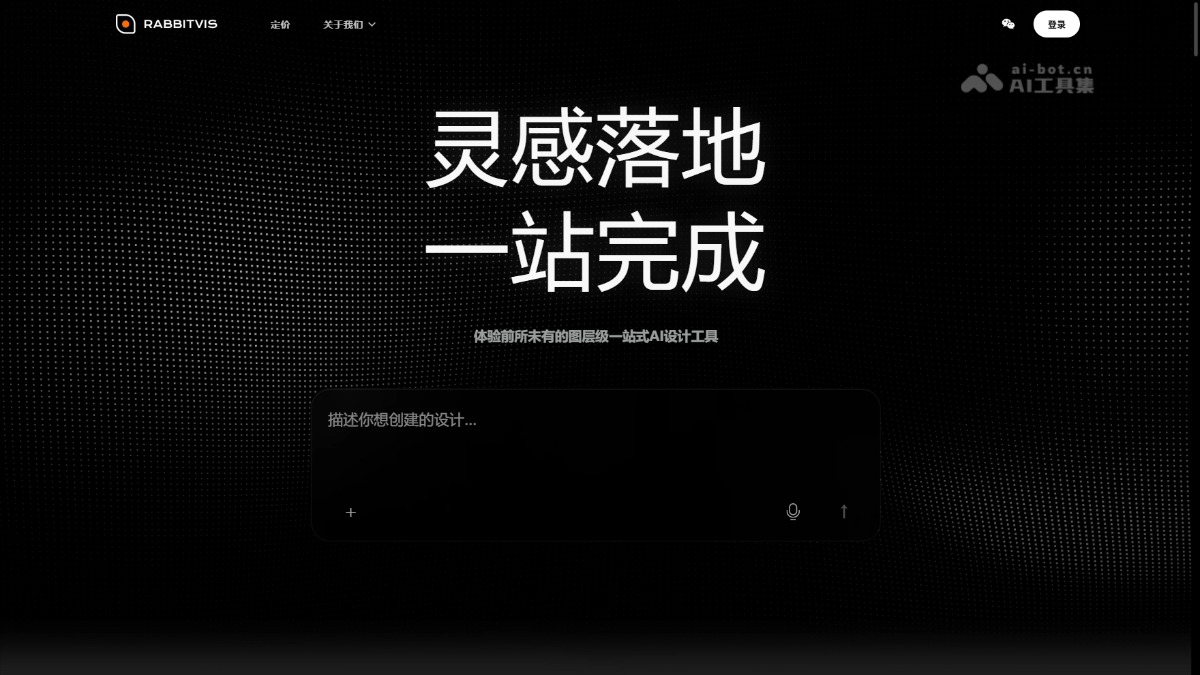
Main features of RabbitVis
- Intelligent generation: Supports generating various professional design content with a single sentence, such as posters, magazine spreads, e-commerce detail pages, long infographics, academic posters, financial analysis reports, and more.
- Transparent material generation: Directly generates design elements with an alpha channel (RGBA) based on text descriptions, which can be directly dragged and reused in other design scenarios.
- Image layer decomposition: Automatically decomposes the generated complete image into multiple independent editable layers such as background, subject, text, and decorations, providing a foundation for subsequent adjustments.
- Natural language editing: Supports completing operations such as background removal, image editing, text editing, and eraser with natural language instructions, without the need to master professional software such as Photoshop.
- High-density Chinese typography: Deeply optimized for Chinese scenarios, supporting high-density Chinese typography such as complex artistic fonts, interwoven text and images, and infographics, with clear and accurate results.
How to use RabbitVis
- Visit the official website: Visit the RabbitVis official website https://rabbitvis.rabbitpre.com/ to enter the RabbitVis platform.
- Describe requirements: In the input box, describe the design content you want to create in natural language, such as "generate a 618 promotion poster" or "design a magazine inner page."
- AI generates a first draft: The system automatically generates a design first draft containing complete layout, images, and text, and supports selecting different style templates.
- Layer-level editing: Continuously adjust the design through natural language instructions, such as "move the LOGO to the left," "enlarge the title font size," "replace the background image," etc.
- Export and deliver: Export the completed design as deliverable assets, and transparent materials can be downloaded separately for reuse.
Core advantages of RabbitVis
- Deep layer-level editing: Breaks through the limitation of traditional AI image generation where generation is the endpoint, supporting decomposition of design content into independent layers and enabling continuous modification, element replacement, and text adjustment after generation.
- Direct transparent material output: Directly generates design elements with an alpha channel (RGBA) based on text descriptions, which can be directly reused in multi-scenario designs without manual cutout.
- Native optimization for Chinese scenarios: Deeply refined for high-density Chinese typography, supporting complex artistic fonts, interwoven text and images, and infographics, solving the pain points of garbled Chinese text and disordered typography in mainstream AI tools.
- Natural language-driven design: The entire process of generation, background removal, text changes, layout adjustment, and other operations is completed through natural language instructions, allowing users with zero design background to produce professional-grade visual materials.
- Integrated production and model architecture: Built on the self-developed UniWorld-Design visual large model, the model capabilities are deeply coupled with product functions, integrating generation, understanding, and editing into one, becoming increasingly precise with use.
Comparison of RabbitVis with similar competitors
| Comparison dimension | RabbitVis | Recraft |
|---|---|---|
| Product positioning | A layer-level one-stop AI design production tool, focusing on deep post-generation editing and layer decomposition | An AI-native design tool, focusing on vector graphic generation and brand style consistency control |
| Layer capabilities | Native support for automatic image layer decomposition, with elements such as background, subject, and text independently editable and adjustable | Supports basic layer management, but mainly for vector objects, with limited bitmap layering capabilities |
| Transparent assets | Can directly generate design elements with an alpha channel (RGBA), with high semantic matching | Supports background removal to generate transparent assets, but not native alpha channel generation |
| Chinese typography | Deeply optimized for Chinese scenarios, supporting complex artistic fonts and high-density text-image layout | Chinese support is relatively basic, with average performance for complex Chinese fonts and vertical writing scenarios |
| Editing method | Natural language-driven layer-level editing, enabling professional-level modifications with zero design background | Leans toward traditional design software interaction, requiring some experience with design tools |
| Model architecture | Based on the self-developed UniWorld-Design visual large model, integrating product and model, with unified generation, understanding, and editing | Based on the self-developed Recraft model, focusing on vector generation and style transfer |
| Applicable scenarios | Design production workflows requiring repeated modifications, such as e-commerce posters, magazine inner pages, and social media graphics | Creation of design assets with consistent style, such as brand VI, icon libraries, and marketing illustrations |
Application scenarios of RabbitVis
- E-commerce marketing: Quickly generate product detail pages, promotional posters, and main image designs, and support adjusting dimensions and copy at any time according to platform requirements.
- Social media operations: Generate images, covers, and long infographics for platforms such as WeChat Official Accounts, Xiaohongshu, and Douyin, allowing operations staff to complete daily materials without relying on designers.
- Brand promotion: Produce professional visual materials such as brand brochures, magazine inner pages, and event posters, supporting continuous iterative optimization of brand visual consistency.
- Content creation: Self-media bloggers and UP creators can use natural language to quickly generate content assets such as video covers, column header images, and knowledge graph infographics.
- Enterprise office: Efficient production of business visual content such as financial analysis reports, PPT illustrations, and internal training materials.