
What is R1-Onevision
R1-Onevision is an open-source multimodal large language model focused on complex visual reasoning tasks. It is fine-tuned based on Qwen2.5-VL and, by integrating visual and textual data, can accurately interpret multimodal information. It performs excellently in fields such as mathematics, science, deep image understanding, and logical reasoning, surpassing models such as Qwen2.5-VL-7B and GPT-4V in multiple reasoning benchmarks. It can process both image and text inputs simultaneously, achieving efficient information extraction and association through advanced embedding techniques. The training dataset covers multiple domains, including natural scenes, science, mathematics problems, OCR content, and complex charts, further enhancing the model's reasoning ability.
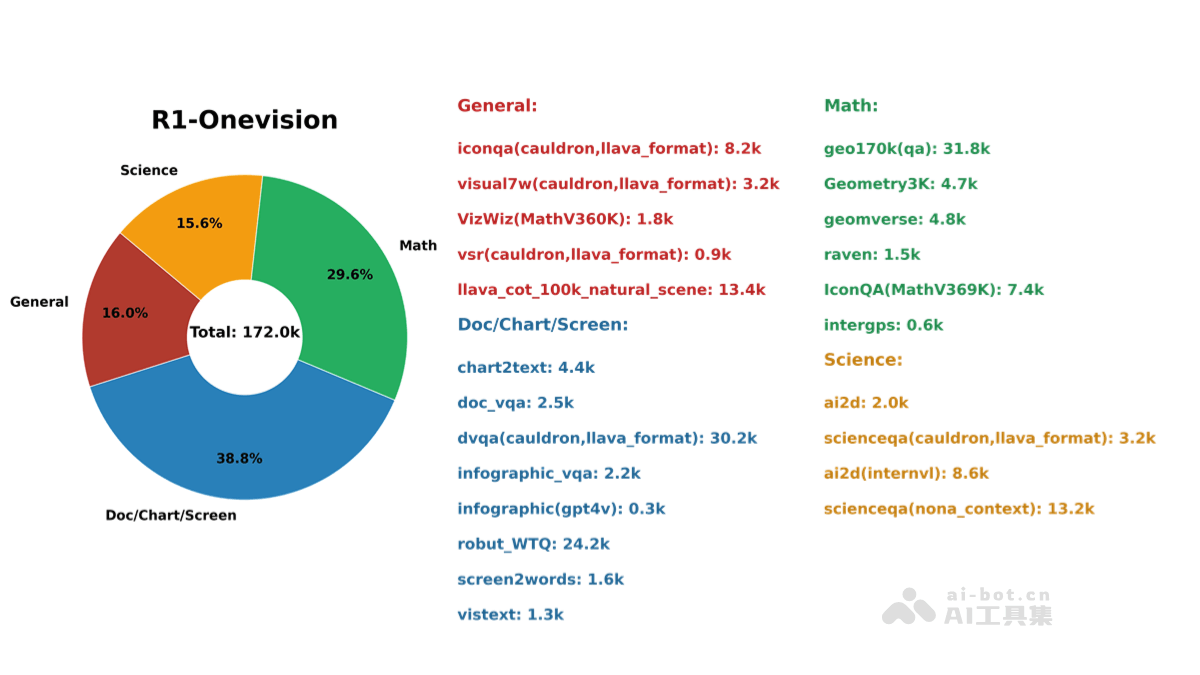
Main Features of R1-Onevision
- Multimodal Fusion and Reasoning: R1-Onevision can process both image and text inputs simultaneously, achieving efficient integration of visual and linguistic information through advanced embedding techniques, and performs excellently in fields such as mathematics, science, deep image understanding, and logical reasoning.
- Complex Reasoning Ability: Through formal language and rule-based reinforcement learning, the model has deep reasoning ability and can provide accurate answers in highly difficult reasoning tasks.
- Diverse Application Scenarios: R1-Onevision can be widely used in scientific research, educational tools, image understanding, and industrial fields. It can help scientists analyze complex datasets, provide students with precise guidance, or be used in scenarios such as medical image analysis and autonomous driving.
- Benchmark Testing and Dataset Support: The R1-Onevision team developed the R1-Onevision-Bench benchmark, covering logical reasoning, mathematics, physics, and chemistry problems, to evaluate the model's reasoning ability in different domains.
- Self-Supervised Learning and Optimization: R1-Onevision conducts reinforcement learning self-exploration through Group Relative Policy Optimization (GRPO), reducing dependence on large amounts of labeled data and improving learning speed and generalization ability.
Technical Principles of R1-Onevision
- Formal Language-Driven Reasoning: The model introduces Formal Language to express image content, making the reasoning process more precise and interpretable. It improves the accuracy of reasoning and makes the model's reasoning process more transparent, easier to understand, and easier to verify.
- Rule-Based Reinforcement Learning: During training, R1-Onevision adopts Rule-Based Reinforcement Learning (RL), ensuring that the model follows the principles of logical derivation in the reasoning process through clear logical constraints and structured outputs.
- Carefully Designed Dataset: R1-Onevision's dataset captures detailed image information through dense annotation techniques, and combines it with the reasoning ability of language models to generate more logical textual descriptions.
- Reinforcement Learning Optimization: R1-Onevision draws on DeepSeek's GRPO (Generative Reward Processing Optimization) reinforcement learning technology and, through self-supervised learning and optimization, reduces dependence on large amounts of labeled data.
- Model Architecture and Training: R1-Onevision is fine-tuned based on Qwen2.5-VL and adopts the Full Model SFT method. During training, 512-resolution image inputs were used to save GPU memory. The model further improves training efficiency through techniques such as optimizing the learning rate and gradient accumulation.
R1-Onevision Project Address
- Github Repository:https://github.com/Fancy-MLLM/R1-onevision
- HuggingFace Model Hub:https://huggingface.co/Fancy-MLLM/R1-Onevision-7B
Application scenarios of R1-Onevision
- Scientific research and data analysis: R1-Onevision performs excellently in complex reasoning tasks in fields such as mathematics, physics, and chemistry, and can help scientists analyze complex datasets and solve highly difficult logic problems.
- Educational tools: The model can serve as an educational assistance tool, providing students with accurate answers and guidance. It can analyze complex scientific problems or mathematics questions and help students understand through a clear logical reasoning process.
- Image understanding and analysis: R1-Onevision can perform in-depth analysis of natural scenes, complex charts, and images. It can identify potentially dangerous objects in street-view photos and provide navigation support for visually impaired people.
- Medical imaging analysis: In the medical field, R1-Onevision can be used to analyze medical images and assist doctors in diagnosis. Its multimodal reasoning capability can combine image and text information to provide more accurate analysis results.
- Autonomous driving and intelligent transportation: The model can be applied to autonomous driving scenarios, helping vehicles better understand complex traffic environments, identify potential dangers, and make reasonable decisions.