
What is Qwen3-LiveTranslate
Qwen3-LiveTranslate is a multilingual real-time audio-video simultaneous interpretation model based on a large language model, launched by the Alibaba Tongyi team. The model supports 18 languages and multiple dialects fortranslation, and features visual enhancement technology that can combine multimodal information such as lip movements and gestures to improve translation accuracy. The model's low latency (as low as 3 seconds) and lossless simultaneous interpretation technology ensure translation quality close to offline translation, and it is equipped with natural-sounding voices. The model performs excellently in complex acoustic environments, bridging language gaps and making communication smoother and more natural.
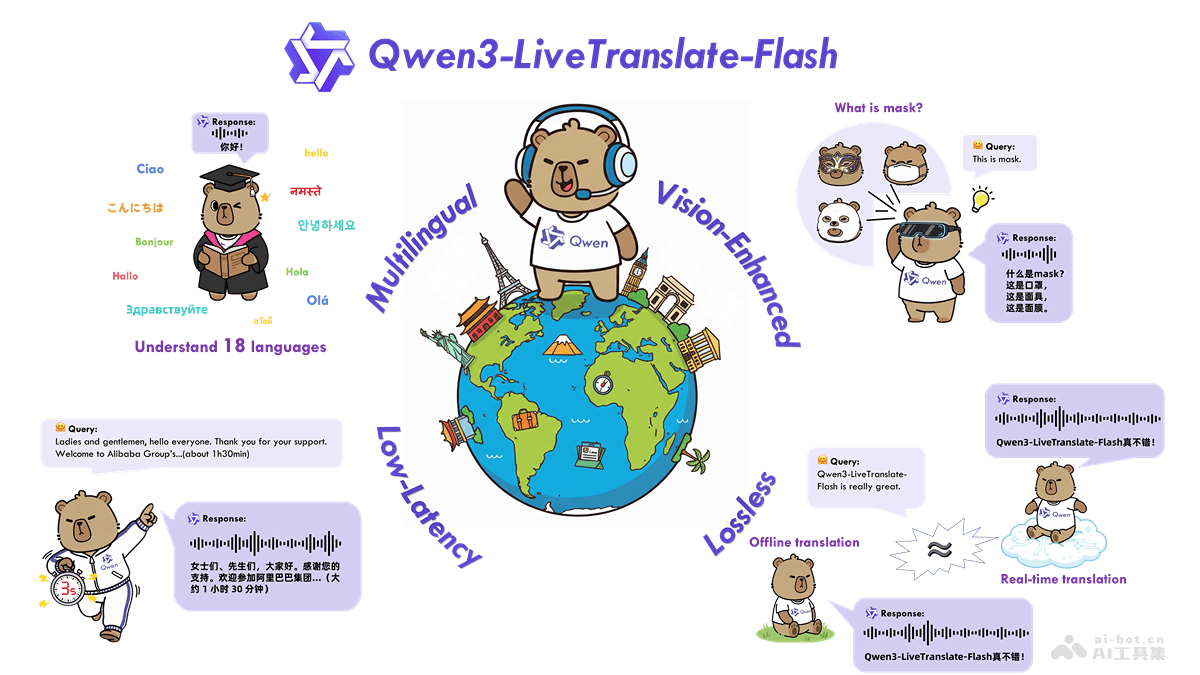
Main Features of Qwen3-LiveTranslate
-
Multilingual Real-Time Translation: Supports offline and real-time audio-video translation for 18 languages (such as Chinese, English, French, German, Japanese, Korean, etc.) and multiple dialects (such as Mandarin, Cantonese, Sichuanese, etc.).
-
Visual-Enhanced Translation: Combines visual context (such as lip movements, gestures, text, etc.) to improve translation accuracy in noisy environments and scenarios with polysemy.
-
Low-Latency Simultaneous Interpretation: Based on a lightweight mixture-of-experts architecture and dynamic sampling strategy, it achieves a simultaneous interpretation experience with latency as low as 3 seconds.
-
Lossless Translation Quality: Through semantic unit prediction technology, it alleviates cross-language word order issues, with translation quality close to offline translation.
-
Natural Voice Output: Adaptively adjusts tone and expressiveness based on the original speech content to generate anthropomorphic voices.
Technical Principles of Qwen3-LiveTranslate
-
Multimodal Data Fusion: Combines multimodal data such as speech and vision to enhance the model's ability to understand context.
-
Semantic Unit Prediction: By analyzing the semantic structure of language, it predicts word order issues in cross-language translation, ensuring translation accuracy and fluency.
-
Lightweight Mixture-of-Experts Architecture: Based on a lightweight mixture-of-experts system combined with a dynamic sampling strategy, it optimizes computational resource allocation and reduces latency.
-
Training on Massive Audio-Video Data: Trained on massive multilingual audio-video data to improve the model's adaptability to different languages and dialects.
-
Visual Enhancement Technology: Uses computer vision technology to recognize visual information such as lip movements and gestures, assisting speech translation and improving translation accuracy and robustness.
Project Address of Qwen3-LiveTranslate
- Project Official Website:https://qwen.ai/blog?id=b2de6ae8555599bf3b87eec55a285cdf496b78e4
- Online Experience Demo:https://huggingface.co/spaces/Qwen/Qwen3-Livetranslate-Demo
Application Scenarios of Qwen3-LiveTranslate
- International Conferences: Provides real-time multilingual translation for international conferences, ensuring that participants from different language backgrounds can instantly understand the conference content and improving communication efficiency.
- Distance Education: In distance education scenarios, it translates teachers' explanations into students' native languages in real time, breaking down language barriers so that students worldwide can learn without obstacles.
- Cross-Border Business Communication: Through low-latency real-time translation, it helps multinational enterprises conduct business negotiations, conference calls, etc., ensuring smooth communication and avoiding misunderstandings caused by language issues.
- Travel: Tourists in foreign countries can communicate with locals without obstacles through voice translation, easily solving language difficulties.
- Media Live Streaming: In live broadcast scenarios such as international news and sports events, translate the host's speech into multiple languages in real time, allowing global audiences to watch simultaneously and enhancing the media's international influence.