
What is Qwen2-VL
Qwen2-VL is an open-source visual multimodal AI model from Alibaba DAMO Academy, featuring advanced image and video understanding capabilities. Qwen2-VL supports multiple languages and can process images of different resolutions and aspect ratios, analyzing dynamic video content in real time. Qwen2-VL excels in tasks such as multilingual text understanding and document understanding, making it suitable for multimodal application development and advancing AI in the fields of visual understanding and content generation.
Main Features of Qwen2-VL
- Image Understanding: Significantly improves the model's ability to understand and interpret visual information, setting new performance benchmarks for image recognition and analysis.
- Video Understanding: Features excellent online streaming capabilities, enabling real-time analysis of dynamic video content and understanding of video information.
- Multilingual Support: Expands language capabilities to support Chinese, English, Japanese, Korean, and other languages, serving global users.
- Visual Agent: Integrates complex system integration capabilities, enabling the model to perform complex reasoning and decision-making.
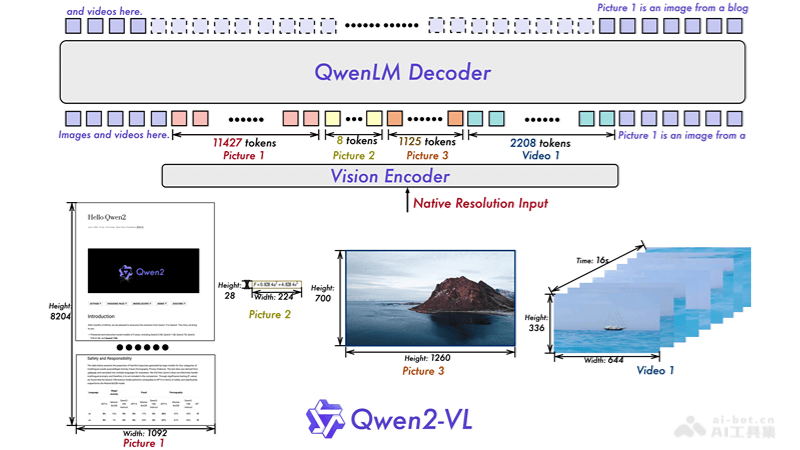
- Dynamic Resolution Support: Can process images of arbitrary resolution without splitting them into blocks, more closely resembling human visual perception.
- Multimodal Rotary Position Embedding (M-ROPE): An innovative embedding technique that enables the model to simultaneously capture and integrate text, visual, and video positional information.
- Model Fine-Tuning: Provides a fine-tuning framework that supports developers in adjusting model performance according to specific needs.
- Inference Capabilities: Supports model inference, enabling users to develop custom applications based on the model.
- Open Source and API Support: The model is open source and provides API interfaces for easy integration and use by developers.
Technical Principles of Qwen2-VL
- Multimodal Learning Capability: Qwen2-VL is designed to simultaneously process and understand multiple types of data such as text, images, and video, requiring the model to establish connections and understanding between different modalities.
- Native Dynamic Resolution Support: Qwen2-VL can process image inputs of arbitrary resolution. Images of different sizes can be converted into a dynamic number of tokens, simulating the natural way of human visual perception and enabling the model to process images of any size.
- Multimodal Rotary Position Embedding (M-ROPE): An innovative positional encoding technique that decomposes traditional rotary position embedding into three components representing time, height, and width, enabling the model to simultaneously capture and integrate positional information from 1D text sequences, 2D visual images, and 3D video.
- Transformer Architecture: Qwen2-VL adopts the Transformer architecture, a model architecture widely used in the field of natural language processing, particularly suitable for processing sequence data and capable of capturing long-range dependencies through the self-attention mechanism.
- Attention Mechanism: The model uses the self-attention mechanism to strengthen associations between different modalities of data, enabling the model to better understand the contextual information of input data.
- Pre-training and Fine-Tuning: Qwen2-VL learns general feature representations through pre-training on large amounts of data, and then adapts to specific application scenarios or tasks through fine-tuning.
- Quantization Technology: To improve the model's deployment efficiency, Qwen2-VL adopts quantization techniques, converting the model's weights and activations from floating-point numbers to lower-precision representations, to reduce the model size and improve inference speed.
Qwen2-VL performance metrics
- Model scale performance comparison:
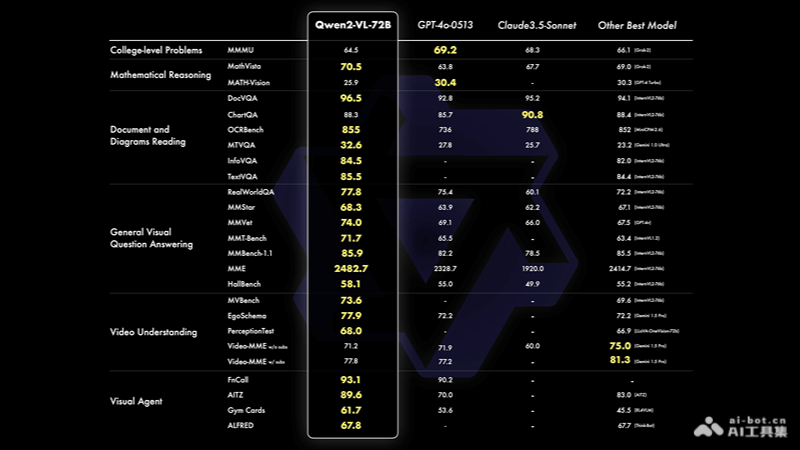
- 72B-scale model: Achieves optimal performance on multiple metrics, even surpassing closed-source models such as GPT-4o and Claude3.5-Sonnet, with particularly outstanding performance in document understanding, though there is a certain gap compared with GPT-4o on comprehensive university-level questions.
- 7B-scale model: Strikes a balance between cost-effectiveness and performance, supports image, multi-image, and video input, and is at the forefront in document understanding capability and multilingual text understanding capability.
- 2B-scale model: Optimized for mobile applications, has complete image, video, and multilingual understanding capabilities, and has clear advantages over models of the same scale in video document understanding and general scenario question answering.
- Multi-resolution image understanding: Qwen2-VL has achieved globally leading performance in visual understanding benchmarks such as MathVista, DocVQA, RealWorldQA, and MTVQA, demonstrating its ability to understand images of different resolutions and aspect ratios.
- Long video content understanding: Qwen2-VL can understand video content up to 20 minutes long, which enables it to perform excellently in application scenarios such as video question answering, dialogue, and content creation.
- Multilingual text understanding: In addition to English and Chinese, Qwen2-VL also supports understanding multilingual text in images, including most European languages, Japanese, Korean, Arabic, Vietnamese, and others, which enhances its application potential worldwide.
Qwen2-VL project address
- Project official website:https://qwenlm.github.io/zh/blog/qwen2-vl/
- GitHub repository:https://github.com/QwenLM/Qwen2-VL
- HuggingFace model library:https://huggingface.co/collections/Qwen/qwen2-vl
- ModelScope community:https://modelscope.cn/organization/qwen?tab=model
- Experience Demo:https://huggingface.co/spaces/Qwen/Qwen2-VL
Qwen2-VL application scenarios
- Content creation: Qwen2-VL can automatically generate descriptions of video and image content, helping creators quickly produce multimedia works.
- Educational assistance: As an educational tool, Qwen2-VL helps students parse math problems and logical diagrams and provides problem-solving guidance.
- Multilingual translation and understanding: Qwen2-VL recognizes and translates multilingual text, promoting cross-language communication and content understanding.
- Intelligent customer service: Integrated with real-time chat functionality, Qwen2-VL provides instant customer consultation services.
- Image and video analysis: In security monitoring and social media management, Qwen2-VL analyzes visual content and identifies key information.
- Assisted design: Designers use Qwen2-VL's image understanding capability to obtain design inspiration and concept diagrams.
- Automated testing: Qwen2-VL automatically detects interface and functionality issues in software development.
- Data retrieval and information management: Through visual agent capabilities, Qwen2-VL improves the level of automation in information retrieval and management.
- Assisted driving and robot navigation: As a visual perception component, Qwen2-VL assists autonomous driving and robots in understanding the environment.
- Medical imaging analysis: Qwen2-VL assists medical professionals in analyzing medical images and improves diagnostic efficiency.