
What is Qwen2-Audio
Qwen2-Audio is the latest open-source AI voice model launched by Alibaba's Tongyi Qianwen team, supporting direct voice input and multilingual text output. It features voice chat and audio analysis, and supports more than 8 languages. Qwen2-Audio performs excellently on multiple benchmark datasets and has now been integrated into Hugging Face's transformers library for developers to use conveniently. The model also supports fine-tuning through the ms-swift framework to adapt to specific application scenarios.
Main features of Qwen2-Audio
- Voice chat: Users can communicate directly with the model using voice, without the need for ASR conversion.
- Audio analysis: It can analyze audio content according to text instructions, identifying speech, sounds, music, and more.
- Multilingual support: It supports multiple languages and dialects such as Chinese, English, Cantonese, French, and more.
- High performance: It surpasses previous models on multiple benchmark datasets and performs excellently.
- Easy integration: The code has been integrated into Hugging Face's transformers library, making it convenient for developers to use and perform inference.
- Fine-tunability: It supports model fine-tuning through the ms-swift framework to adapt to different application needs.
Technical principles of Qwen2-Audio
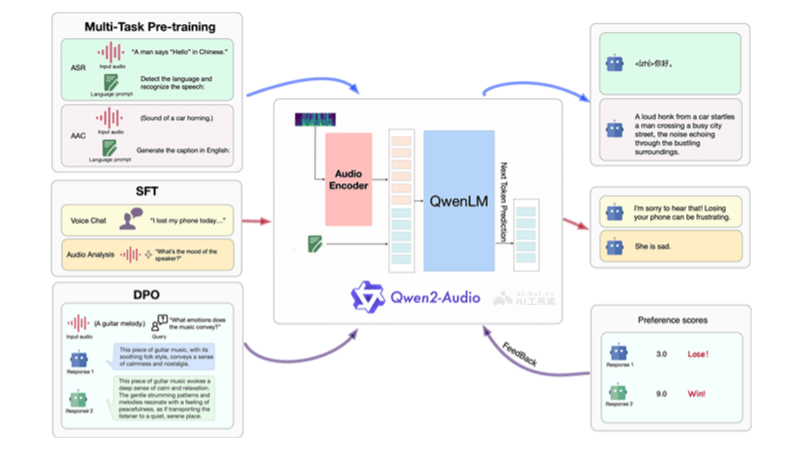
- Multimodal input processing:The Qwen2-Audio model can receive and process input in both audio and text modalities. Audio input is usually converted by a feature extractor into numerical features that the model can understand.
- Pretraining and fine-tuning:The model is pretrained on large amounts of multimodal data to learn joint representations of language and audio. Fine-tuning further trains the model on data for specific tasks or domains to improve its performance in specific application scenarios.
- Attention mechanism:The model uses an attention mechanism to strengthen the association between audio and text, allowing it to take relevant information from the audio content into account when generating text.
- Conditional text generation:Qwen2-Audio supports conditional text generation, meaning the model can generate corresponding response text based on given audio and text conditions.
- Encoder-decoder architecture:The model adopts an encoder-decoder architecture, in which the encoder processes the input audio and text, and the decoder generates the output text.
- Transformer architecture:As part of the transformers library, Qwen2-Audio adopts the Transformer architecture, a deep learning model commonly used for processing sequence data and suitable for natural language processing tasks.
- Optimization algorithms:During training, optimization algorithms such as Adam are used to adjust model parameters, minimize the loss function, and improve the model's prediction accuracy.
Qwen2-Audio project address
-
Experience Demo:https://huggingface.co/spaces/Qwen/Qwen2-Audio-Instruct-Demo
-
GitHubRepository:https://github.com/QwenLM/Qwen2-Audio
-
arXivTechnical paper:https://arxiv.org/pdf/2407.10759
Application scenarios of Qwen2-Audio
- Intelligent assistant: As a virtual assistant, it interacts with users through voice, answers questions, or provides help.
- Language translation: It enables real-time voice translation and helps cross-language communication.
- Customer service center: It automates customer service, handles inquiries, and solves problems.
- Audio content analysis: Analyze audio data for sentiment analysis, keyword extraction, or speech recognition.