
What is Qwen2.5-Math
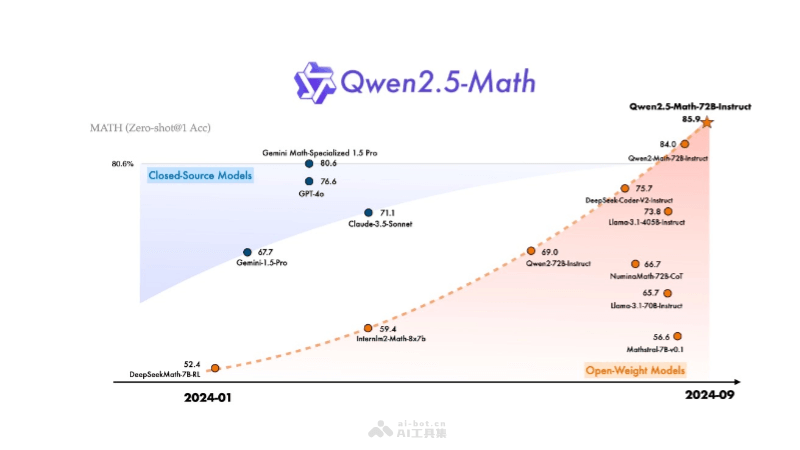
Qwen2.5-Math is an open-source AI math model launched by the Alibaba Qwen team. It is an upgraded version of Qwen2-Math and supports both Chinese and English. The model is pretrained on large-scale mathematical data and combines CoT, PoT, and TIR reasoning methods to improve its ability to solve mathematical problems. The Qwen2.5-Math series includes foundation models and instruction-tuned models of different scales, among which the 72B-Instruct model performs excellently on the MATH benchmark, surpassing previous-generation models and GPT-4o. Qwen2.5-Math provides a demo that supports TIR, allowing users to experience its mathematical problem-solving capabilities.
Main features of Qwen2.5-Math
- Bilingual mathematical problem solving: supports solving mathematical problems in Chinese and English, covering a wide range from basic arithmetic to advanced mathematics.
- Chain-of-Thought (CoT): solves multi-step logic problems through step-by-step reasoning, enhancing the model's mathematical reasoning ability.
- Tool-Integrated Reasoning (TIR): performs precise calculations and complex mathematical operations based on external tools (such as a Python interpreter), improving calculation accuracy.
- Large-scale data pretraining: pretrained on a large amount of mathematics-related data, including synthetic data and real-world data, enhancing the model's mathematical understanding.
- Instruction tuning: through instruction tuning, the model better understands and executes specific mathematical problem-solving instructions.
Technical principles of Qwen2.5-Math
- Large-scale pretraining: builds a high-quality mathematical pretraining dataset and trains on a large amount of mathematical text.
- Chain-of-Thought (CoT): enhances the model's reasoning ability by showing the intermediate steps of problem solving.
- Tool-Integrated Reasoning (TIR): integrates external computational tools to improve the model's capabilities in precise calculation and algorithmic operations.
- Instruction tuning: on the basis of the pretrained model, further improves the model's performance on specific tasks through instruction tuning.
- Reward Model (RM): develops a dedicated reward model and uses rejection sampling and reinforcement learning to optimize the model's problem-solving process.
- Iterative training and updates: guides data iteration based on the reward model, and uses iterative training to update the reward model, forming a positive cycle.
Project address of Qwen2.5-Math
- Project official website:qwenlm.github.io/blog/qwen2.5-math
- GitHub repository:github.com/QwenLM/Qwen2-Math
- HuggingFace model library:https://huggingface.co/collections/Qwen/qwen25-math-66eaa240a1b7d5ee65f1da3e
- arXiv technical paper:https://arxiv.org/pdf/2409.12122
Application scenarios of Qwen2.5-Math
- Educational assistance: as an auxiliary tool for teachers and students, helping solve mathematical problems, providing personalized learning support, and generating teaching materials and practice problems.
- Online education platforms: as an intelligent tutoring tool in online education platforms, providing 24*7 instant mathematical problem-solving services to assist students in learning.
- Mathematical competition training: helps students and coaches preparing for mathematical competitions by providing problem-solving strategies and training for high-difficulty problems.
- Academic research: assists researchers in complex mathematical modeling, data analysis, and algorithm development, accelerating the process of scientific discovery.
- Automated content generation: generates mathematics-related educational content, such as textbooks, tutorials, online courses, and exercise banks.