
What is Qwen-Robot Suite
Qwen-Robot Suite is a foundation model suite introduced by Alibaba Tongyi for advancing intelligence in the physical world, comprising three foundation models: Qwen-RobotNav (navigation), Qwen-RobotManip (manipulation), and Qwen-RobotWorld (world model). The suite bridges the visual-language representation space to physical actions through language-first interfaces, unifying training and inference across embodiments and scenarios, enabling general-purpose large models to serve as high-level planners that dynamically invoke low-level physical tools to complete long-horizon task loops.
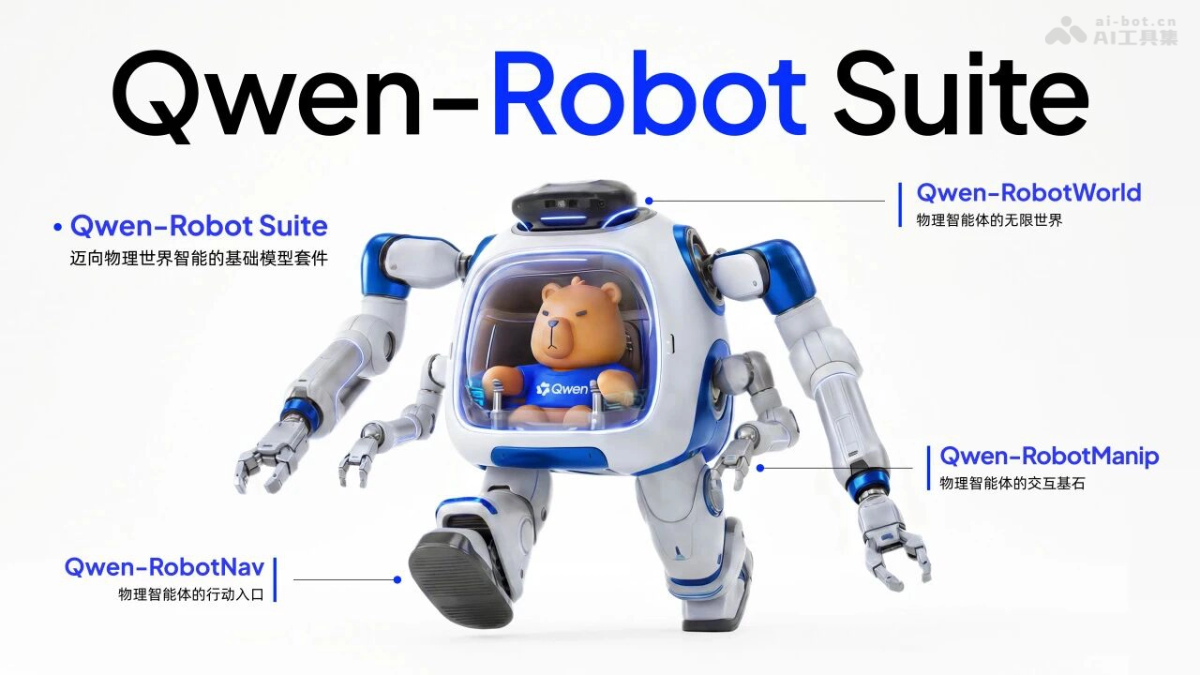
Main Features of Qwen-Robot Suite
-
Unified Physical Navigation: Qwen-RobotNav covers five major domains—instruction following, point/goal navigation, target tracking, autonomous driving, and embodied question answering—executed uniformly by a single model.
-
Cross-Embodiment Manipulation Control: Qwen-RobotManip is compatible with 15 robot embodiments, including single-arm, dual-arm, dexterous hand, and mobile platforms, achieving direct mapping from visual language to actions.
-
World Dynamics Prediction: Qwen-RobotWorld receives natural language action descriptions and predicts future states that comply with physical laws in manipulation, driving, and navigation scenarios.
-
Agent Tool Composition: All three models provide language-first interfaces and can be dynamically invoked and composed as physical world tools by general-purpose Qwen models.
-
Zero-Shot Real-World Deployment: Supports zero-shot deployment on real robots such as Unitree Go2, without the need for scenario-specific fine-tuning.
Technical Principles of Qwen-Robot Suite
- Qwen-RobotNav: Parameterized Visual Allocation and Controllable Observation Protocol, the model parameterizes the visual allocation strategy itself, selecting navigation behaviors (instruction following, target search, tracking, autonomous driving) via task modes, and exposes four-axis inference-time parameters—visual token budget, temporal decay, per-camera weights, frame sampling patterns—as adjustable interfaces. The model is trained on 15.6 million samples jointly with visual-language data, allowing the same set of weights to adapt to different navigation needs without modifying the architecture. The high-level planner dynamically switches task modes and context strategies, repeatedly invoking the model as a reconfigurable navigation primitive, and works with a dual-layer memory mechanism to achieve long-horizon reasoning.
- Qwen-RobotManip: Unified Cross-Embodiment Alignment and Large-Scale Training, with Qwen3.5-4B VL as the backbone and a flow-matching DiT action head, it resolves heterogeneous embodiment conflicts through three mechanisms. A unified 80-dimensional state-action representation is shared across diverse embodiments; end-effector incremental poses in the camera coordinate system make visually similar motions numerically similar, masking morphological differences; finally, context strategy adaptation treats execution history as an implicit embodiment identifier, enabling online behavior calibration at inference time. At the data level, training is completed with over 38,100 hours of corpus, including 11,320 hours of open-source robot data, 1,933 hours of human videos, and 24,808 hours of cross-embodiment data generated by a human-to-robot transfer synthesis pipeline.
- Qwen-RobotWorld: Language-Driven Dual-Stream World Model, the key design is to unify all actions into a natural language interface, standardizing end-effector poses, steering commands, and navigation waypoints into a single training signal, enabling collaborative training across more than 20 embodiments and over 500 action categories. The model adopts a 60-layer dual-stream MMDiT, deeply coupling Qwen2.5-VL's semantic representations with video latent variables. Unlike lightweight text encoders, the model uses a complete multimodal large language model as the action encoder, internalizing physical knowledge such as rigid bodies, fluids, and gravity, implicitly constraining generation to physically plausible futures.

Follow WeChat and reply "Open Source" to join theAI Open Source Project Exchange Group
How to use Qwen-Robot Suite
-
Select a module: Choose RobotNav (navigation), RobotManip (manipulation), or RobotWorld (prediction) as the underlying physics engine according to task requirements.
-
Configure the interface: Adjust visual history encoding parameters through the four-axis controllable observation protocol to adapt to different input configurations with a single camera or multiple cameras.
-
Connect the planner: An upper-level general agent (such as Qwen-3.5) decomposes long-horizon goals into subtasks and dynamically invokes the corresponding model through language instructions.
-
Execute the closed loop: The underlying model receives language instructions and outputs physical actions or future frames, driving a real robot or simulation environment to execute.
-
Memory management: Use cross-segment memory and an evidence notebook to compress context, supporting multi-step navigation, environmental forensics, and failure recovery.
Core advantages of Qwen-Robot Suite
- Language-first unified interface: All three models provide a natural language action interface and can be seamlessly invoked as tools by general LLMs, without the need to design proprietary protocols for different robot embodiments.
- Strong cross-embodiment generalization: A unified 80-dimensional representation and camera-coordinate action alignment enable the model to achieve zero-shot transfer across 15 platforms, reaching twice the performance of the previous state of the art in real environments.
- Fully open-source data training: RobotManip relies solely on open-source data to complete over 38,000 hours of training, greatly reducing data barriers through a human-to-robot transfer synthesis pipeline, proving that alignment is a prerequisite for scaling.
- Physically consistent generation: The world model uses a complete VLM as the action encoder, internalizing Newton's laws, conservation of mass, and fluid dynamics, ranking first among open-source models on physical reasoning benchmarks such as WorldModelBench.
Project address of Qwen-Robot Suite
Model weights, technical blogs, and standalone project pages may not yet be fully public.
Comparison of Qwen-Robot Suite with similar competitors
| Comparison dimension | Qwen-Robot Suite | π0.5 (Physical Intelligence) |
|---|---|---|
| Data strategy | Fully open-source data training (>38K hours), including a human-to-robot transfer synthesis pipeline | Relies on large-scale real robot teleoperation data collection |
| Embodiment compatibility | Unified 80-dimensional representation, across 15 platforms / more than 20 embodiments | Mainly optimized for specific embodiments, with limited cross-morphology generalization |
| Action interface | Language-first, with natural language unifying the three task types of manipulation, navigation, and driving | Primarily action tokens, with language as an auxiliary condition |
| Generalization ability | Zero-shot cross-embodiment transfer, real deployment in open environments | Strong in-distribution performance, but OOD generalization and cross-embodiment transfer are relatively limited |
| System architecture | Layered combination of a three-model suite plus an agent framework, supporting long-horizon planning | Single VLA model executes end-to-end, with long-horizon tasks relying on external planning |
Application scenarios of Qwen-Robot Suite
-
Home service robots: Executes long-horizon operations such as tabletop cleanup, clothing storage, and cooking assistance, with task decomposition and failure recovery capabilities.
-
Warehouse logistics: The same navigation model handles target search, shelf inventory, and AGV path tracking within warehouses, with zero-shot deployment across robot types.
-
Autonomous driving and embodied navigation: A unified model covers urban driving, indoor instruction following, and open-environment exploration, and supports evidence-based question answering.
-
Simulation data synthesis: Uses a world model to generate physically plausible future frames as a low-cost, large-scale training data engine.
-
Human-robot collaborative industrial arms: Enables skill transfer across 15 industrial/service robot platforms, reducing reprogramming costs when changing production lines.