
What is Qwen-Image-Layered
Qwen-Image-Layered is an AI image editing model launched by the Alibaba team. It can automatically split ordinary images into independent RGB transparent layers, enabling Photoshop-like layered editing. It dynamically splits layers through attention mechanisms and positional encoding, supports flexible decomposition into 3-10 layers, and allows operations such as scaling and recoloring on a single layer without affecting other parts. Compared with the problem of traditional AI image editing where "one change affects the whole thing," the model's open-source tests on Hugging Face show that the color restoration error is only 0.0033, and the transparency accuracy is as high as 0.916, significantly outperforming existing technologies.
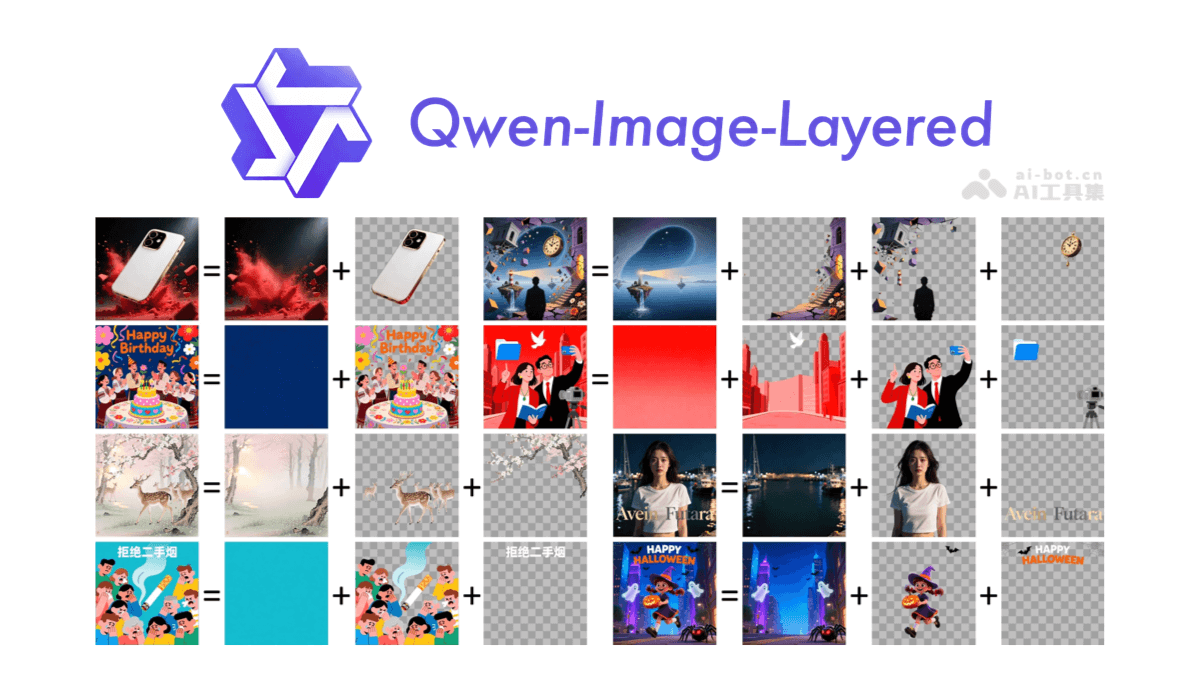
Main features of Qwen-Image-Layered
-
Image layering: Decompose a single RGB image into multiple RGBA layers, each with independent semantics, facilitating subsequent editing.
-
Independent editing: Each layer can be operated on separately, such as resizing, repositioning, recoloring, etc., without affecting other layers.
-
High-fidelity operations: Supports high-fidelity basic operations, such as cleanly deleting objects, resizing without distortion, and freely moving objects.
-
Flexible decomposition: Supports decomposition into a variable number of layers, and can also recursively decompose to achieve unlimited decomposition, meeting different editing needs.
-
Data pipeline: Establishes a pipeline for extracting multilayer images from Photoshop documents, solving the problem of scarce high-quality multilayer training data.
Technical principles of Qwen-Image-Layered
-
RGBA-VAE: By unifying the latent representations of RGB and RGBA images, it provides a foundational framework for the generation and decomposition of multilayer images.
-
VLD-MMDiT architecture: Adopts an MMDiT architecture with variable layer decomposition, capable of flexibly decomposing images into different numbers of layers.
-
Multi-stage training strategy: Combines pretrained image generation models and, through multi-stage training, adapts them to multilayer image decomposition tasks, improving model performance.
-
Data pipeline: Extracts and annotates multilayer images from Photoshop documents, establishes high-quality training datasets, and solves the problem of data scarcity.
-
Diffusion model: Based on the generation mechanism of diffusion models, it gradually reconstructs the multilayer representation of images from noise, achieving high-quality layer decomposition.
Project address of Qwen-Image-Layered
- Github repository:https://github.com/QwenLM/Qwen-Image-Layered
- HuggingFace model library:https://huggingface.co/Qwen/Qwen-Image-Layered
- arXiv technical paper:https://arxiv.org/pdf/2512.15603
- Online experience Demo:https://huggingface.co/spaces/Qwen/Qwen-Image-Layered
Application scenarios of Qwen-Image-Layered
-
Advertising design: Quickly decompose images into multiple layers, making it convenient to independently edit elements in advertisements, such as changing the background, adjusting product positions, etc.
-
Film and television post-production: Perform layered processing on characters, props, etc. in film and television footage, facilitating operations such as adding special effects and color correction.
-
Creative design: Designers can easily decompose creative images and independently modify different elements, inspiring more creative ideas.
-
Image restoration: After decomposing an image, damaged layers can be repaired separately without affecting other parts, improving restoration efficiency.
-
Educational demonstration: In teaching, complex images can be decomposed into simple layers to help students better understand image composition and editing principles.