
What is Qwen-Image-3.0
Qwen-Image-3.0 is the third-generationimage generationfoundation model launched by Alibaba's Tongyi Qianwen team. The model supports ultra-long input of 4.5k tokens and can render complex nine-grid knowledge atlases in one pass; it supports precise typography of 10px small text, making academic papers, formula derivations, and handwritten annotations clearly legible; it features native rendering in 12 languages and rich world knowledge, and can simulate webpages, games, livestreams, and other interfaces. The flagship version Qwen-Image-3.0-Pro and the standard version Qwen-Image-3.0-Standard simultaneously open APIs, supporting 4.5k token long instructions and complex layouts generated in one pass, and rank first in China on the Arena.ai text-to-image leaderboard.
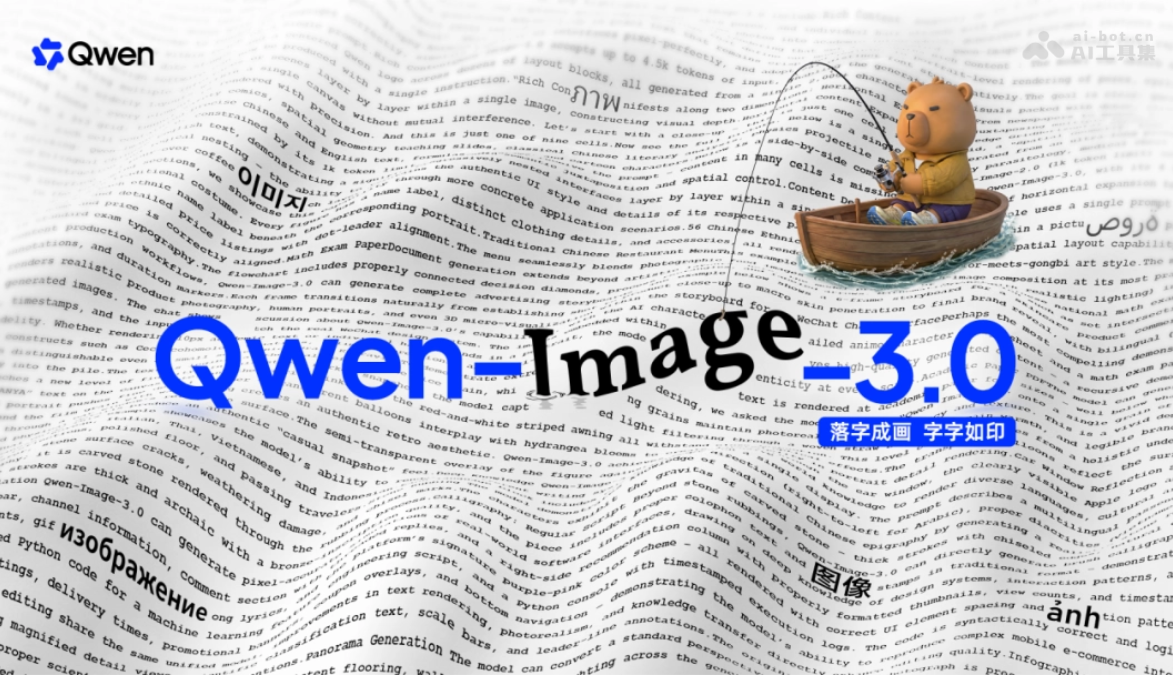
Main Features of Qwen-Image-3.0
-
Ultra-long context generation: Supports up to 4.5k token input, and can understand and render extremely complex, information-dense visual layouts, such as newspapers, storyboards, and exam papers.
-
Semantic juxtaposition and spatial control: Features content horizontal expansion, and can orderly lay out multiple parallel elements in the same image without interfering with each other.
-
Semantic deconstruction and logical nesting: Features content depth, and can progressively render multiple nested interfaces layer by layer in one image, creating a picture-within-a-picture-within-a-picture effect.
-
Micro-level detail rendering: 10px small text is clearly legible, pores and hair strands are rendered in minute detail, and skin texture approaches photographic-level realism.
-
Native multilingual rendering: Supports precise presentation of 12 languages in images, not simple texture mapping.
-
Interface simulation: Can simulate the styles and details of mainstream webpages, games, livestreams, and other interfaces.
-
Knowledge diagram generation: Can generate complex knowledge popular science atlases containing large amounts of text, illustrations, formulas, and charts.
Technical Principles of Qwen-Image-3.0
-
Ultra-long context understanding architecture: By increasing the acceptable instruction length to 4.5k tokens, the model can handle complex spatial relationship descriptions and multi-element layout instructions.
-
Fine-grained text rendering technology: Optimized for small font size scenarios, ensuring the readability and typographic accuracy of 10px-level text against complex backgrounds.
-
Multilingual embedded generation: Internalizes language knowledge into the generation process, achieving native rendering of 12 languages rather than post-processing overlay.
-
World knowledge fusion: The model has built-in rich domain knowledge, ensuring the professional accuracy of generated content.
-
Layered semantic control: Achieves precise control of complex layouts through semantic juxtaposition and semantic deconstruction.
How to Use Qwen-Image-3.0
VisitQianwen AI Platform、Qwen StudioorQwen Cloud, open for free to all users, and enter instructions to generate images.
Core Advantages of Qwen-Image-3.0
-
Practical orientation: Unlike text-to-image models that pursue artistry, it focuses on implementable productivity scenarios and emphasizes usability.
-
Native generation of complex layouts: No need for multi-image stitching; a single image can generate complex layouts containing nine-grids and multi-layer nested UIs.
-
Industry-leading text rendering precision: 10px small text, LaTeX formulas, and academic paper layouts can all be presented precisely.
-
Knowledge accuracy: Leveraging the knowledge base of Tongyi Qianwen to ensure the professional accuracy of generated content (such as mathematical theorems and biological knowledge).
-
Native Chinese Optimization: Deep optimization for Chinese typesetting, Chinese character rendering, and Chinese knowledge illustrations.
Comparison of Qwen-Image-3.0 with Similar Competitors
| Comparison Dimension | Qwen-Image-3.0 | GPT-Image 2.0 |
|---|---|---|
| Core Positioning | A productivity tool focused on precise typesetting of complex layouts and implementation in Chinese scenarios | A general visual execution system emphasizing reasoning planning and multilingual text rendering |
| Input Length | Supports 4.5k token, and can describe extremely complex layouts such as nine-grid layouts and nested UI | Supports long instructions at the thousand-character level; Thinking mode can break down complex requirements, but input length is weaker than Qwen |
| Small Text Rendering | 10px small textclearly legible, with precise formulas, paper typesetting, and handwritten annotations | Claimed ~99% text accuracy and support for multilingual small text, but stability in complex academic typesetting remains to be verified |
| Multilingual Support | Native rendering in 12 languages, with deep optimization for long Chinese text, vertical writing, and mixed formula layout | Supports character-level rendering in 50+ languages, with greatly improved Chinese performance, but understanding of local cultural details is slightly inferior |
| Complex Layouts | Native support for one-pass generation of complex structures such as nine-grid layouts, multi-layer nested UI, and "picture-in-picture-in-picture" | Excels at grid systems, UI layouts, and information layer hierarchies, pre-planning compositions through Thinking mode |
| Reasoning Ability | Leverages the Qwen knowledge base to ensure content accuracy, with layout control leaning toward semantic juxtaposition and spatial control | Natively integrated O-series reasoning, autonomously planning layouts, searching the web, and analyzing uploaded documents before generation |
| Knowledge Accuracy | Built-in Tongyi Qianwen knowledge, with high accuracy for Chinese knowledge such as mathematical theorems and biology popular science | Can retrieve real-time information online, accurately rendering technical artifacts and current events, but relies on external retrieval |
| Continuous Consistency | The article does not emphasize multi-image consistency, focusing instead on complex layouts in a single image | A single prompt can generate up to 8 consecutive images with consistent style/characters, suitable for storyboards |
| Output Resolution | The article does not clearly specify, focusing on layout complexity rather than a single resolution | Supports 2K(2048×2048) and multiple aspect ratios, with the API reaching up to 4K(3840×2160) |
Application Scenarios of Qwen-Image-3.0
-
Education and Publishing: The model can generate teaching materials such as math exam papers, physics formula diagrams, biology knowledge popular science illustrations, and Chinese textbook annotations.
-
Academic Research: Automatically generates academic paper illustrations and conference posters containing complex formulas and multi-column layouts.
-
UI/UX Design: Rapidly generates high-fidelity prototypes and nested interface mockups for webpages, apps, and game interfaces.
-
Content Operations: The model can create infographics, long-image posters, and multilingual social media assets, ensuring accurate communication of textual information.
-
Digital Publishing: Generate content such as magazine layouts, newspaper typography, and comic panels that require precise mixing of text and images.