
What is QLIP
QLIP (Quantized Language-Image Pretraining) is a visual tokenization method introduced by NVIDIA and others, combining high-quality image reconstruction and zero-shot image understanding capabilities. QLIP is trained with a Binary Spherical Quantization (BSQ) autoencoder while optimizing both reconstruction objectives and language-image alignment objectives. QLIP can serve as a visual encoder or image tokenizer, seamlessly integrating into multimodal models and performing excellently in understanding and generation tasks. QLIP provides new ideas for the development of unified multimodal models.
Main Features of QLIP
- High-Quality Image Reconstruction: Reconstructs high-quality images with a lower compression rate.
- Powerful Semantic Understanding: Supports generating semantically rich visual tokens, and supports zero-shot image classification and multimodal understanding tasks.
- Multimodal Task Support: Serves as a visual encoder or image tokenizer, seamlessly integrating into multimodal models and supporting tasks such as text-to-image generation and image-to-text generation.
- Unified Multimodal Model: Supports a single model handling pure text, image-to-text, and text-to-image tasks simultaneously.
Technical Principles of QLIP
- Binary Spherical Quantization (BSQ): Uses Binary Spherical Quantization (BSQ) technology to encode images into discrete visual tokens. BSQ maps points in high-dimensional space to binary corner points on the unit sphere, achieving efficient quantization and compression.
- Contrastive Learning Objective: QLIP introduces a contrastive learning objective, aligning visual tokens with language embeddings based on image-text alignment. QLIP uses the InfoNCE loss function to learn to bring embeddings of the same image-text pair closer and push embeddings of different pairs farther apart. The alignment mechanism enables visual tokens to reconstruct images and understand the semantic content of images.
- Two-Stage Training:
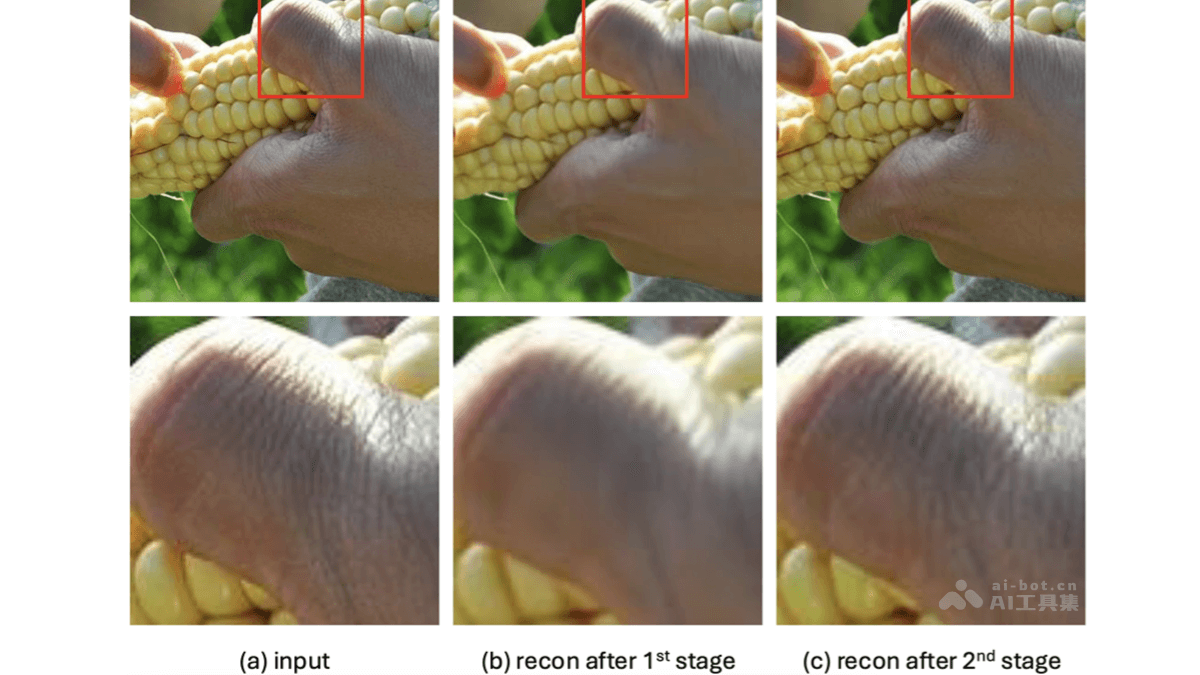
- First Stage: Optimizes the weighted sum of reconstruction loss, quantization loss, and contrastive loss. The goal is to learn semantically rich visual representations while maintaining image reconstruction quality.
- Second Stage: Builds on the first stage to further optimize reconstruction quality by fine-tuning the quantization bottleneck and visual decoder to recover high-frequency details. This stage discards the text encoder and freezes the visual encoder to avoid performance degradation during large-batch training.
- Dynamic Loss Balancing: Dynamically adjusts the weights of the contrastive loss and reconstruction loss to resolve the competition between the two objectives. Specifically, the weights are adjusted based on the inverse of the loss values to balance the convergence speed of the two objectives.
- Accelerated Training and Better Initialization: Initializes the visual encoder and text encoder from pretrained models (such as Masked Image Modeling or CLIP), significantly improving training efficiency and reducing the number of samples required for training.
QLIP Project Addresses
- Project Website:https://nvlabs.github.io/QLIP/
- GitHub Repository:https://github.com/NVlabs/QLIP/
- HuggingFace Model Library:https://huggingface.co/collections/nvidia/qlip
- arXiv Technical Paper:https://arxiv.org/pdf/2502.05178
Application Scenarios of QLIP
- Multimodal Understanding: Used in Visual Question Answering (VQA) and Graphic Question Answering (GQA) to help models understand images and generate accurate answers.
- Text-to-Image Generation: Generates high-quality images based on text descriptions, with details that better match the semantics.
- Image-to-Text Generation: Generate image captions to provide more accurate text content.
- Unified multimodal model: Supports a single model to simultaneously handle text, image-to-text, and text-to-image tasks.