
What is QA-MDT
QA-MDT (Quality-aware Masked Diffusion Transformer) is an open-source music generation model jointly launched by the University of Science and Technology of China and iFLYTEK. The model generates high-quality and highly musical music based on text descriptions, with an innovative quality-aware training strategy that identifies and improves the quality of music waveforms during the training process. QA-MDT combines the Masked Diffusion Transformer (MDT) and quality control techniques to achieve excellent performance on large-scale datasets, providing a powerful tool for music production and multimedia creation.
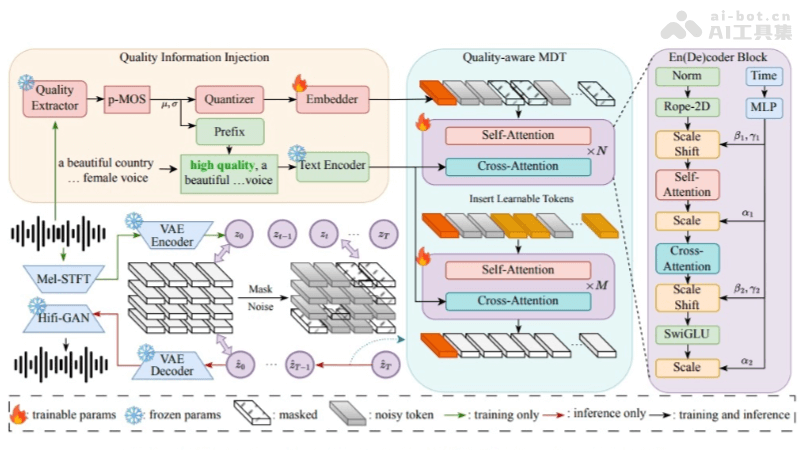
Main Features of QA-MDT
- Text-to-Music Generation: Users provide text descriptions, and QA-MDT generates matching music.
- Quality Control: The model identifies and improves the quality of generated music, ensuring that the output music has high fidelity.
- Dataset Optimization: Through preprocessing and optimizing the dataset, the alignment between music and text is improved.
- Diverse Generation: The model can generate music in diverse styles to meet the needs of different users.
Technical Principles of QA-MDT
- Text-to-Music Generation: Based on natural language processing (NLP) technology, text is parsed and converted into music features, and then music is generated.
- Quality-Aware Training: During the training process, a quality scoring model (such as pseudo-MOS scores) is used to evaluate the quality of music samples, so that the model generates high-quality music.
- Masked Diffusion Transformer (MDT): Based on the Transformer architecture, it masks and predicts parts of the music signal to learn the latent representation of music, improving the accuracy of music generation.
- Quality Control: In the generation stage, the model is guided by the quality information learned during the training stage to generate high-quality music.
- Music and Text Synchronization: Large language models (LLMs) and the CLAP model are used to synchronize music signals with text descriptions, enhancing the consistency between text and audio.
QA-MDT Project Address
- GitHub Repository:https://github.com/QA-MDT
- arXiv Technical Paper:https://arxiv.org/pdf/2405.15863v2
Application Scenarios of QA-MDT
- Advertising and Multimedia Production: Generate customized background music and sound effects for advertisements, movies, television, video games, and online videos.
- Music Industry: Assist music producers and composers in creating new musical works, providing creative inspiration or serving as a tool in the creative process.
- Music Education: As a teaching tool, it helps students understand music theory and composition techniques, or is used for music practice and improvisation.
- Audio Content Creation: Provide original music for podcasts, audiobooks, and other audio content creation, enhancing the listening experience for audiences.
- Virtual Assistants and Smart Devices: Generate personalized music and sounds in smart home devices, virtual assistants, or other intelligent systems to improve the user experience.