
What is ProtGPS
ProtGPS (Protein Localization Prediction Model) is a deep learning-based protein language model launched by the Massachusetts Institute of Technology (MIT) and the Whitehead Institute for Biomedical Research, used to predict the subcellular localization of proteins within cells. ProtGPS is based on analyzing the amino acid sequences of proteins, using an evolutionary-scale protein Transformer architecture to learn complex patterns and interrelationships in the sequences. ProtGPS can predict the distribution probability of proteins across 12 different subcellular regions (such as the nucleolus, nuclear speckles, etc.), and successfully guides the generation of novel protein sequences that can specifically assemble into particular subcellular regions. ProtGPS can identify pathogenic mutations that lead to changes in protein subcellular localization, providing new tools and perspectives for understanding cellular functions and disease mechanisms.
Main functions of ProtGPS
- Predict the distribution of proteins within cells: Predict the localization probability of proteins across 12 different subcellular regions (such as the nucleolus, nuclear speckles, stress granules, etc.).
- Design proteins with specific subcellular localization: Generate novel protein sequences that specifically assemble into target subcellular regions (such as the nucleolus or nuclear speckles).
- Identify the impact of pathogenic mutations on protein localization: Analyze the impact of mutations on protein subcellular localization, and predict whether pathogenic mutations will cause abnormal protein distribution.
Technical principles of ProtGPS
- Transformer-based sequence learning: Based on the ESM2 (Evolutionary Scale Model 2) architecture, a Transformer-based protein language model. It simultaneously learns the relationships among all amino acids in the input sequence, capturing complex patterns and interactions in protein sequences.
- Joint training with a neural network classifier:
- ESM2 is jointly trained with a neural network classifier. The classifier's task is to predict the localization probability of proteins in different subcellular regions based on the features extracted by ESM2.
- The training dataset includes 5,480 human protein sequences, annotated as belonging to 12 different subcellular regions, to learn the protein sequence features of different subcellular regions.
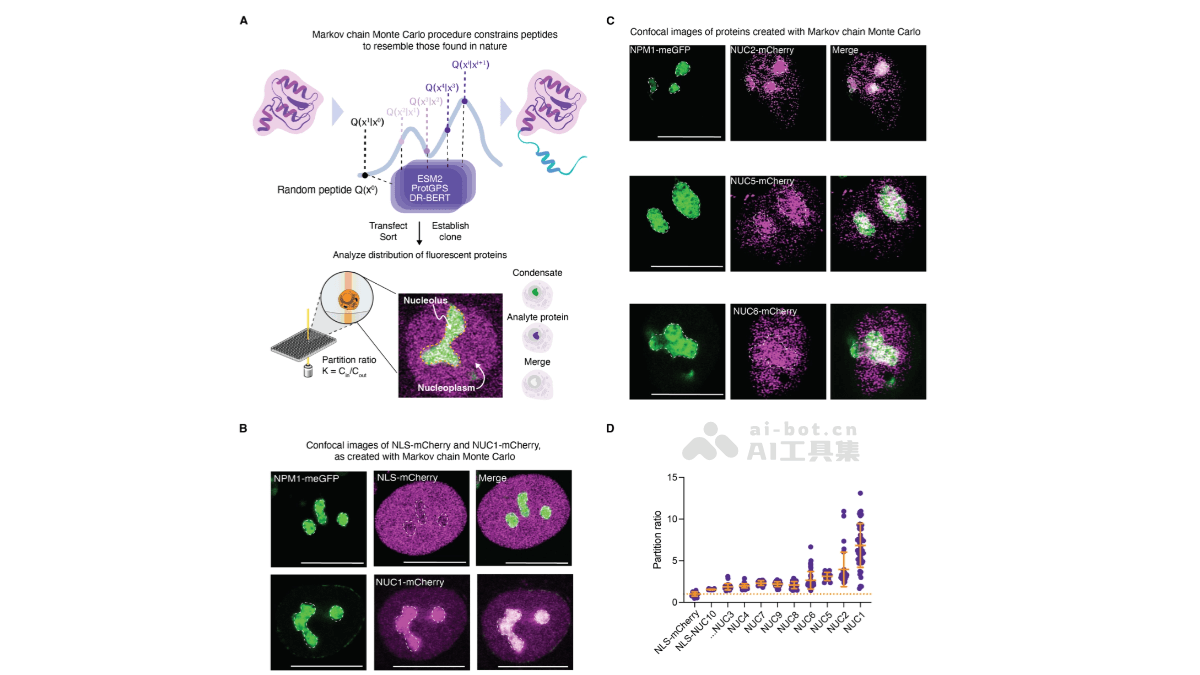
- Algorithm for generating protein sequences: To design proteins with specific subcellular localization, the Markov Chain Monte Carlo (MCMC) algorithm is used. When generating protein sequences, the chemical space and intrinsic disorder of proteins are taken into account to ensure that the generated sequences conform to the distribution of natural proteins and can specifically localize to the target subcellular region.
- Pathogenic mutation analysis: Analyze the impact of pathogenic mutations on protein subcellular localization. Compare the localization prediction results of wild-type and mutant proteins to identify mutations that cause changes in protein distribution. Use Shannon entropy and Wasserstein distance from information theory to quantify the impact of mutations on the uncertainty of protein localization predictions.
ProtGPS project addresses
- GitHub repository:https://github.com/pgmikhael/protgps
- arXiv technical paper:https://www.biorxiv.org/content
Application scenarios of ProtGPS
- Disease mechanism research: Identify the impact of pathogenic mutations on protein subcellular localization, helping to understand disease pathogenesis.
- Protein engineering and drug design: Design proteins with specific subcellular localization, used to develop novel protein drugs or biosensors.
- Cell biology research: Predict protein localization in different subcellular regions, facilitating research on protein function and interactions within cells.
- Gene Therapy and Gene Editing: Design gene editing tools that specifically target subcellular regions, improving the efficiency and specificity of gene editing.
- Protein Function Annotation and Database Construction: Provide clues for protein function research, helping to build a more comprehensive protein function database.