
What is Proactive Agent
Proactive Agent is a new generation proactive Agent interaction paradigm launched by Tsinghua University in collaboration with ModelBest and other teams. It possesses proactivity, can predict user needs, and take action without direct instructions. Proactive Agent observes the environment and user behavior, infers potential tasks, and autonomously provides assistance. Compared with traditional passive AI agents, Proactive Agent demonstrates higher autonomous decision-making capability and environmental adaptability, and can achieve more natural and smoother human-computer interaction experiences in various scenarios. The development of this technology marks the transformation of AI from a simple command executor to an intelligent collaborative partner with insight and proactive assistance capabilities.
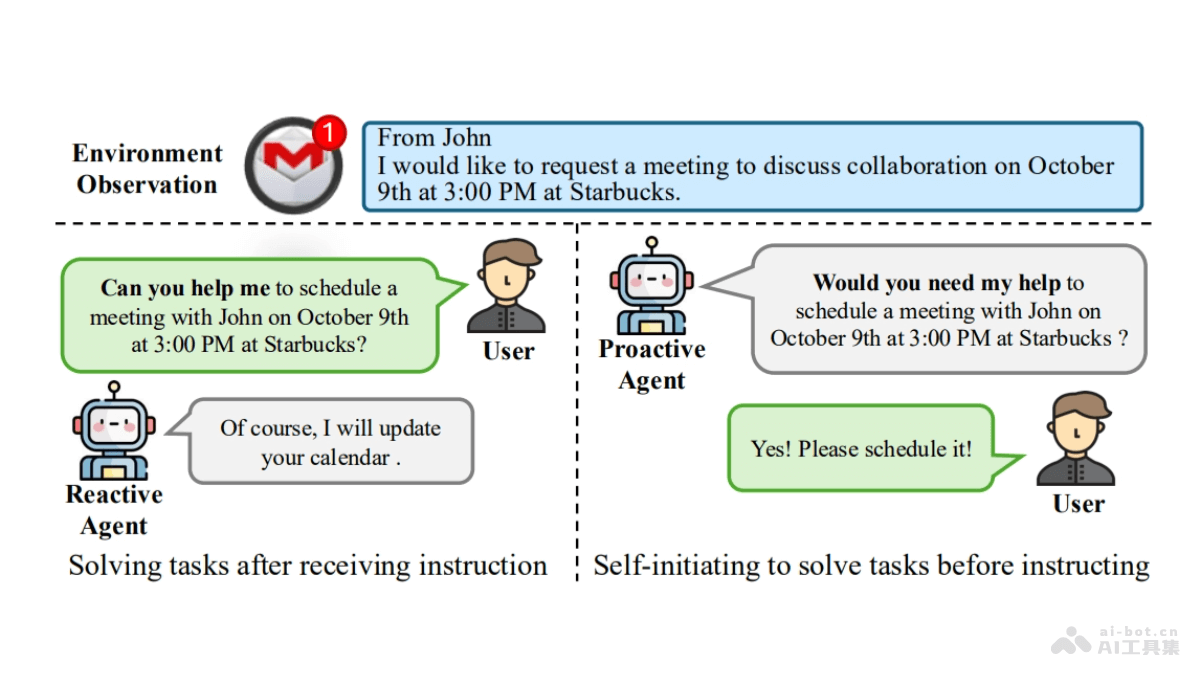
Main features of Proactive Agent
- Environmental observation and anticipation: Proactively observes the user's environment and behavior, and predicts the user's needs and intentions.
- Autonomous decision-making: Based on understanding of the environment and the user's intentions, autonomously makes decisions without waiting for explicit user instructions.
- Task initiation: When recognizing that the user may need help, proactively proposes tasks or provides information.
- Context awareness: Understands the contextual environment and provides appropriate assistance according to the current situation.
- User interaction: Interacts with the user, adjusts its behavior and predictions based on user feedback, and improves accuracy and user satisfaction.
- Task execution: When the user accepts the tasks proposed by Proactive Agent, the system executes these tasks and generates follow-up events as needed.
Technical principles of Proactive Agent
- Environment Gym: Simulates a specific environment, generates event sequences, maintains the environment state, and provides sandbox conditions for the agent to interact.
- Proactive Agent: Receives input from the environment simulator, updates memory, combines historical interactions and user feedback, predicts user intentions, and generates tasks.
- User Agent: Simulates user behavior, provides feedback on the tasks proposed by Proactive Agent, and decides whether to accept the tasks.
- Data generation pipeline: Based on simulated user activities and responses, generates data used for training and evaluating models.
- Reward model: Trains a model to evaluate the proactive behavior of Proactive Agent, simulate human judgment, provide feedback, and optimize the agent's behavior.
- Performance evaluation: Uses metrics (such as missed needs, silent responses, correct detection, and false detection) to evaluate the performance of Proactive Agent and continuously optimize it.
Project address of Proactive Agent
- GitHub repository:https://github.com/thunlp/ProactiveAgent
- arXiv technical paper:https://arxiv.org/pdf/2410.12361
Application scenarios of Proactive Agent
- Personal assistant: Intelligent schedule management, automatically arranging meetings and reminders based on the user's emails, calendar events, and habits.
- File management: Automatic storage and renaming, automatically saving new files to specified locations and intelligently renaming them based on file content.
- Life services: Itinerary planning, proactively planning itineraries and transportation methods based on the user's travel habits and preferences.
- Assistive technology: Assistance for visually impaired individuals, providing real-time environmental description, obstacle warnings, and text recognition and reading.
- Office Automation: Meeting scheduling, automatically arranging meeting times and locations based on team members' schedules and preferences.