
What Is PRefLexOR
PRefLexOR (Preference-based Recursive Language Modeling for Exploratory Optimization of Reasoning) is a new self-learning AI framework proposed by the MIT team, combining concepts of preference optimization and reinforcement learning (RL), enabling the model to improve its self-learning through iterative reasoning. The core of the framework is a recursive reasoning algorithm: during both training and inference, the model performs multi-step reasoning, reviews and improves intermediate steps, and ultimately generates more accurate outputs. PRefLexOR is based on Odds Ratio Preference Optimization (ORPO), where the model aligns reasoning paths by optimizing the log odds between preferred and non-preferred responses. It integrates Direct Preference Optimization (DPO) and further improves reasoning quality through rejection sampling.
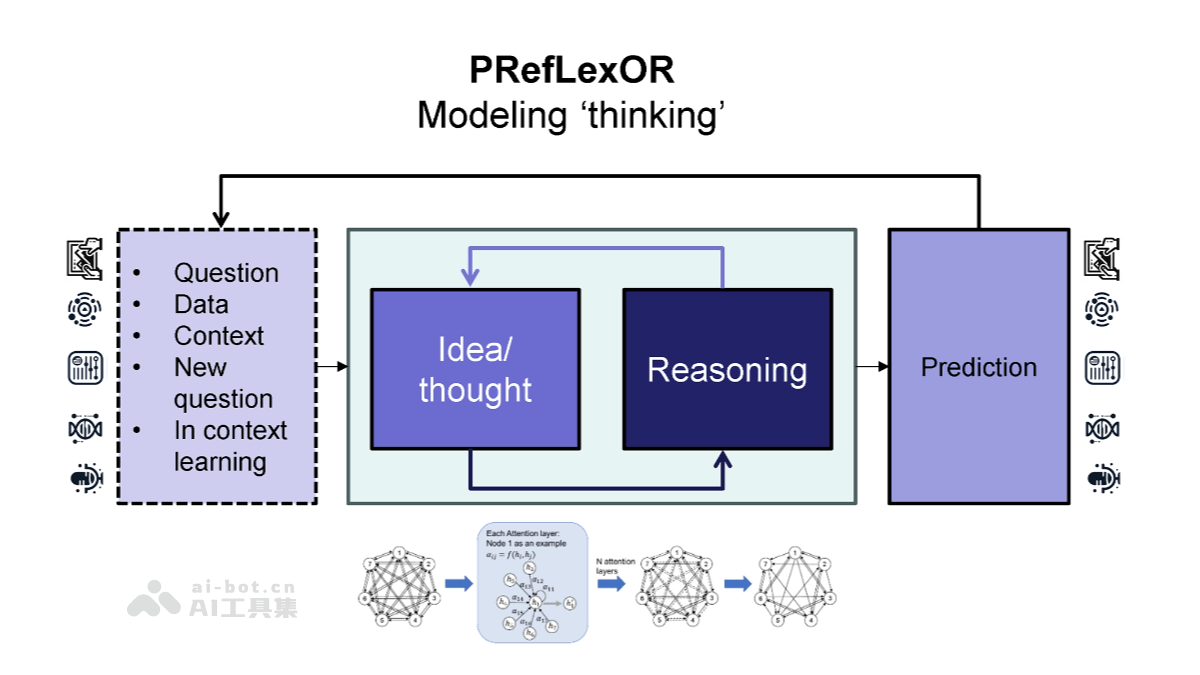
Main Features of PRefLexOR
- Dynamic Knowledge Graph Construction: The framework does not rely on pre-generated datasets; instead, it dynamically generates tasks and reasoning steps to build a knowledge graph in real time. This enables the model to continuously adapt to new tasks and dynamically expand knowledge during reasoning.
- Cross-Domain Reasoning Capability: PRefLexOR can integrate and reason over knowledge from different domains. For example, in materials science, the model can generate new design principles through recursive reasoning and knowledge graphs.
- Autonomous Learning and Evolution: Through recursive optimization and real-time feedback, PRefLexOR can teach itself during training, continuously improve its reasoning strategies, and demonstrate human-like deep thinking and autonomous evolution capabilities.
Technical Principles of PRefLexOR
- Recursive Reasoning and Reflection: PRefLexOR introduces "thinking tokens" and "reflection tokens" to explicitly mark intermediate steps and reflection stages in the reasoning process. During reasoning, the model generates an initial response, then gradually improves it through reflection, ultimately producing a more accurate answer.
- Preference Optimization: PRefLexOR is based on Odds Ratio Preference Optimization (ORPO) and Direct Preference Optimization (DPO). By optimizing the log odds ratio between preferred and non-preferred responses, the model aligns its reasoning paths with human preference decision paths. DPO further adjusts reasoning quality through rejection sampling to ensure the nuances of preference alignment.
- Multi-Stage Training: PRefLexOR training is divided into multiple stages: first, reasoning paths are aligned through ORPO, and then reasoning quality is further optimized through DPO. This hybrid approach is similar to policy refinement in RL, where the model continuously improves through real-time feedback and recursive processing.
Project Addresses for PRefLexOR
- Github Repository:https://github.com/lamm-mit/PRefLexOR
- arXiv Technical Paper:https://arxiv.org/pdf/2410.12375
Application Scenarios of PRefLexOR
- Materials Science and Design: PRefLexOR has demonstrated strong reasoning capabilities in the field of materials science. Through dynamically generated questions and retrieval-augmented generation (RAG), it can extract information from random text and build dynamic knowledge graphs.
- Cross-Domain Reasoning: PRefLexOR can integrate knowledge from different domains for cross-domain reasoning and decision-making. In biomaterials science, it can combine biological principles with materials science through recursive reasoning and reflection mechanisms to propose new solutions.
- Open-Domain Problem Solving: As a reinforcement learning-based self-learning system, PRefLexOR can solve open-domain problems and continuously improve its reasoning paths through iterative optimization and feedback-driven learning.
- Generating Materials Informatics: PRefLexOR can be used to generate materials informatics workflows, transforming information into knowledge and actionable results. Through multi-step reasoning and self-evaluation, it can achieve more complex predictions and support continuous improvement of materials predictions.