
What Is Praison AI
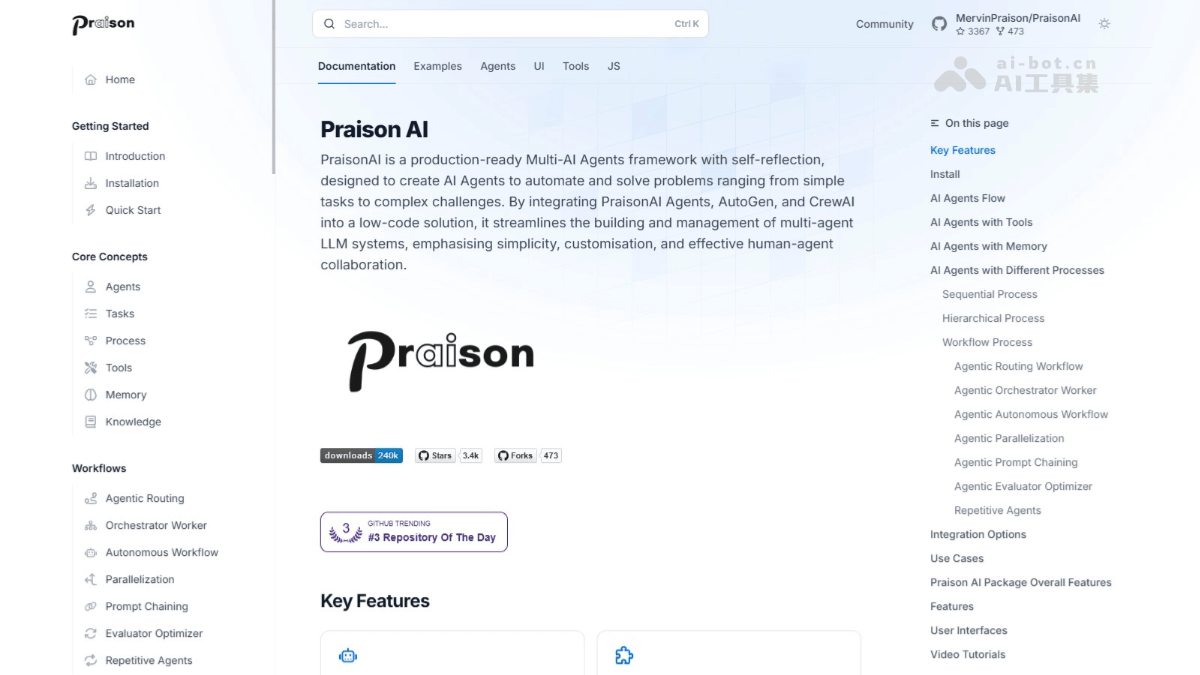
Praison AI is a production-grade multi-agent framework that creates and manages AI agents based on a low-code solution, using automation to solve tasks from simple to complex. Praison AI supports multiple process types, including sequential, hierarchical, and workflow processes, enabling dynamic routing of tasks, parallel execution, prompt chaining, and iterative optimization. Praison AI provides memory capabilities that let agents retain contextual information across different tasks. Praison AI offers multiple user interfaces and integration options, emphasizing simplicity, customization, and efficient human-agent collaboration, making it suitable for scenarios that require flexible building and management of multi-agent systems.
Main Features of Praison AI
- Creation and Management of AI Agents: Supports the creation of AI agents with tool interaction capabilities to exchange data and perform operations with external systems. Provides AI agents with memory capabilities to retain contextual information across tasks, enhancing task continuity and efficiency. Supports multiple process types, including sequential processes, hierarchical processes, and workflow processes, meeting task requirements of different complexity.
- Multiple Task Execution Processes:
- Sequential Process: Tasks are executed in sequence, suitable for simple linear tasks.
- Hierarchical Process: Coordinates task execution and agent allocation based on a manager agent, suitable for complex task allocation scenarios.
- Workflow Process: Supports complex task relationships and conditional execution, including dynamic routing, parallelization, prompt chaining, and other features.
- Efficient Task Processing:
- Parallel Execution: Processes tasks in parallel to improve performance.
- Iterative Optimization: Optimizes solutions through evaluation and feedback mechanisms.
- Repetitive Task Handling: Efficiently handles repetitive tasks using automated loops.
- Integration and Extension: Provides multiple integration options and supports seamless connection with other systems and tools. Supports multiple user interfaces, including chat interface, code interface, real-time voice interface, and more.
- Low-Code Development: Provides a low-code environment that simplifies the construction and management of multi-agent systems. Emphasizes simplicity, customization, and efficient human-agent collaboration.
Technical Principles of Praison AI
- Multi-Agent System (MAS):
- Agent: Each agent is an independent, autonomous entity capable of perceiving the environment and making decisions.
- Collaboration and Communication: Agents complete complex tasks through collaboration and communication, supporting task allocation, information sharing, and dynamic adjustment.
- Large Language Model (LLM): Uses the powerful language understanding and generation capabilities of LLMs to provide intelligent decision support for agents. Supports dynamic routing and task allocation, assigning tasks to the most suitable LLM instance.
- Workflow Engine: Supports workflow definitions for complex tasks, including conditional execution, parallel processing, and task chains. Implements task automation and optimization based on the workflow engine.
- Memory and Context Management: Based on memory mechanisms, agents can save and restore contextual information, enhancing task continuity and efficiency. Supports long-term and short-term memory to adapt to different task requirements.
Project Address of Praison AI
- Project Website:https://docs.praison.ai/
- GitHub Repository:https://github.com/MervinPraison/PraisonAI
Praison AI Application Scenarios
- Enterprise Process Automation: Automatically process orders, approve documents, etc., improving efficiency and reducing errors.
- Intelligent Customer Service: Quickly answer user questions and enhance the service experience.
- Data Analysis: Efficiently process and analyze data, and generate real-time reports.
- Monitoring and Early Warning: Monitor equipment or the environment in real time, promptly detect anomalies, and issue warnings.
- Educational Tutoring: Personalized learning paths, with real-time tutoring and Q&A.