
What is PP-OCRv6
PP-OCRv6 is the sixth-generation open-source OCR model launched by the Baidu PaddlePaddle PaddleOCR team. It is the first to offer three model tiers—Tiny (1.5M), Small (7.7M), and Medium (34.5M)—covering the full range of computing platforms from browser-side to server. Compared with the previous generation, detection accuracy is improved by 4.9% and recognition accuracy by 5.1%. Among them, Medium requires only 1.40 seconds end-to-end on an Intel Xeon CPU, reaching 5.2 times the speed of v5_server, while Tiny achieves single-image prediction as low as 97ms on the browser side. A single model supports an expansion from 4 to 50 languages, with newly added industrial scenarios such as circuit boards, digital tubes, CAD drawings, and inkjet dot-matrix characters.
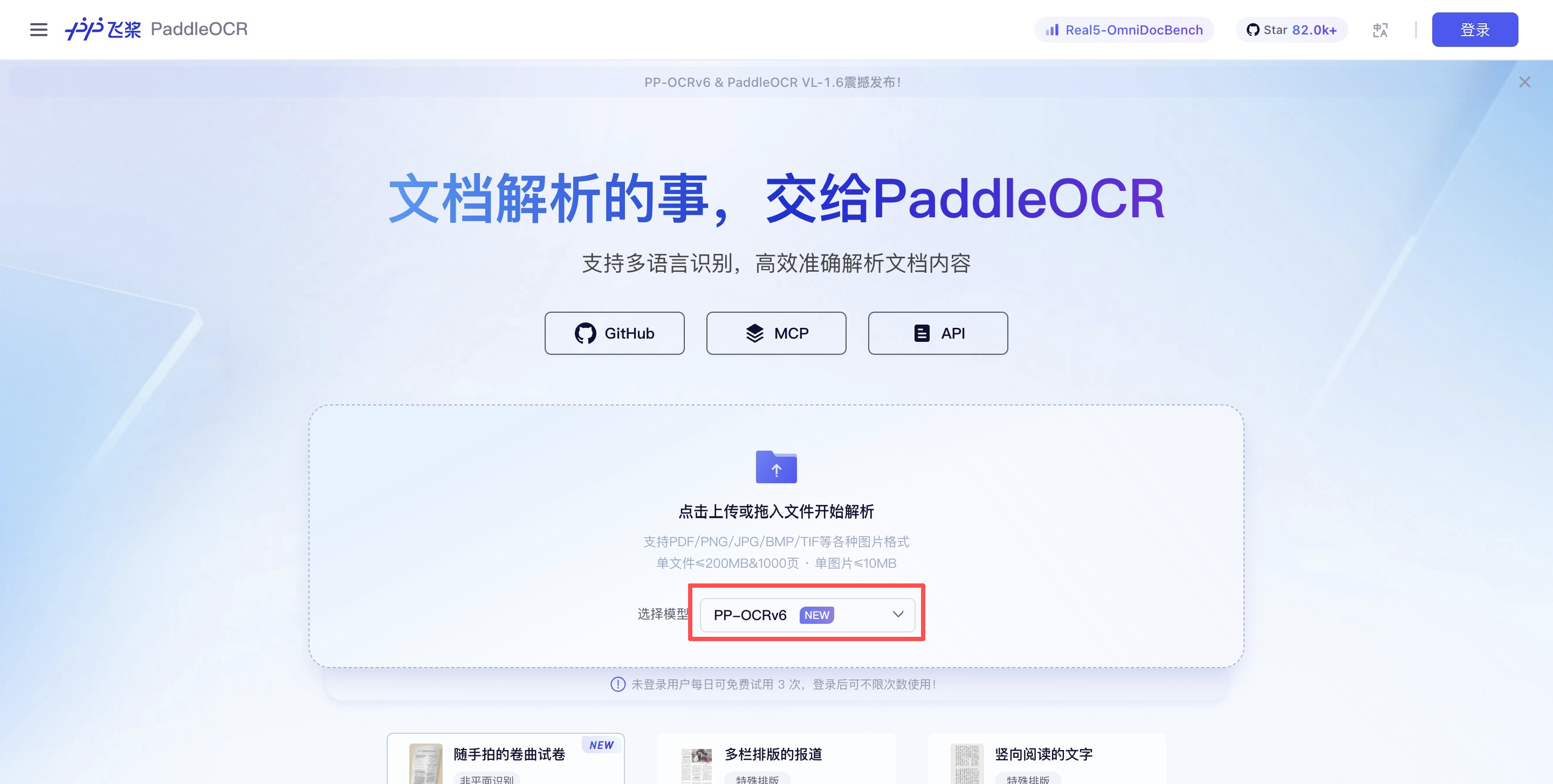
Main features of PP-OCRv6
-
Flexible deployment with three model tiers: Provides three specifications—Tiny (1.5M), Small (7.7M), and Medium (34.5M)—respectively suited for browser-side, embedded devices, and servers, ready to use out of the box as needed.
-
High-accuracy text detection and recognition: Completes end-to-end text region localization and content recognition, with detection accuracy reaching 86.2% and recognition accuracy reaching 83.2%, achieving a generational leap over the previous generation.
-
Single-model coverage of 50 languages: A single model simultaneously supports Chinese, English, Japanese, and 46 Latin-script languages, handling multilingual mixed documents without switching models.
-
Special enhancement for industrial scenarios: Adds detection and recognition capabilities for complex industrial scenarios such as circuit boards, digital tubes, CAD drawings, inkjet dot-matrix characters, and tire printing.
-
Ultra-fast inference and low latency: The Tiny tier achieves single-image prediction as low as 97ms purely on the browser front end; Medium requires only 1.40 seconds end-to-end on an Intel Xeon CPU, 5.2 times the speed of the previous-generation server model.
-
High robustness and stable output: Detection multi-size prediction consistency variance is only 5.19%, and recognition consistency under edge-size perturbation is improved by 20.5% over v5, providing strong resistance to input resolution changes and cropping boundaries.
-
Multiple backends and private deployment: Supports inference backends such as OpenVINO, ONNX Runtime, and TensorRT, and can be privately deployed in intranet, offline, and security-sensitive environments.
-
Structured document parsing: Combined with PP-StructureV3, it can convert complex PDFs and images into Markdown or JSON format, outputting fine-grained text coordinates and layout information.

Follow WeChat and reply "open source" to join theAI open-source project communication group
How to use PP-OCRv6
-
Quick command-line invocation: After installing PaddleOCR 3.7.0+, directly execute
paddleocr ocr -i image.png --text_detection_model_name PP-OCRv6_medium_det --text_recognition_model_name PP-OCRv6_medium_recto perform OCR on an image. -
Python API integration: Import
from paddleocr import PaddleOCRin your code, specify the model name during initialization such asPaddleOCR(text_detection_model_name="PP-OCRv6_medium_det", text_recognition_model_name="PP-OCRv6_small_rec"), and call thepredict()method with an image path to get the recognition results. -
Automatic model download: When using a specified model for the first time, PaddleOCR automatically downloads the corresponding weights from HuggingFace or ModelScope without manual configuration; you can also download model files in advance from the ModelScope collection page or GitHub repository to your local machine.
-
Browser-side front-end deployment: Select the Tiny model (1.5M) and use ONNX Runtime Web or OpenVINO frontend inference to achieve ultra-fast prediction of a single image in 97ms in a pure browser environment, with no backend server required.
-
Multi-backend inference acceleration: Supports backends such as OpenVINO, ONNX Runtime, and TensorRT, allowing on-demand switching of the inference engine on CPU, GPU, and embedded devices to optimize production environment performance.
-
Structured document parsing: Combined with the PP-StructureV3 module, after inputting an image or PDF, it can output structured results in Markdown or JSON format, including text content, coordinate positions, and layout hierarchy information.
-
Choose model tier on demand: Choose Tiny (mobile/browser), Small (embedded/medium compute), or Medium (server/high precision) according to the compute power of the deployment environment. The interfaces of the three model tiers are unified, and seamless switching can be achieved by replacing the model name.
PP-OCRv6 project address
- Project official website:https://paddleocr.com
- ModelScope:https://modelscope.cn/collections/PaddlePaddle/PP-OCRv6
Core advantages of PP-OCRv6
-
Leapfrog generational improvement in accuracy: Text detection accuracy improved by 4.9% compared with v5, and recognition accuracy improved by 5.1%. The Medium tier achieves 86.2% detection Hmean and 83.2% recognition accuracy, achieving a major leap.
-
Extreme inference speed: Medium takes only 1.40s end-to-end on an Intel Xeon CPU, 5.2 times faster than the previous generation server model; Tiny achieves single-image prediction as low as 97ms on the browser side, suitable for extremely low-compute environments.
-
Highest robustness ever: The consistency variance of detection across multiple sizes is only 5.19% (35% lower than v5), and recognition consistency under edge size perturbation improves by 20.5%, providing extremely strong resistance to interference from input changes and cropping boundaries.
-
Seamless coverage across all compute platforms: The three model tiers Tiny, Small, and Medium support deployment across all scenarios from browser side and embedded devices to servers, with on-demand selection and out-of-the-box usability.
-
Unified recognition of 50 languages: A single model supports an expansion from 4 to 50 languages, covering Chinese, English, Japanese, and 46 Latin-script languages, and can handle mixed multilingual content without switching models.
-
Deep enhancement for industrial scenarios: Adds specialized recognition capabilities for real complex industrial scenarios such as circuit boards, digital tubes, CAD drawings, inkjet dot-matrix characters, and tire printing.
-
Lightweight parameters outperform large models: With 34.5M parameters, Medium surpasses hundred-billion-scale vision-language models such as Qwen3-VL-235B, GPT-5.5, and Gemini-3.1-Pro in detection and recognition accuracy.
-
Extremely low hallucination and faithful restoration: The accuracy of restoring the original text (including intentional spelling errors) is far higher than that of general large models, avoiding the "hallucinatory" alteration commonly seen in large models.
Comparison of PP-OCRv6 with similar competitors
| Comparison dimension | PP-OCRv6 | EasyOCR | MMOCR |
|---|---|---|---|
| Developer | Baidu PaddlePaddle PaddleOCR | JaidedAI | OpenMMLab (SenseTime) |
| Open-source license | Apache 2.0 | Apache 2.0 | Apache 2.0 |
| System architecture | Unified MetaFormer (LCNetV4 + RepLKFPN + LightSVTR) | CRAFT/DB detection + CRNN recognition | DB/PSENet/FCENet detection + CRNN/SAR/NRTR recognition |
| End-to-end support | Integrated detection and recognition, three tiers ready out of the box | End-to-end integration, automatic language detection | Modular combination, requiring manual configuration of the detection + recognition pipeline |
| Supported Languages | 50 (Chinese, English, Japanese, and 46 Latin-script languages) | 80+ | Depends on the selected model configuration; must be extended by yourself |
| Model Size | 1.5M–34.5M(extremely lightweight) | Detection is about 10M+; recognition models can accumulate to 50M+ depending on language | Flexible configuration, typically 10M–100M+ per single model |
| Chinese Scenario Optimization | Deeply optimized; supports vertical text, ancient books, and Pinyin annotation | Average level; Chinese accuracy is weaker than PP-OCR | Supported, but requires your own tuning |
| Industrial Scenarios | Built-in circuit boards, digital tubes, CAD, dot-matrix characters, tire printing, etc. | Mainly general scenarios; no industrial specialization | Mainly general scenarios; no industrial specialization |
| CPU Inference Speed | Extremely fast: Tiny browser 97ms, Medium CPU 1.40s | Medium, usually on the order of seconds | Medium, usually on the order of seconds |
| Browser/Frontend Deployment | Native support(Tiny tier ONNX/Web) | Does not support native browser inference | Not supported |
| Hallucination Control | Extremely low (faithful reproduction rate 93.2%) | Low, but errors and omissions exist | Medium; depends on model combination |
Application Scenarios of PP-OCRv6
-
Real-time recognition on mobile and edge devices: The Tiny tier (1.5M) can achieve millisecond-level OCR on phones, IoT devices, and embedded terminals, suitable for low-power scenarios such as offline scanning and express waybill recognition.
-
Browser-side frontend integration: Deployed through ONNX/Web in a pure web environment, with single-image prediction as low as 97ms, enabling instant text extraction from user-uploaded images without a backend server.
-
Document digitization and archive management: Batch structured extraction of certificates and bills such as ID cards, driver's licenses, business licenses, invoices, receipts, and contracts, combined with PP-StructureV3 to output JSON/Markdown format.
-
Financial and medical data entry: With an extremely low hallucination rate (93.2% faithful reproduction), it accurately recognizes sensitive texts with extremely high accuracy requirements, such as bills, medical records, prescriptions, and insurance policies.
-
Industrial quality inspection and automation: Adds automated detection and recognition for complex industrial scenarios such as circuit board silkscreen, digital tube readings, CAD drawing annotations, inkjet dot-matrix characters, tire printing, and industrial nameplates.
-
Multilingual internationalization processing: A single model covers 50 languages, suitable for cross-border e-commerce, foreign trade documents, multilingual manuals, international content review, and translation preprocessing.