
What is PosterCopilot
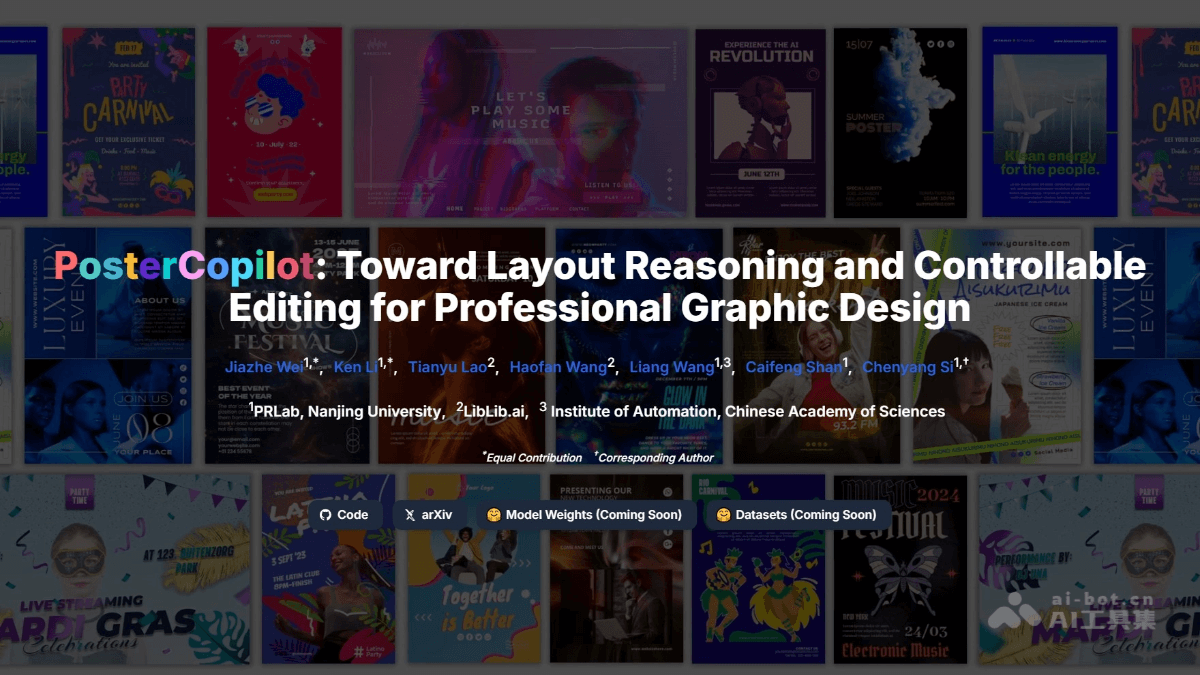
PosterCopilot is a professional-grade LibLib.ai jointly launched by Nanjing University in collaboration withposter designlarge model. Through a unique three-stage training strategy, the model is endowed with powerful layout reasoning and precise editing capabilities, enabling full-chain design from material planning to final draft. The model supports full-material generation, missing-material completion, multi-round fine-grained editing, and other functions. It is also equipped with a high-quality layered poster dataset, addressing the geometric, visual, and editing pain points of existing design models and providing a new paradigm for AI-assisted creative design.
Main Features of PosterCopilot
- Full-material poster generation: When users provide complete materials, the model can precisely arrange multimodal elements and generate professional posters that conform to aesthetic principles while ensuring zero distortion of materials.
- Intelligent completion of missing materials: When materials are missing, it automatically synthesizes a stylistically consistent background or foreground decorative layer, achieving seamless realization from abstract ideas to complete posters.
- Multi-round fine-grained editing:
- Precise single-layer editing: Modify only a specific layer (such as changing a model's hair color or changing an object's material) while keeping other areas unchanged.
- Global theme transfer: Switch the poster theme with one click, automatically replace the main subject and adjust related elements while preserving the original layout.
- Intelligent size reconstruction: Re-infer the layout according to canvas size parameters to adapt to different media formats.
- Creative transformation: Supports seamless transformation from abstract design concepts to concrete materials, generating high-quality engineering-grade prompts to drive the generation of stylistically matching materials.
Technical Principles of PosterCopilot
-
Progressive three-stage training strategy:
-
Stage 1: Perturbation Supervised Fine-Tuning (PSFT): Introduces Gaussian noise perturbation, enabling the model to learn coordinate distributions rather than discrete points, correcting distortions in geometric space and improving the geometric rationality of layouts.
-
Stage 2: Reinforcement Learning with Visual-Reality Alignment (RL-VRA): Introduces reward signals based on DIoU and element fidelity, correcting overlap and proportion mismatch issues and ensuring the visual realism of layouts.
-
Stage 3: Reinforcement Learning with Aesthetic Feedback (RLAF): Uses an aesthetic reward model to encourage the model to generate layouts with greater visual impact and diversity, going beyond a single ground truth.
-
-
Generative Agent:Combines a Reception Model and a T2I model to achieve seamless transformation from abstract inspiration to concrete materials. The Reception Model decomposes user intent into detailed plans, generates engineering-grade prompts, and drives the T2I model to generate high-quality materials.
-
High-quality layered poster dataset:Constructs a dataset containing 160,000 professional posters and a total of 2.6 million layers. Through OCR-assisted fine-grained layer fusion technology, it solves the problem of excessive layer fragmentation in traditional datasets, providing rich and high-quality data support for model training.
PosterCopilot Project Address
- Project Official Website:https://postercopilot.github.io/
- GitHub Repository:https://github.com/JiazheWei/PosterCopilot
- arXiv Technical Paper:https://arxiv.org/pdf/2512.04082
Application Scenarios of PosterCopilot
-
Advertising and Marketing: Quickly generate posters that match the brand and marketing theme, adapt to multi-platform sizes, support multiple rounds of revisions, and meet advertising and promotional needs.
-
Creative Design Studio: As a designer assistant tool, quickly generate preliminary proposals, support material completion and optimization, and improve design efficiency and creative inspiration.
-
In-house Corporate Design Team: Standardize the design process, quickly respond to market changes, support multi-department collaboration, and improve overall team efficiency.
-
Education and Training: As a teaching tool, help students understand design principles, inspire creativity, and suit design teaching and creative inspiration scenarios.
-
Cultural and Arts Institutions: Design artistically appealing posters for exhibitions and cultural events, and support generating design proposals consistent with the cultural atmosphere.