
What is PoseTalk
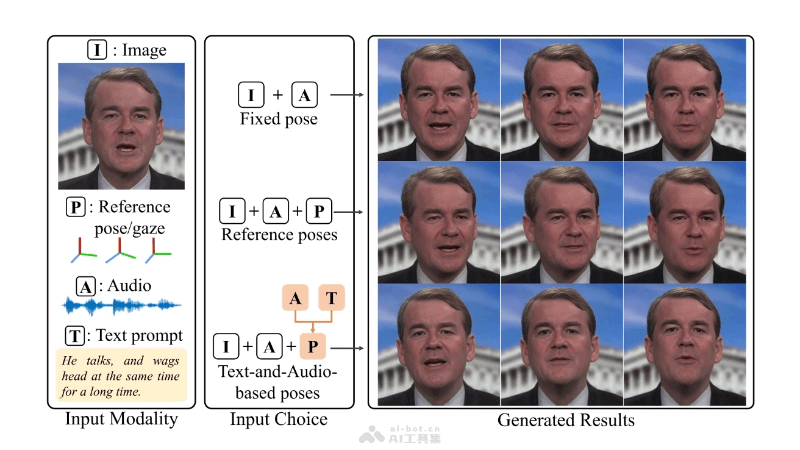
PoseTalk is an open-source project based on a pose control and motion refinement method driven by text and audio, used for one-shot generation of talking head videos. It synthesizes talking face videos from images, driving audio, and driving poses, providing users with an efficient and convenient way to generate head animations. The core of PoseTalk lies in generating motion latents in a pose latent space based on text prompts and audio cues, achieving natural and realistic head motion effects. Through the Pose Latent Diffusion (PLD) model and the cascaded networks CoarseNet and RefineNet, it achieves high-quality lip synchronization and head pose generation, suitable for various application scenarios such as virtual anchors, online education, and social media.
Main Features of PoseTalk
- Text- and Audio-Driven Pose Generation: PoseTalk generates head poses based on text prompts and audio input, reflecting the long-term semantics and short-term variations of head movements.
- Pose Latent Diffusion (PLD) Model: PoseTalk generates motion latents in a pose latent space, achieving natural and realistic head movements.
- Cascaded Network Refinement Strategy: Based on two cascaded networks, CoarseNet and RefineNet, it first estimates coarse motion to generate animated images of new poses, then refines lip movements to improve lip synchronization performance.
- High Lip Synchronization Quality: Through the motion refinement strategy, the head animations generated by PoseTalk are highly synchronized with audio, especially excelling in lip synchronization.
- Diverse Pose Generation: Users guide PoseTalk to generate multiple poses through different text prompts, increasing the diversity and customizability of the generated animations.
Technical Principles of PoseTalk
- Pose Latent Diffusion (PLD) Model: It works in the expression space of a neural parametric head model, capturing fine details of the human head. The PLD model converts text and audio information into head pose and motion information, providing the foundation for subsequent animation generation.
- Cascaded Network Refinement Strategy: PoseTalk uses two cascaded networks, CoarseNet and RefineNet, to synthesize natural talking videos. CoarseNet is responsible for estimating coarse motion and generating animated images of new poses. RefineNet progressively estimates lip movements from low to high resolution, learning finer lip movements and improving lip synchronization performance.
- Audio Feature Extraction: PoseTalk extracts features from input audio signals based on a pre-trained audio encoder (such as the Wave2Vec 2.0 model). The audio features are combined with text information to jointly drive the motion of the head model, enabling the generated head animation to be perfectly synchronized with the audio and achieve a high degree of alignment in lip movements, expressions, and other aspects.
- Training and Inference: In the training phase, PoseTalk uses a variational autoencoder (VAE) to learn a low-dimensional latent space of head poses and eye movements. In the inference phase, PLD predicts natural pose sequences and uses a video generation model to synthesize realistic talking videos from audio features and the generated pose sequences.
PoseTalk Project Address
- Project Website:posetalk.github.io/
- arXiv Technical Paper:https://arxiv.org/pdf/2409.02657
Application Scenarios of PoseTalk
- Virtual Assistants and Digital Humans: PoseTalk is used to generate realistic head animations for virtual assistants or digital humans, providing a more natural and engaging interactive experience.
- Film and Game Production: In the entertainment industry, PoseTalk is used to generate high-quality character animations, making characters' head movements and expressions more realistic and enhancing the audience's sense of immersion.
- Online education and training: In remote teaching environments, PoseTalk is used to generate avatars of teachers or instructors, providing a more vivid teaching experience.
- Social media and content creation: Users generate personalized dynamic avatars or meme stickers based on PoseTalk, increasing the fun and interactivity of social media content.