
What is Poppy
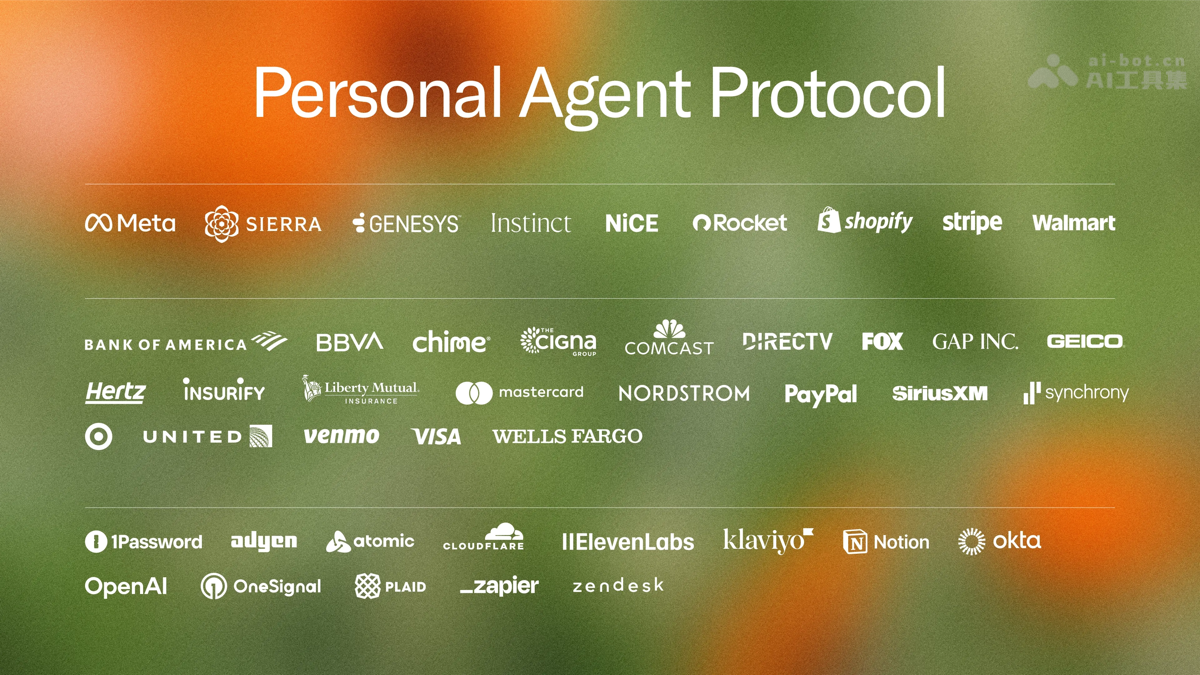
Poppy (Personal Agent Protocol) is an open protocol draft jointly launched by Sierra and Meta with multiple companies, which can solve the identity and authorization issues for personal AI Agents accessing enterprise services. The protocol lets enterprises declare Agent access methods through /.well-known/poppy.json , Agents can identify their identity and perform tasks on behalf of users through OAuth authorization, permissions are adjustable across five levels, and a single login can reuse the session across websites, APIs, and the enterprise's own Agents. Currently, 35+ enterprises including Stripe, Shopify, Walmart, Visa, and OpenAI have participated.
Poppy's main features
- Identity recognition: Enterprises can clearly identify that the visitor is "a certain user's AI Agent".
- Standard discovery mechanism: Enterprises publish
/.well-known/poppy.jsonfiles on their websites to declare Agent access methods, login entry points, and available capabilities. - Tiered authorization: Permissions are divided into five levels, from completely prohibited to fully taken over; enterprises decide which levels to open, and users decide the authorization scope.
- OAuth secure login: Users log in personally on the enterprise's page, and the agent only obtains a minimal-scope session token approved by the user.
- Single session across channels: The same token can be reused across the enterprise website, API, and the enterprise's own agent, with a continuous and uninterrupted interaction process.
- Multi-channel execution: Supports Agents directly operating web pages, calling OpenAPI/MCP interfaces, or collaborating with the enterprise's self-built AI Agent to complete tasks.
- Fully auditable and revocable: Enterprises can see the Agent's complete operation path, and users can revoke authorization at any time.
- Based on existing standards: Built on OAuth, JWT, HTTPS, OpenAPI, and MCP, enterprises can quickly implement it with existing tools, and it supports industry-specific custom extensions.
How to use Poppy
End users:
-
Give tasks to the AI Agent without installing anything;
-
When a task requires an account, log in personally on the enterprise's page;
-
Check and approve the Agent's permission scope;
-
At any time, view connected agents in account settings and disconnect them with one click.
Personal agent developers:
-
Publish client metadata documents (client_id, public key, callback address) as the Agent's identity credentials;
-
Read the enterprise's
poppy.jsondiscovery files to learn its login methods and available interfaces; -
Send a signed assertion + DPoP proof to the enterprise token endpoint, start an anonymous session, and obtain a Session Token;
-
When an account is needed, initiate one of the three login methods supported by the enterprise: direct/device/mediated;
-
After user approval, obtain a long-term Account Token, store it encrypted, and afterwards silently exchange it for a logged-in session;
-
Use the Session Token to call enterprise APIs (DPoP), browse web pages (browser assertion exchanged for Cookie), or converse with the enterprise agent;
-
Handle 429 rate limiting, idempotent retries,
sign_in_requiredand other errors, and renew or log in again according to the specification.
Enterprise integration:
-
At
/.well-known/poppy.jsonpublish the discovery file, declaring login methods, permission scopes, and provided interfaces; -
Configure the OAuth server according to RFC 8414 and declare
poppy_domains; -
validate the agent signature, DPoP proof, and scope permissions for each request;
-
Enforce the same set of permission checks across all channels: web, API, enterprise proxy, and human customer service;
-
Provide a compliant authorization page (showing the agent's identity and permission description) and a disconnect entry in account settings.
Poppy's Core Advantages
-
Ending the "all-or-nothing" dilemma: Between the two extremes of "Agent impersonating the user" and "enterprises banning agents," it provides an intermediate solution of identity recognition + tiered authorization.
-
Enterprises can identify and control agents: Every request is bound to a verified client_id, user ID, and scope, so enterprises finally know "who is acting on whose behalf and what they can do."
-
Users do not hand over passwords, and permissions are minimized: Users log in and authorize on the enterprise's own page, and the agent only receives a scoped token that can be revoked at any time.
-
Implement once, use everywhere: The protocol aims to cover all interactions between enterprise and personal agents, and each side can connect to all supporting parties with a single implementation.
-
Thoroughly reuse existing standards: Built on OAuth 2.0, JWT, DPoP, OpenAPI, and MCP, so enterprises' existing authorization servers can basically be adapted and integrated directly.
Poppy's Project Address
- Project Website:https://personalagentprotocol.org/
Poppy's Six Principles
-
Based on existing standards: Use OAuth, JWT, HTTPS, OpenAPI, and MCP whenever possible, and define new things only where no standard covers them;
-
Controls rather than policy: The protocol only provides options; enterprises decide anonymous/login requirements, which agents to allow, and which channels to open, while users decide whether the agent can view or modify;
-
Security and privacy: Agents always identify themselves, but before the user logs in, enterprises can only see astable ID that contains no personal information—the same user's ID differs across different enterprises, allowing returning customers to be recognized without cross-site tracking; authorization can be revoked;
-
Progressive adoption: Enterprises can start with only the web, API, or self-built agents and expand gradually without refactoring existing systems;
-
Extensible: Discovery, identity, API, and conversation are the four major building blocks, and industries can extend capabilities such as payments, push notifications, and interactive components on top of them;
-
Apache 2.0 open source license。
Poppy's Application Scenarios
-
E-commerce returns and exchanges: The user says to the Agent, "Return the jacket," and the Agent queries the return policy as a guest, then automatically completes the return or exchange after the user logs in and authorizes it.
-
Flight rebooking: After a flight is canceled, the Agent queries alternative flights through the airline's MCP interface and automatically completes the rebooking after the user approves it.
-
Mortgage pre-approval: After the user authorizes it, Meta's Muse Agent collaborates with Rocket's Agent to complete confirmation of price, down payment, and interest rate, and issues a pre-approval letter within minutes.
-
Banking account services: When the user grants only the
poppy:readpermission, the Agent can check balances and statements, while write operations such as transfers require separately grantedpoppy:write。 -
Warranty and customer service escalation: The Agent converses with the enterprise's customer service Agent to handle warranty claims, and complex situations are automatically transferred to a human or a direct conversation between the user and the enterprise representative is opened.