
What is Pokee AI
Pokee AI is a next-generation general-purpose AI Agent development platform. The platform builds efficient, personalized, and highly interactive AI Agents based on reinforcement learning (RL) technology, replacing traditional large language models for task planning and tool calling. Pokee AI's Agents perform excellently in multi-step task execution, reasoning, and tool use, and can quickly respond to user instructions and provide precise services. They are suitable for many fields such as e-commerce, development and creation, and enterprise automation. Based on personalized services, they establish long-term binding relationships with users and promote the implementation and application of AI in more scenarios.
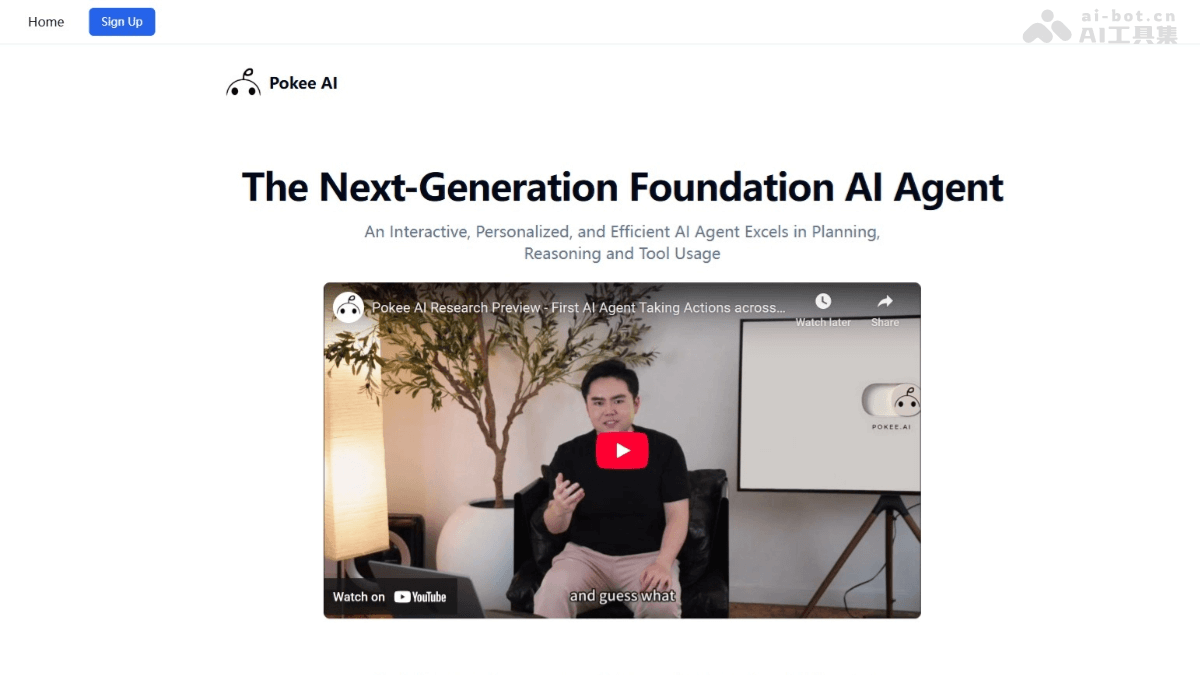
Main features of Pokee AI
- Efficient task planning: Based on reinforcement learning models, efficiently plan multi-step tasks.
- Flexible tool calling: Agents can flexibly call various tools (such as APIs, databases, file systems, etc.), support precise calling of thousands or tens of thousands of tools, while maintaining low computational cost.
- Powerful reasoning capability: Supports complex reasoning and decision-making, suitable for tasks such as mathematics and programming.
- Personalized service: Provides customized services according to user needs and habits, and understands users' personalized needs to execute tasks.
- Fast response: Supports fast response to user instructions, provides instant results, and improves user experience.
Pokee AI official website address
- Official website address:pokee.ai
Pokee AI application scenarios
- Social media operations: Helps marketers and operations personnel automatically publish content, reply to comments and private messages, and achieve efficient management across multiple platforms.
- Content creation and distribution: Quickly generate and edit content, distribute it to different platforms, and save manual operation time.
- Data collection and analysis: Based on integrated data interfaces, automatically collect and analyze data to support decision-making.
- Customer service automation: Automatically handle customer inquiries, provide answers to common questions, and improve customer satisfaction.
- Enterprise workflow optimization: Assists with internal enterprise task assignment, progress tracking, and document management, improving work efficiency.