
What is POINTS 1.5
POINTS 1.5 is a multimodal large model released by Tencent WeChat, and is an upgraded version of POINTS 1.0. The model continues to use the LLaVA architecture from POINTS 1.0, consisting of a vision encoder, a projector, and a large language model. POINTS 1.5 has been enhanced in both efficiency and performance, particularly ranking first among global open-source models under 10B, surpassing other industry-leading models such as Qwen2-VL, InternVL2, and MiniCPM-V-2.5. POINTS 1.5 performs well in OCR for complex scenes, reasoning ability, key information extraction, LaTeX formula extraction, mathematics, image translation, object recognition, and more.
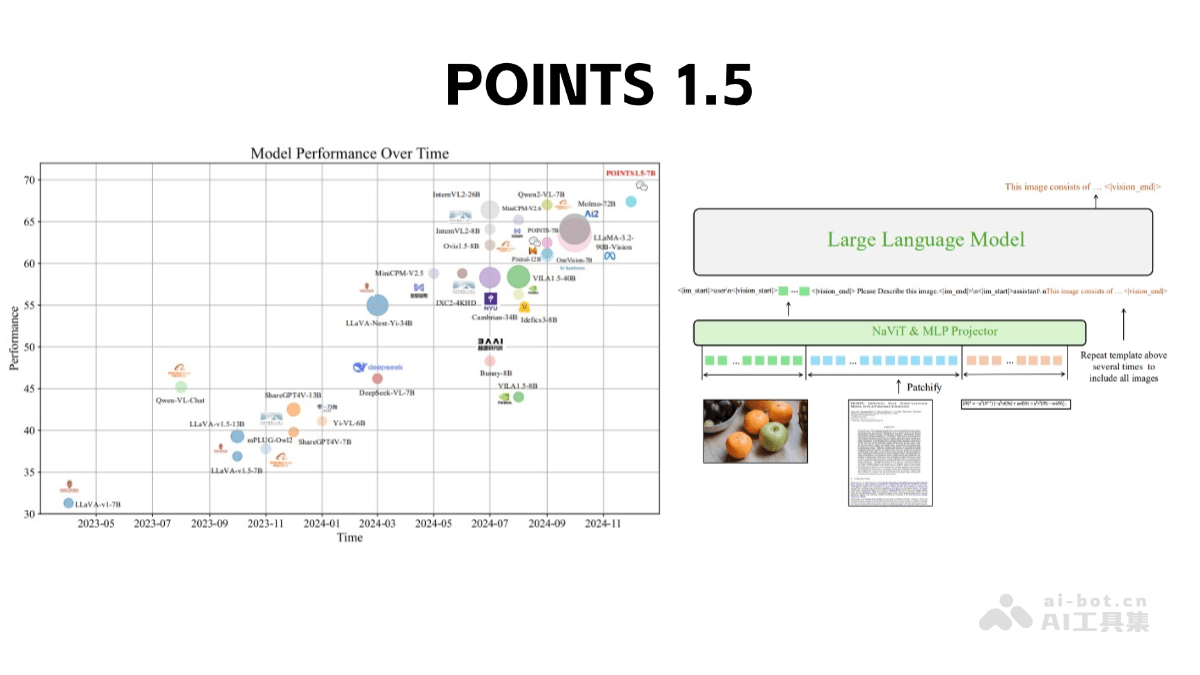
Main Features of POINTS 1.5
- OCR (Optical Character Recognition) for complex scenes: POINTS 1.5 can perform effective text recognition in complex scenes.
- Reasoning ability: The model has strong reasoning ability and can understand and handle complex logical problems.
- Key information extraction: It can extract key information from large amounts of data, improving the efficiency and accuracy of information processing.
- LaTeX formula extraction: The model can recognize and extract mathematical formulas in LaTeX format.
- Mathematical problem handling: POINTS 1.5 can understand and solve mathematical problems, showing application potential in the field of mathematics.
- Image translation: The model can translate image content, making it suitable for multilingual environments.
- Object recognition: POINTS 1.5 can recognize objects in images and apply this to image analysis and understanding.
Technical Principles of POINTS 1.5
- Vision Encoder: Responsible for processing input image data and extracting image features. It is implemented using convolutional neural networks (CNNs) in deep learning and can capture spatial hierarchical structures and semantic information in images.
- Projector: Maps the image features extracted by the vision encoder into a feature space suitable for interaction with the language model. This involves dimensionality reduction and transformation of features to ensure that image features and text features are effectively aligned in the same space.
- Large Language Model: Processes text input and generates language-related output. It is a pretrained Transformer model that can understand natural language and generate coherent, meaningful text responses.
- Data input: The model receives image and/or text data as input. Image data is processed through the vision encoder, while text data is directly input into the language model.
- Feature extraction: The vision encoder extracts key features of the image, including visual information such as color, shape, and texture. At the same time, the language model extracts semantic features of the text, understanding the meaning and context of the text.
- Feature fusion: Through the projector, image features are transformed into a common feature space suitable for combination with text features. In this space, image and text features can complement each other to form a unified multimodal feature representation.
- Task processing: The fused multimodal features are used to perform specific tasks, such as image description, visual question answering, text-to-image generation, and more. The model can generate corresponding outputs according to task requirements, such as text describing image content, answering image-related questions, and so on.
POINTS 1.5 Project Address
- GitHub Repository:https://github.com/WePOINTS/WePOINTS
- HuggingFace Model Library:https://huggingface.co/WePOINTS
- arXiv Technical Paper:https://arxiv.org/pdf/2412.08443
POINTS 1.5 Application Scenarios
- Receipt Recognition: Automatically recognize and extract text information from invoices, receipts, and other documents.
- Automated Customer Service: Understand user questions and provide logical reasoning to automatically answer user inquiries.
- News Summarization: Extract key information from long news reports and generate summaries.
- Academic Paper Processing: Extract mathematical formulas from academic papers for further editing and analysis.
- Travel Translation: While traveling, take photos of road signs, menus, etc. with a phone and translate them into the target language in real time.
- Online Education Platforms: Assist students in solving math problems and provide solution steps and answers.